

Start here
Why Car Fluids Matter More Than Most Drivers Realize
Core knowledge
Engine Oil: The Lifeblood of Your Powertrain
Go deeper
Coolant: Keeping Temperatures in Check
Safety-critical
Brake Fluid: The Link Between Your Foot and Your Stopping Power
Round it out
Transmission and Power Steering Fluids
Put it into practice
How to Build a Simple Fluid-Check Habit
Why Car Fluids Matter More Than Most Drivers Realize
A modern car contains between six and eight distinct fluids, each engineered for a specific task. These aren't interchangeable — they operate at different temperatures, under different pressures, and within different chemical environments. When one is low, contaminated, or the wrong type entirely, the consequences range from reduced performance to catastrophic component failure.
Most drivers are vaguely aware that oil needs changing. Fewer know that brake fluid absorbs moisture from the air, that coolant corrodes from the inside out, or that transmission fluid can degrade silently for years before a gearbox gives up. The good news: understanding the basics doesn't require mechanical training. It requires knowing what each fluid does and why it degrades.
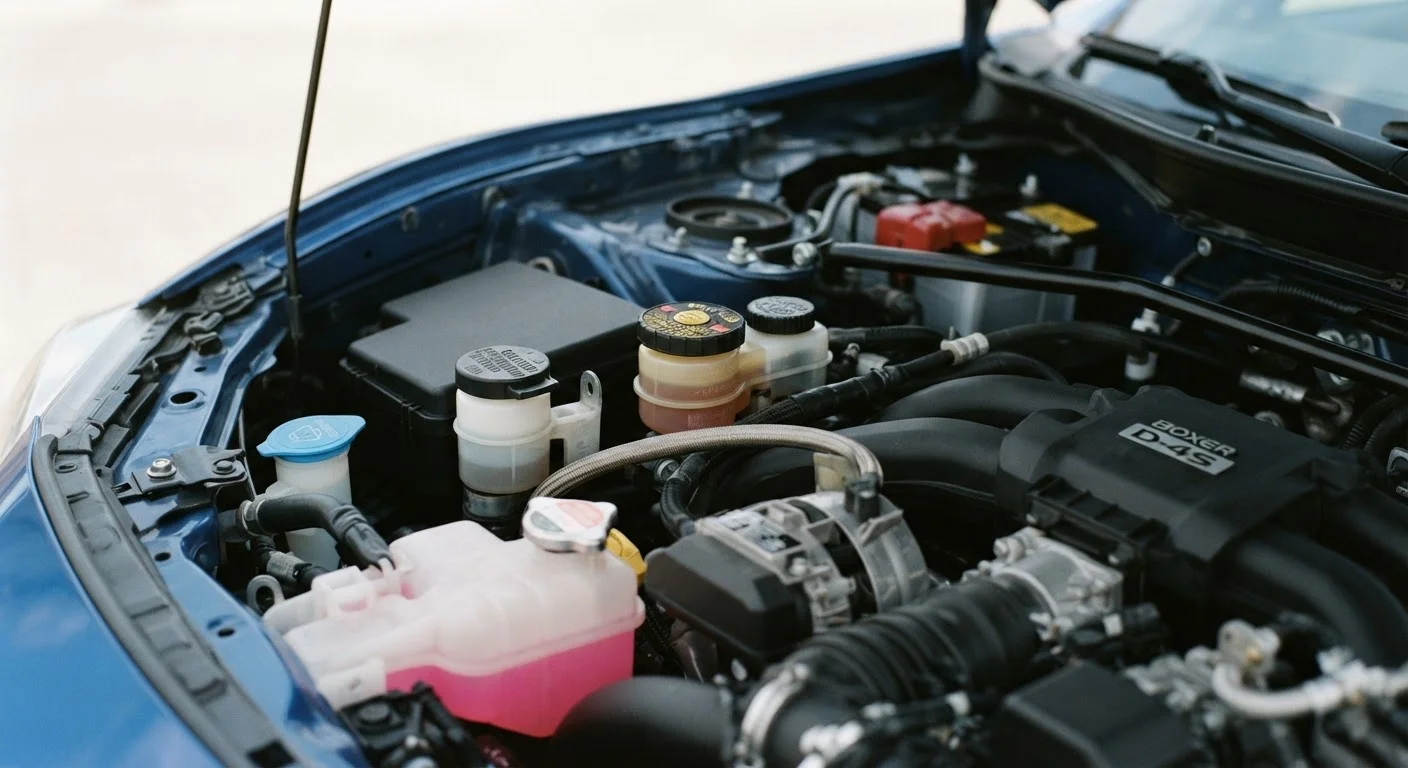
This guide covers the five fluids you're most likely to encounter, explains what each one actually does, and tells you what happens when it's neglected. For a practical visual reference on where each reservoir lives under the hood, see our plain-English reservoir guide.
Viscosity
A measure of how thick or thin a fluid is and how easily it flows. Engine oil viscosity ratings (like 5W-30) describe how the oil behaves at cold startup and at operating temperature.
Hygroscopic
A substance that naturally absorbs moisture from the air over time. Brake fluid is hygroscopic, which is why it must be replaced periodically even if the system appears sealed.
Corrosion inhibitor
A chemical additive in coolant that prevents internal engine and radiator components from corroding. These inhibitors deplete with age, which is why coolant must be changed on schedule.
Vapor lock
A condition where moisture in brake fluid boils under heat, creating a gas bubble in the brake line. Gas compresses where fluid does not, causing a soft or unresponsive brake pedal.
Hydraulic system
A system that uses incompressible fluid under pressure to transmit force. Both braking and power steering systems in many vehicles rely on hydraulic principles to multiply the driver's input.
Additive package
The blend of chemical compounds added to base oil to enhance performance — including detergents, anti-wear agents, and oxidation inhibitors. These deplete with use, which is a key reason oil must be changed.
Engine Oil: The Lifeblood of Your Powertrain
Engine oil does three things simultaneously: it lubricates metal surfaces that move against each other at thousands of revolutions per minute, it carries heat away from components the cooling system can't directly reach, and it suspends combustion byproducts so they can be trapped by the filter rather than left to form sludge.
Oil degrades because it works hard. Heat breaks down the base oil's molecular structure, combustion gases blow past piston rings and contaminate the oil, and the additive package — which includes detergents, anti-wear agents, and viscosity modifiers — gets consumed. The result is oil that is thinner, dirtier, and less protective than when it went in.
Modern synthetic oils are more resistant to thermal breakdown than conventional mineral oils, but no oil lasts indefinitely. Check your owner's manual for the manufacturer's recommended interval — and check the oil level visually between services, not just at oil change time. A quart low doesn't trigger a warning light on most vehicles, but it does reduce the oil's ability to protect. For a deeper look at how engine oil works and what's actually at stake, see our guide to why engine oil matters. And if you've heard that synthetic oil causes leaks or that every car needs a change every 3,000 miles, our engine oil myth-busting article separates fact from fiction.
Check Oil When the Engine Is Cold
For the most accurate dipstick reading, check engine oil at least five minutes after the engine has been off and while the vehicle is on level ground. Hot oil expands and partially clings to internal surfaces, which can give a falsely low reading. Making this part of your morning routine — rather than right after parking — takes the guesswork out of it.
Coolant: Keeping Temperatures in Check
Coolant — also called antifreeze — circulates between the engine and the radiator, absorbing heat from combustion and releasing it to the air outside. In winter, it also prevents the water in the system from freezing and cracking the engine block or radiator. It's a dual-purpose fluid operating year-round.
Beyond temperature regulation, coolant contains corrosion inhibitors that protect aluminum and iron components inside the engine, radiator, and heater core. As the inhibitor package depletes — typically over two to five years depending on coolant type — the fluid becomes acidic and begins attacking the very parts it's supposed to protect. An overheated engine can warp cylinder heads or crack the block; internal corrosion causes slower but equally expensive damage.
Signs of coolant trouble include a rising temperature gauge, a sweet smell from the engine bay, or a low level in the translucent reservoir. Your cooling system does more than most drivers assume — it also supports cabin heating and, on many modern vehicles, helps regulate transmission temperature.
Never Open a Hot Radiator Cap
The cooling system operates under pressure, and a hot radiator cap holds superheated coolant that can instantly spray and cause serious burns if released. Always wait for the engine to cool fully before opening the radiator cap or checking any coolant connections. For routine level checks, use only the translucent overflow reservoir — it can be read without opening anything.
Brake Fluid: The Link Between Your Foot and Your Stopping Power
Hydraulic brake systems use fluid to transmit the pressure from your brake pedal to the calipers and wheel cylinders that actually slow the car. Unlike most other fluids, brake fluid must remain stable under extreme heat — repeated hard stops can push brake fluid temperatures well above 300°F (150°C) in performance or heavy-load conditions.
The critical issue with brake fluid is that it is hygroscopic, meaning it actively absorbs moisture from the surrounding air over time, even inside a sealed system. As water content rises, the fluid's boiling point drops significantly. In extreme cases, this can cause vapor lock — a bubble of steam forms in the line, the pedal goes soft, and stopping distances increase. This is not a theoretical risk; it's why most manufacturers specify a replacement interval measured in years rather than mileage.
A dark, murky appearance in the reservoir is one indicator of aged brake fluid, but color alone isn't reliable. A mechanic can test the moisture content directly. If the brake pedal feels spongy or the vehicle pulls to one side under braking, have the system inspected promptly — don't defer it. See our article on what your dashboard warning lights mean if a brake-related light has appeared on your instrument panel.
Transmission and Power Steering Fluids
Transmission fluid lubricates the gears, clutch packs, and hydraulic circuits inside your gearbox. In automatic transmissions, it also acts as a hydraulic medium that controls gear changes. This fluid operates under sustained heat and pressure, and like engine oil, it breaks down over time — losing its ability to protect and function hydraulically. Symptoms of degraded transmission fluid include delayed or rough gear changes, slipping between gears, or unusual sounds during shifts. The differences between automatic and manual transmissions affect what type of transmission fluid your vehicle requires, so always consult your owner's manual.
Power steering fluid pressurizes the hydraulic assist system that makes turning your steering wheel effortless. It, too, degrades chemically over time and can cause seal failure or pump wear if neglected. Vehicles with electric power steering have no fluid to manage — but hydraulic systems, still common in older vehicles, need periodic attention. A whining noise when turning the wheel and stiff steering are both signs that something may be wrong.
Not All Vehicles Use the Same Fluids
Transmission fluid specifications, coolant types, and power steering fluid requirements vary significantly by manufacturer and model year. Using the wrong specification — even when the fluid looks similar — can degrade seals and reduce component life. Your owner's manual is the authoritative source for every fluid type your vehicle requires; a dealership or mechanic can also confirm the correct specification if the manual is unavailable.
How to Build a Simple Fluid-Check Habit
A meaningful under-hood inspection takes about five minutes and requires no tools. The most practical approach is to tie it to something you already do regularly — once a month when you fill up with gas is a common anchor. Here's a simple sequence:
- Engine oil: With the engine cold and the car on level ground, pull the dipstick, wipe it clean, reinsert fully, and withdraw again. The oil level should fall between the minimum and maximum marks.
- Coolant: Check the translucent overflow reservoir (not the radiator cap itself on a hot engine). The level should be between the MIN and MAX lines.
- Brake fluid: Locate the small reservoir on the master cylinder near the firewall. If it's visibly low, have the brakes inspected — low brake fluid often signals worn pads or a leak, not just natural consumption.
- Power steering fluid: If your vehicle has a hydraulic system, there's a small reservoir with a dipstick or MIN/MAX markings. A low level here also warrants investigation for leaks.
You don't need to be a mechanic to catch a developing problem early. What you need is the habit of looking. Pairing these checks with your manufacturer's service schedule — which specifies when each fluid should be changed, not just topped off — gives you a complete picture. Our guide to understanding your service schedule explains how to read those intervals and what each service typically covers. For tasks where a professional is the right call, our article on DIY vs mechanic helps you draw that line with confidence.
Frequently Asked Questions
No — mixing incompatible fluids can cause chemical reactions, seal damage, or system failure. Always use the fluid type specified in your owner's manual. In an emergency, topping off with water (for coolant only) is safer than using the wrong coolant type, but have the system flushed promptly.
A monthly visual check is a reasonable baseline for most drivers. Some fluids — like brake fluid — rarely need topping off between services, so a sudden drop signals a problem worth investigating immediately. Engine oil should also be checked before long road trips.
Coolant loss without a visible puddle can indicate an internal leak, such as a failing head gasket, which allows coolant to burn inside the engine. White exhaust smoke and a sweet smell are warning signs. This warrants prompt inspection by a qualified mechanic.
No — the oil pressure warning light indicates critically low oil pressure, which can destroy engine components within minutes. Pull over safely as soon as possible, turn off the engine, and check the oil level before attempting to drive further. Do not ignore this light.
Yes. EVs still use brake fluid, coolant (for battery and electronics thermal management), and sometimes a dedicated transmission or differential fluid. They do not require engine oil, but fluid maintenance is still part of routine upkeep.
Fresh engine oil is amber; dark brown or black indicates age but not always failure. Coolant is typically green, orange, or pink — brown or rusty coolant suggests contamination. Brake fluid should be clear to light yellow; dark fluid signals moisture absorption. Any milky appearance in oil or coolant suggests water contamination and needs immediate attention.
The content on this site is for informational purposes only and is not a substitute for professional advice. Always consult a qualified professional for guidance specific to your situation.