

Option A
Manual Transmission
The driver-controlled, mechanically direct classic.
Best for: Drivers who want full control over gear selection and are willing to engage a clutch pedal.
Option B
Automatic Transmission
The self-managing, convenience-first system.
Best for: Drivers who prefer the vehicle to handle gear changes, particularly in stop-and-go traffic.
How Each System Actually Works
At their core, both transmission types do the same job: they transfer power from the engine to the driven wheels while allowing the engine to operate within its useful rev range. How they manage that transfer, however, is fundamentally different.
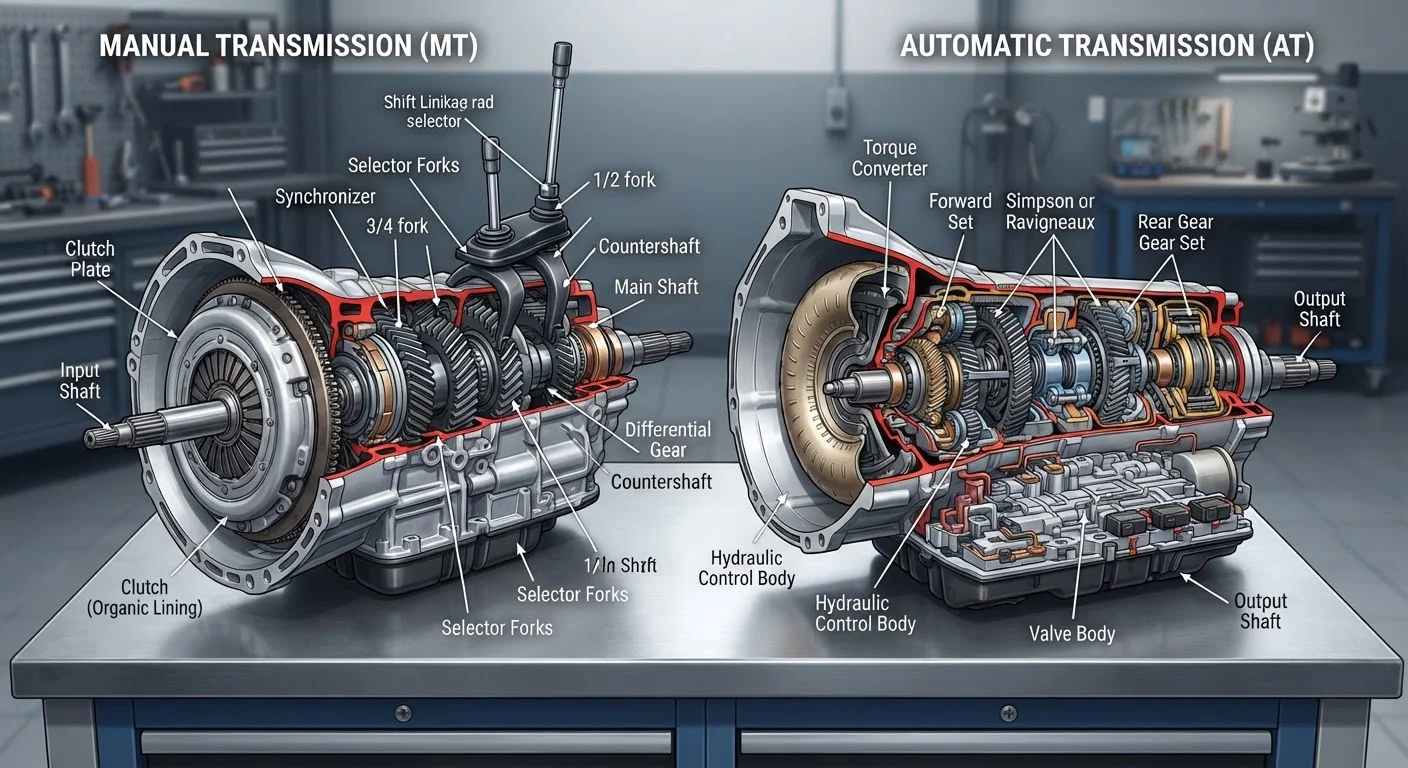
A manual transmission uses a friction clutch — a disc clamped between the engine's flywheel and the transmission input shaft. When the driver presses the clutch pedal, the clutch disc disengages, breaking the mechanical link between engine and gearbox. The driver then selects a gear using the gear lever, which moves selector forks to mesh different sized gear pairs on the input and output shafts. Releasing the clutch re-engages the drive. The entire process is mechanical and directly controlled by the driver.
An automatic transmission replaces the friction clutch with a torque converter — a fluid coupling that uses hydraulic pressure to transmit engine power. Inside the gearbox, a planetary gear set (a central sun gear, surrounding planet gears, and an outer ring gear) produces different ratios depending on which elements are held stationary by internal clutch packs and bands. A control unit monitors vehicle speed, throttle position, and load, then commands the appropriate gear change automatically. For a broader look at how power delivery differs across vehicle types, see our guide to petrol, diesel, hybrid, and electric powertrains.
| Criterion | Manual Transmission | Automatic Transmission |
|---|---|---|
| Gear selection | Driver controlled via clutch and lever | Computer controlled automatically |
| Power coupling | Friction clutch disc | Torque converter (fluid coupling) |
| Typical number of ratios | 5–6 forward gears | 6–10 forward gears |
| Fuel economy trend | Comparable on modern vehicles | Often marginally better with many ratios |
| Primary wear item | Clutch assembly | Transmission fluid and clutch packs |
| Repair complexity | Generally lower | Generally higher |
| Driver engagement | High — direct mechanical input | Low — system manages changes |
| Stop-and-go usability | More demanding for driver | More convenient |
Fuel Economy, Performance, and Driving Feel
For many years, manuals held a clear fuel economy advantage because drivers could choose the most efficient gear for a given situation, and the direct mechanical connection avoided the energy loss inherent in a fluid coupling. That gap has largely closed. Modern automatics — especially dual-clutch transmissions (DCTs), which use two separate clutch packs to pre-select the next gear — shift faster and more precisely than most drivers can manually, and their greater number of ratios (often eight, nine, or ten) keep the engine closer to its efficiency sweet spot continuously.
8–10
Forward gears in many modern automatics
Most new automatic-equipped passenger vehicles offer eight or more ratios, compared to five or six in a typical manual gearbox.
~3%
Average fuel economy difference (modern vehicles)
The US Department of Energy notes that the traditional fuel-economy advantage of manuals has narrowed significantly with modern automatic designs.
Driving feel is where the distinction remains most subjective. Manual drivers describe a greater sense of connection — the feedback through the clutch pedal and gear lever communicates what the drivetrain is doing. Understanding concepts like torque and horsepower becomes more intuitive when you're physically managing gear changes. Automatics, by contrast, can feel smoother and less demanding, which is a genuine advantage on motorway journeys — something new drivers especially notice, as covered in our motorway driving guide.
Maintenance, Wear, and Long-Term Costs
The mechanical differences between the two systems translate directly into different maintenance profiles.
Manual transmissions have relatively few wear items. The clutch assembly — disc, pressure plate, and release bearing — is the primary consumable. Clutch lifespan varies widely depending on driving style and conditions, typically ranging from 60,000 to over 150,000 miles. Gearbox oil should be checked and replaced on the manufacturer's schedule. Rebuilds are generally less expensive than automatic repairs due to fewer internal components.
Automatic transmissions require periodic fluid and filter changes; degraded automatic transmission fluid (ATF) is a leading cause of premature wear in these systems. For context on how fluid condition affects mechanical components broadly, our guide to car fluids is a useful reference. Internal repairs — replacing solenoids, clutch packs, or the torque converter — tend to be more labor-intensive and expensive than equivalent manual gearbox work. However, automatics do not carry the recurring clutch replacement cost.
Neither system is maintenance-free. If you're uncertain where transmission servicing falls on the DIY-versus-mechanic spectrum, our article on knowing when to call a mechanic can help you decide. Transmission internal work should always be handled by a qualified technician.
Dual-Clutch Transmissions: A Middle Ground
Dual-clutch transmissions (DCTs) are technically automated manuals — they use two clutch packs rather than a torque converter, but shift automatically. They offer fast, efficient gear changes and are found in a growing number of mainstream vehicles. Unlike traditional automatics, they can sometimes feel jerky at very low speeds. If your vehicle has a DCT, follow manufacturer-specific service intervals, as their fluid and clutch requirements differ from both conventional manuals and traditional automatics.
The content on this site is for informational purposes only and is not a substitute for professional advice. Always consult a qualified professional for guidance specific to your situation.