

Start here
Why Motorways Feel Different
Next
Joining the Motorway: Using the On-Ramp Correctly
Core skills
Lane Discipline and Overtaking
Safety essentials
Maintaining Safe Following Distances
Completing the journey
Exiting the Motorway Safely
Long-term habit
Managing Fatigue and Planning Ahead
Why Motorways Feel Different
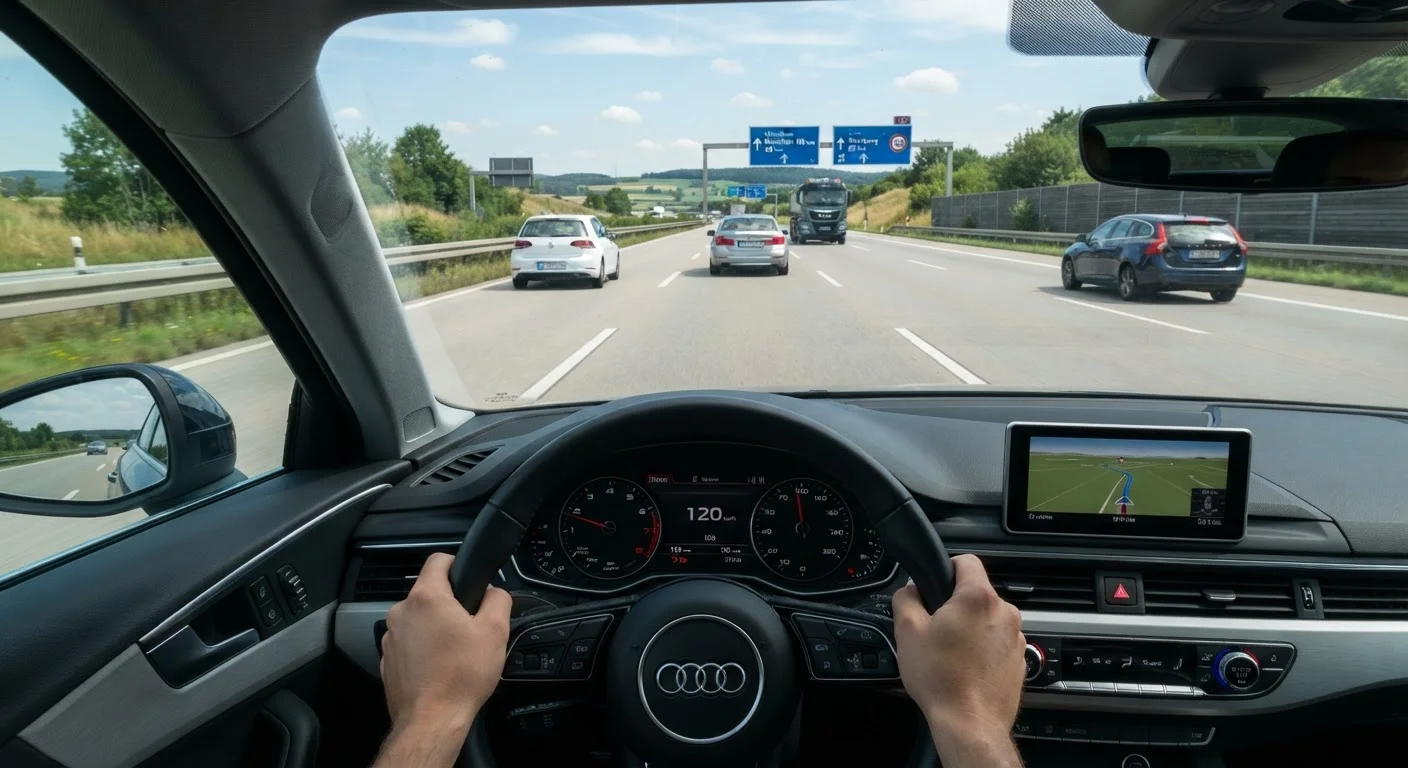
The first time you pull onto a motorway, the sensation is immediate: everything moves faster, the margins for error feel smaller, and the decisions happen in quick succession. This is not a reason for alarm — it is simply a new driving environment that rewards preparation and calm.
At higher speeds, the distance your vehicle travels while you react to a hazard increases dramatically. At 70 mph, a car covers roughly 31 metres every second. That compression of time is the defining characteristic of motorway driving, and it shapes every habit described in this guide.
Unlike urban roads, motorways are designed to reduce conflict — no junctions, no pedestrians, no traffic lights. But that predictability can breed complacency. Staying alert and scanning far ahead are habits that distinguish experienced motorway drivers from anxious or distracted ones. Before any high-speed journey, it is worth running through a pre-journey vehicle check — tyre pressures, fluid levels, and lights all matter more when you are covering long distances at speed.
Carriageway
The main road surface of a motorway used for through traffic, divided into numbered lanes. Lane 1 is the leftmost lane.
Slip road
A short connecting road used to join (on-ramp) or leave (off-ramp) a motorway. You accelerate on entry slip roads and decelerate on exit slip roads.
Two-second rule
A simple method for maintaining a safe following distance by ensuring at least two seconds of travel time exists between your vehicle and the one ahead.
Lane hogging
The practice of staying in a middle or outer motorway lane without overtaking. It is illegal in the UK and disrupts traffic flow.
Blind spot
An area around your vehicle that mirrors do not cover. On a motorway, always check your blind spot by glancing over your shoulder before changing lanes.
Joining the Motorway: Using the On-Ramp Correctly
The on-ramp (also called the slip road or acceleration lane) exists for one purpose: to allow you to reach a speed compatible with the traffic already on the carriageway before you merge. This is critical. Joining at too low a speed forces motorway traffic to brake or swerve for you.
As you travel down the on-ramp, accelerate smoothly and continuously while checking your mirrors and looking over your right shoulder for a gap in lane 1. Signal right to indicate your intention. When a safe gap appears, merge — do not stop at the end of the on-ramp unless absolutely necessary.
Build Speed Gradually on the On-Ramp
Accelerate progressively from the moment you enter the slip road rather than leaving it to the last stretch. A smooth, steady build-up gives you more time to assess traffic and choose your gap. Rushing a merge at the last moment leaves you with fewer options and less control.
If the slip road is short or traffic is dense, you may need to adjust your speed carefully and wait for a gap. Forcing a merge is never safer than momentarily holding back. Once on the carriageway, move to a comfortable lane-1 position and settle your speed.
Lane Discipline and Overtaking
UK motorway law and the Highway Code are clear: lane 1 (the left lane) is the default. Lanes 2 and 3 are for overtaking. Once you have passed slower traffic, return promptly to the left. Staying in the middle lane — sometimes called 'lane hogging' — is a fixed-penalty offence and a genuine hazard because it compresses usable road space.
When overtaking, follow a consistent process: check your mirrors, signal right, check your blind spot, move when safe, pass smoothly, signal left, return to lane 1. Avoid cutting back in sharply in front of the vehicle you have just passed — leave a sensible gap.
Motorway driving contrasts sharply with urban driving, where you contend with cyclists, pedestrians, and narrow gaps. On the motorway, the hazards are fewer but the consequences of a lapse are more severe. Consistent lane discipline reduces unpredictability for every driver around you.
Never Undertake on the Motorway
Passing a vehicle on its left side (undertaking) is illegal in the UK except in slow-moving, queuing traffic where the left lane is moving faster. Undertaking at speed is particularly dangerous because drivers do not expect vehicles to pass on their left. Always overtake on the right and return to lane 1 promptly.
Maintaining Safe Following Distances
The two-second rule is the baseline for dry conditions: pick a fixed point ahead, watch the vehicle in front pass it, and ensure at least two full seconds elapse before you reach the same point. In wet weather, double it to four seconds. In fog or ice, increase it further still.
Tailgating is one of the most common causes of motorway collisions. At 70 mph, the stopping distance for a typical car is around 96 metres — more than a football field. A driver following too closely has no meaningful stopping distance if the vehicle ahead brakes suddenly.
Conditions change the equation significantly. For a detailed look at how wet and low-visibility weather affects handling and braking, see our guide on driving in rain, fog, and snow.
Exiting the Motorway Safely
Missing your exit and reacting impulsively is more dangerous than simply continuing to the next junction. Plan well in advance: most motorways use countdown markers at 300, 200, and 100 yards before the exit. Begin signalling left at the 300-yard marker and move into lane 1 if you are not already there.
A common error is braking on the main carriageway before reaching the slip road. Decelerate on the slip road itself, not before it. After sustained motorway speeds, your perception of lower speeds can be distorted — 40 mph at the end of a slip road may feel much slower than it is. Check your speedometer rather than relying on feel.
If you are travelling with others on board, be aware that passengers affect your concentration and decision-making — particularly during manoeuvres like exits where attention is most critical.
Managing Fatigue and Planning Ahead
Fatigue is responsible for a disproportionate share of serious motorway collisions, particularly on long journeys. The monotony of a motorway — consistent speed, fewer visual stimuli — accelerates tiredness in ways that urban driving does not. Plan rest stops approximately every two hours or 100 miles, whichever comes first.
If you feel yourself losing concentration — yawning repeatedly, difficulty holding your lane, or drifting thoughts — pull off at the next services. A 15–20 minute rest is far more effective than turning up the radio or opening a window. Caffeine can provide a short-term boost but is not a substitute for sleep.
Night motorway driving compounds fatigue risk considerably. Our guide on night driving explains how reduced visibility and altered reaction times change the risk profile significantly. For new licence holders, combining night conditions with high speeds requires careful preparation — not avoidance, but readiness.
Highway Code: Motorway Rules
The official UK Highway Code rules 253–273 cover motorway driving comprehensively, including lane use, hard shoulder rules, and overhead signals. Available free on GOV.UK.
Pre-Journey Vehicle Check Guide
A structured walk-through of what to inspect before a motorway journey — tyres, lights, fluid levels, and mirrors — to ensure your vehicle is ready for high-speed travel.
Frequently Asked Questions
In many regions, newly licensed drivers are permitted to use motorways unsupervised, though some jurisdictions impose restrictions during a probationary period. In England, learner drivers can now access motorways with an approved driving instructor in a dual-control car. Always check the rules that apply to your specific licence type and region.
The left-hand lane (lane 1) is the default driving lane on UK motorways. Lanes 2 and 3 are for overtaking only — once you have passed slower traffic, return to the left lane. Remaining in a middle or outer lane unnecessarily is called 'lane hogging' and can result in a fixed penalty.
Signal before every lane change, in good time so other drivers can react. Check your mirrors, signal, then check your blind spot before moving. On exit slip roads, signal left as you approach the junction, ideally at the 300-yard marker.
Continue to the next junction and exit there. Never reverse on a motorway or cross a solid white line to reach a slip road you have passed — these actions are extremely dangerous and illegal.
Poor weather significantly increases motorway risk for all drivers, but especially for the inexperienced. If conditions are severe, consider delaying your journey. If you must travel, reduce your speed, increase following distances, and use headlights in reduced visibility.
In the UK, the national speed limit on a motorway is 70 mph for cars. This is a legal maximum, not a target — adjust your speed to suit traffic density, visibility, and road conditions. Travelling at a safe, consistent speed that suits the conditions is always preferable to hitting the maximum limit.
The content on this site is for informational purposes only and is not a substitute for professional advice. Always consult a qualified professional for guidance specific to your situation.