

The Numbers Behind the Dark
Most drivers feel confident behind the wheel after dark, yet the collision data tells a different story. The National Highway Traffic Safety Administration (NHTSA) consistently reports that while nighttime accounts for only about 25% of driving, it contributes to roughly 50% of traffic fatalities. That ratio alone signals that something fundamental changes when the sun sets.
The disparity isn't simply about drunk drivers or isolated incidents. It reflects a broad degradation in every driver's ability to perceive, process, and react to the road environment. Understanding why — rather than assuming familiarity makes you immune — is the first step toward genuinely safer night driving.
~50%
Of traffic fatalities occur at night
Despite nighttime accounting for roughly 25% of total driving, NHTSA data shows it contributes to approximately half of all traffic deaths.
3×
Higher fatal crash rate per mile at night
Mile for mile, driving after dark carries approximately three times the fatal crash rate compared to daytime driving, according to NHTSA analysis.
160–250 ft
Typical low-beam headlight range
Standard low-beam headlights illuminate roughly 160 to 250 feet of road ahead — often less than the stopping distance needed at highway speeds.
What Darkness Actually Does to Your Vision
Human eyes are not well-designed for low-light driving. The shift from daylight to scotopic (low-light) vision reduces visual acuity, eliminates reliable colour perception, and significantly narrows peripheral awareness. A pedestrian in dark clothing at the edge of your headlight range may simply not register as a threat until it is too late to act.
Depth perception — your brain's ability to judge how far away an object is — also becomes less reliable at night because it depends heavily on visual cues that diminish in low light. Judging the gap to a vehicle ahead, or estimating when an intersection will arrive, takes more cognitive effort and carries more uncertainty.
Add in the temporary blindness caused by oncoming high beams, and the visual environment at night is far more hostile than it appears during the day. Even clean, correctly aimed headlights on a modern vehicle cast a limited cone of useful light — beyond that edge, the world is essentially invisible.
“Visibility is the foundation of safe driving. At night, that foundation shrinks dramatically, and drivers often don't appreciate how much they're relying on a very small window of usable information.”
— AAA Foundation for Traffic Safety, Road safety research and driver education organisation
The Fatigue Factor
Darkness and tiredness are closely linked. The body's circadian rhythm — its internal clock — drives natural sleepiness in the late night and early-morning hours, regardless of how much sleep a person had the previous night. A driver who feels alert at 10 p.m. may find their focus deteriorating significantly by midnight, not because of anything they did wrong, but because of basic human biology.
Fatigue impairs reaction time, narrows attention, and produces micro-sleeps — brief, involuntary lapses in consciousness that a driver often does not notice. At highway speed, even a two-second micro-sleep covers the length of two basketball courts. See our guide to tiredness at the wheel for a detailed look at the warning signs and what to do when they appear.
Headlights, Stopping Distances, and the Overdriving Problem
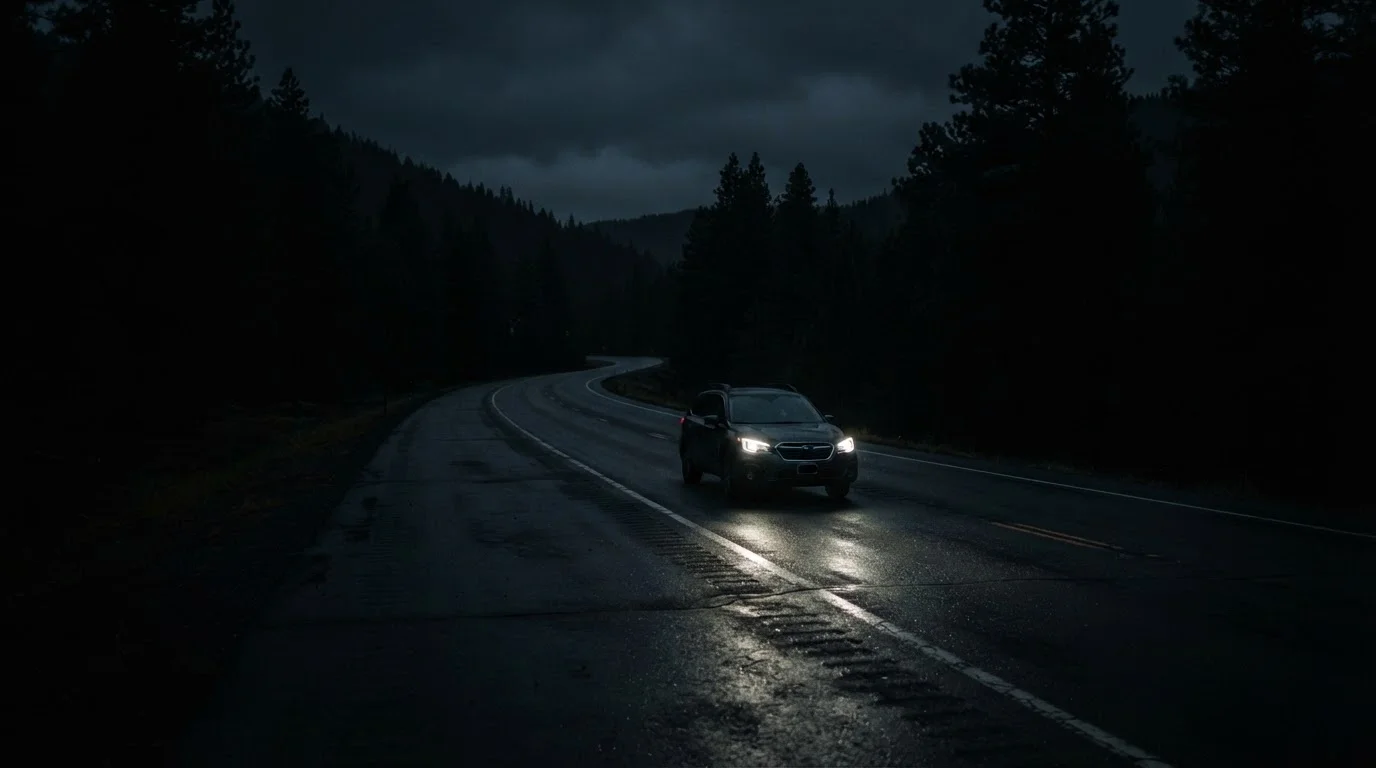
One of the most counterintuitive facts about night driving is how little road a standard headlight actually illuminates relative to a vehicle's stopping distance. On low beam, most headlights light up 160–250 feet of road. At 60 mph, a vehicle needs roughly 300 feet to stop — meaning the visible stopping zone and the actual stopping zone don't match. This is called overdriving your headlights, and it is surprisingly easy to do without realising it.
The practical implication is simple but important: night driving often requires lower speeds than the posted limit to maintain a genuine margin of safety. Increasing following distance serves the same purpose, giving extra time for hazards to become visible before a driver needs to react. For a broader look at how speed and reaction time translate into braking numbers, see the science behind stopping distances.
Match Your Speed to Your Headlights
A practical rule for safe night driving: never travel faster than you can stop within the distance your headlights illuminate. On low beams, this often means reducing your speed below the posted limit on unlit roads. High beams can extend your range significantly on open roads — use them whenever it is safe and legal to do so.
Habits That Experienced Night Drivers Use
Experienced drivers approach night driving differently — not with anxiety, but with deliberate adjustments. They reduce speed gradually as conditions darken, increase following distance, and avoid staring at oncoming headlights (instead looking toward the right edge of the road to preserve night-adapted vision). They keep their windshield clean, inside and out, because even minor smearing scatters headlight glare significantly.
Rural roads at night deserve particular caution. Unlit lanes, animal crossings, and the absence of road markings combine to make them disproportionately risky. Our article on safe driving on rural roads covers the specific hazards involved. More broadly, the mindset of anticipating problems before they develop — rather than reacting to them — is central to night safety, a principle explored in depth in defensive versus reactive driving.
Night driving does not need to be feared, but it does need to be respected. Treating every after-dark journey as a slightly different task from daytime driving — adjusting speed, attention, and expectations accordingly — is what separates confident, responsible drivers from those caught off guard.
This article provides general driving safety information for educational purposes. Always follow applicable traffic laws and consult official highway safety guidance for regulations specific to your state.
Frequently Asked Questions
According to NHTSA data, traffic fatalities occur at a rate roughly three times higher per mile driven at night than during the day. Reduced visibility, compromised depth perception, and higher rates of driver fatigue and impaired driving all contribute. Fewer vehicles on the road can create a false sense of safety that encourages lower vigilance.
Low-beam headlights generally illuminate between 160 and 250 feet ahead. At 60 mph, a vehicle travels approximately 88 feet per second, which means a driver has roughly two seconds of usable visibility — far less than the time needed to react and stop safely from a hazard at that speed.
Overdriving your headlights means travelling at a speed where your stopping distance exceeds the distance illuminated by your headlights. If a hazard appears at the edge of your light range, you physically cannot stop in time. It is one of the most common — and underappreciated — night driving errors.
Yes. Full dark adaptation can take 20–30 minutes and can be disrupted in an instant by oncoming high-beam headlights. Even brief exposure to bright light resets part of the adaptation process, temporarily reducing your ability to see clearly in the surrounding darkness.
High beams are appropriate on unlit rural roads when no other vehicles are present. You should switch to low beams whenever you're within 500 feet of an oncoming vehicle or following another vehicle closely — high beams can temporarily blind other drivers and reduce everyone's safety.
Fatigue impairs reaction time, judgment, and situational awareness in ways that closely parallel alcohol impairment. The body's circadian rhythm naturally drives sleepiness in the late night and early morning hours, making these the highest-risk periods for drowsy driving incidents. Pulling over and resting is the only reliable remedy.
The content on this site is for informational purposes only and is not a substitute for professional advice. Always consult a qualified professional for guidance specific to your situation.