

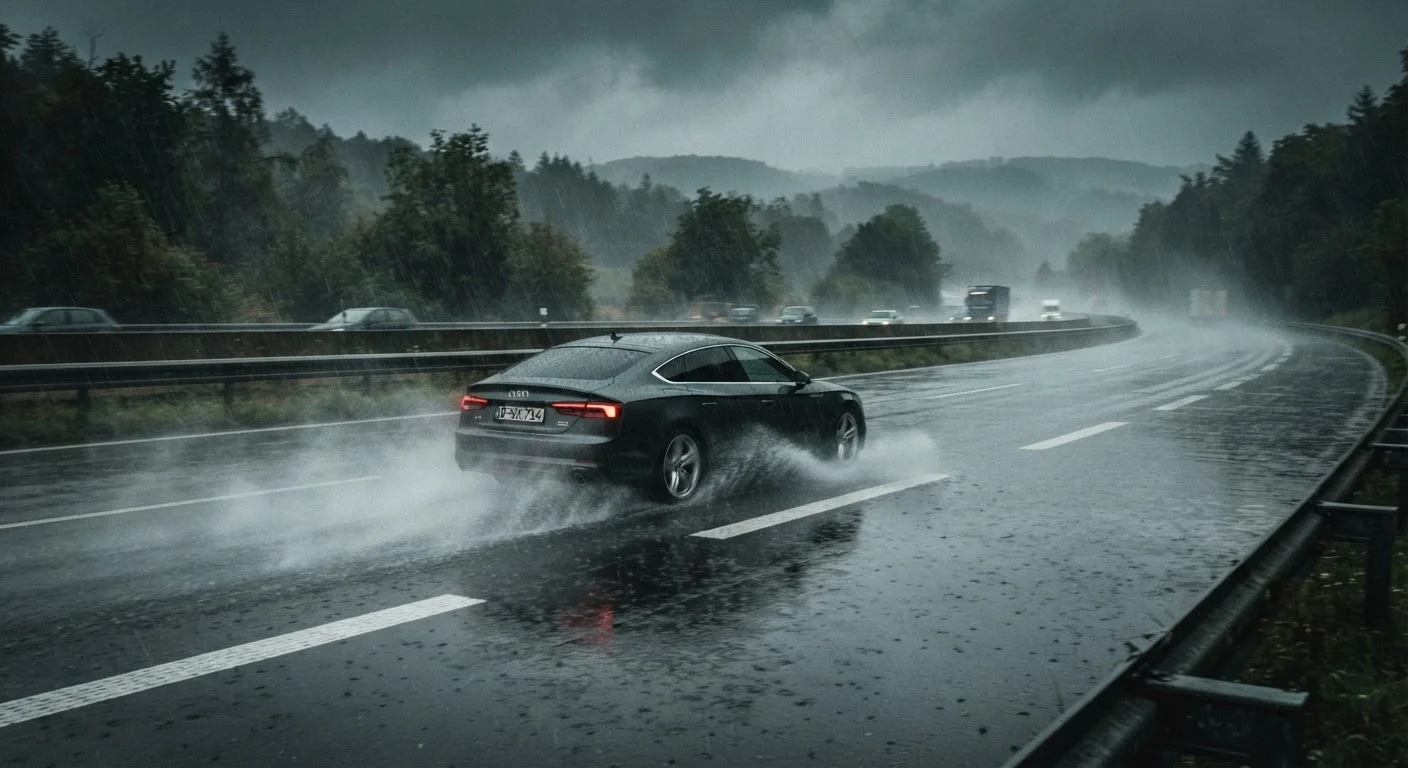
Why Adverse Conditions Change Everything
Most drivers learn in fair weather and carry those habits into rain, fog, and snow without adjusting for the physics that have fundamentally changed beneath them. The road surface, your visibility window, and the time your vehicle needs to respond are all different — sometimes dramatically so. Understanding why helps you respond with intention rather than instinct.
Friction between your tires and the road is what allows you to steer, accelerate, and stop. Water, ice, and packed snow each reduce that friction in different ways and to different degrees. A dry road gives your tires something to grip; a wet road inserts a thin film of water that must be displaced; ice can cut available grip to a fraction of normal. The physics don't negotiate — your driving has to.
See our guide to stopping distances for a detailed breakdown of how speed and surface affect braking. And if you want to understand your vehicle's systems before conditions deteriorate, the Understanding Your Car hub is a solid starting point.
~1.2M
US crashes annually linked to wet pavement
According to FHWA (Federal Highway Administration) data, wet pavement is a contributing factor in approximately 1.2 million crashes each year in the United States.
10x
Increase in stopping distance on ice vs. dry road
Safety research consistently shows that stopping distances on ice can be up to ten times greater than on a dry road at equivalent speeds.
Driving in Rain: What Actually Changes
Rain creates three distinct hazards: reduced grip, reduced visibility, and the risk of aquaplaning — where your tires ride on a layer of water rather than the road itself. Aquaplaning typically occurs above 45 mph on standing water, though worn tires lower that threshold considerably.
Reduce speed progressively as rain intensity increases
Heavier rain reduces both visibility and tire-to-road contact. Driving at the same speed as in dry conditions dramatically shortens the margin for error. Speed reduction is the most direct way to buy back stopping distance.
Double your following distance in wet conditions
Wet roads extend stopping distances significantly compared to dry pavement. The two-second rule used in dry conditions is insufficient; four seconds is a commonly recommended minimum in rain.
Ease off the accelerator immediately if you feel aquaplaning
Aquaplaning means your tires have lost contact with the road surface. Braking or steering sharply at this point can cause a spin. Reducing throttle gently allows tires to regain traction progressively.
Use engine braking instead of heavy footbraking on ice
Hard braking on ice can lock wheels and send a vehicle into an uncontrolled slide. Engine braking — achieved by reducing speed gradually using lower gears or simply lifting off the throttle — slows the car with less risk of wheel lockup.
Always clear your entire vehicle of snow before setting off
Snow left on the roof or hood becomes a hazard when it slides onto your windshield under braking or becomes airborne onto other vehicles. It also obscures your lights and signals from other road users.
Keeping your tires properly inflated and your wiper blades in good condition are pre-conditions for safe wet-weather driving, not afterthoughts. Check your washer fluid level before winter — see the fluid levels reference guide for what to look for under the hood.
Fog and Low Visibility: Slow Down and Light Up Correctly
Fog is uniquely deceptive. It creates a false sense of enclosure that can slow your perceived speed, and drivers frequently travel faster than they realise. The rule of thumb: if you cannot stop within the distance you can see ahead, you are going too fast.
The Fog Rule: Stay Within Your Sight Line
A practical way to gauge safe speed in fog: if you cannot bring your vehicle to a complete stop within the distance you can clearly see ahead, you are travelling too fast for conditions. This applies regardless of the posted speed limit. In dense fog, that may mean speeds well below 30 mph even on a highway.
Use low-beam headlights — never high beams — in fog. High beams reflect off water droplets and create glare that further reduces what you can see. Rear fog lights (where fitted) improve your visibility to drivers behind you, but turn them off when conditions improve so they don't dazzle following traffic.
Fog shares several risk factors with night driving. Our article on why night driving is more demanding covers the overlap between darkness and limited sight lines.
Snow and Ice: The Most Unforgiving Conditions
Ice and compacted snow represent the sharpest departure from normal driving. Even at low speeds, steering and braking responses feel delayed or absent. The key discipline is eliminating abrupt inputs entirely — smooth acceleration, early and light braking, and gradual steering changes give tires the best chance to maintain grip.
If your vehicle begins to slide, avoid the instinct to brake hard or counter-steer sharply. Ease off the accelerator, look and steer toward where you want to go, and allow the vehicle to recover progressively. On front-wheel-drive cars especially, gentle throttle can sometimes help pull the nose back into line.
Defensive driving principles matter most in snow and ice — anticipating hazards before they develop leaves you enough space and time to respond without emergency maneuvers. Collision data consistently shows that following distances are a leading factor in adverse-condition crashes; see what collision patterns reveal about when and where incidents cluster.
Before You Drive: Preparation That Pays Off
No amount of skilled driving compensates for a vehicle that isn't road-ready. Tire tread depth matters more in wet and icy conditions than in the dry — the legal minimum is a floor, not a target. Wiper blades, battery condition, and brake performance all degrade without obvious warning signs.
All-Season Tires Have Limits in Snow
All-season tires are engineered for year-round use in mild climates, but their compound stiffens in temperatures below about 45°F, reducing grip on snow and ice. Drivers in regions with consistent winter conditions may benefit from dedicated winter tires, which use a softer compound and different tread pattern designed for cold-weather performance. Consult a qualified tire professional about what's appropriate for your region and vehicle.
Check your car maintenance fundamentals before winter sets in rather than after the first frost. Visibility preparation matters too: clear all snow from your roof, hood, and lights — snow that slides onto your windshield while braking or onto another driver's car is both a hazard and, in many states, a legal liability.
The content on this site is for informational purposes only and is not a substitute for professional advice. Always consult a qualified professional for guidance specific to your situation.