

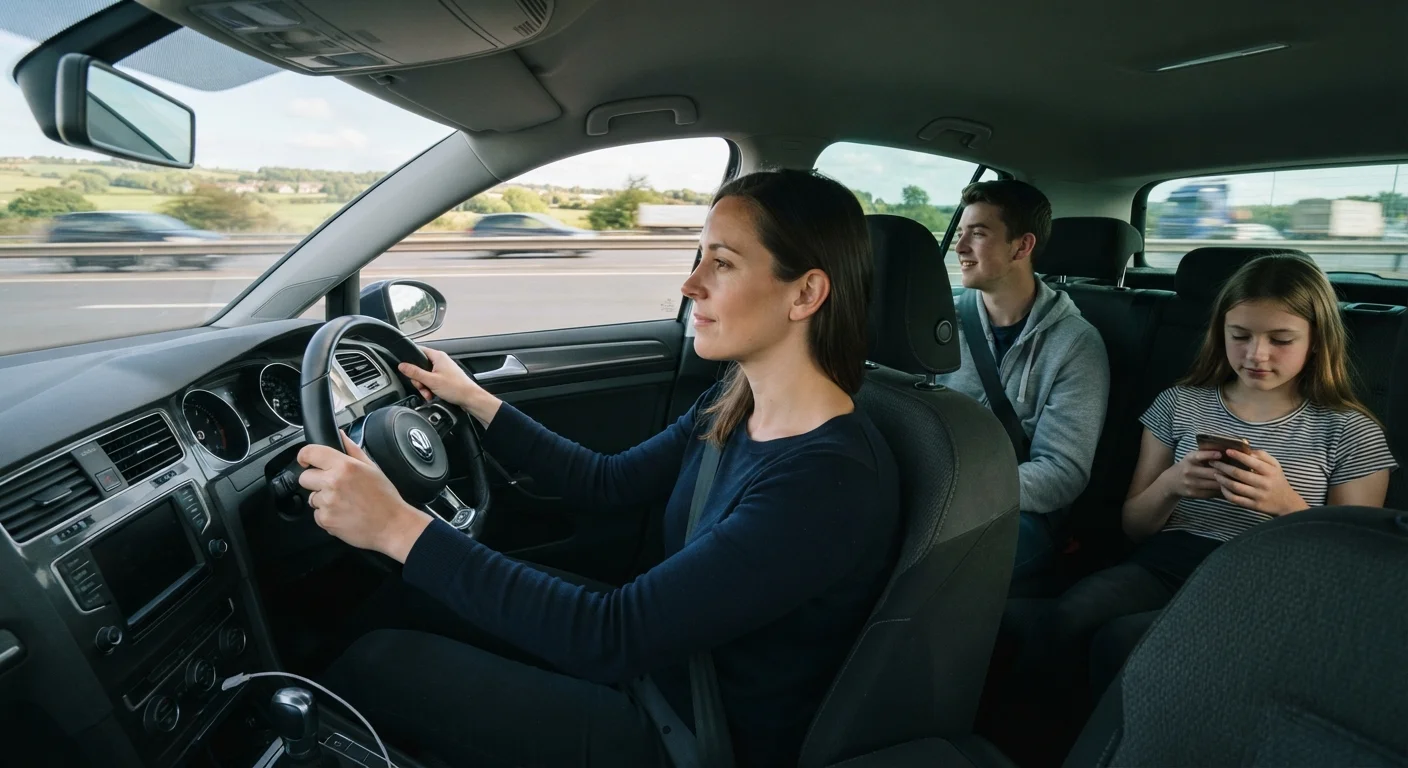
How Passengers Physically Change Your Vehicle
Most drivers think of passenger safety in terms of seatbelts and nothing more. But the moment additional people climb into a vehicle, its physical behaviour changes in ways that directly affect how safely it can be driven.
Weight is the most immediate factor. A vehicle carrying four adults may be 600–800 lbs heavier than when driven solo. That extra mass lengthens braking distances, increases momentum in corners, and reduces acceleration response. On a downhill stretch or in a sudden hazard situation, those differences are not trivial.
Tyre pressure becomes more critical too. Vehicles have a recommended load rating, and tyres should be inflated to the pressure specified for heavier loads — often found on a sticker inside the driver's door jamb or in the owner's manual. Underinflated tyres under load run hotter and are more prone to blowout.
Suspension and centre of gravity also shift. A heavily loaded rear seat raises the back of the vehicle slightly and alters steering feel. This is especially pronounced in smaller cars, SUVs carrying roof cargo, or vehicles near their maximum load rating.
3×
Crash risk increase for teen drivers with passengers
According to AAA Foundation for Traffic Safety research, teenage drivers carrying two or more passengers face roughly triple the fatal crash risk compared to driving alone.
20–30%
Increase in braking distance under full load
Physics dictates that a vehicle carrying maximum passenger weight requires meaningfully longer distances to stop from the same speed compared to a solo driver in the same conditions.
Managing Distraction: The Passenger Problem
Research consistently identifies distraction as a leading contributor to collisions, and passengers are a significant distraction source — sometimes more so than phone use. Unlike a phone conversation, a passenger sitting next to you can pull your eyes off the road, prompt you to turn your head, or create sudden noise that breaks concentration at a critical moment.
This risk is particularly elevated for newer drivers. Studies by the AAA Foundation for Traffic Safety have found that teen drivers carrying peer-age passengers face a substantially higher crash risk than when driving alone, with risk increasing with each additional passenger.
“The presence of passengers — especially peers — significantly increases crash risk for young drivers. Managing the social environment inside the vehicle is as important as managing the road environment outside it.”
— AAA Foundation for Traffic Safety, Nonprofit traffic safety research organization
Experienced drivers manage this by establishing low-key norms before the journey begins: keeping the radio at a reasonable level, asking passengers to hold non-urgent conversations at natural pauses, and being clear that their focus stays on the road. This isn't about being unfriendly — it's about being the responsible person at the controls.
For longer trips, consider structuring conversation around quieter road sections and pausing when navigating complex junctions, merging onto high-speed roads, or driving in poor conditions. Our guide to driving in rain, fog, and snow covers how reduced visibility demands even more mental focus — passengers should understand this too.
Best Practices for Carrying Passengers Responsibly
Check tyre pressure before any journey with a full passenger load.
Increased vehicle weight places greater demand on tyres. Running at the correct load-rated pressure reduces heat buildup, improves braking performance, and lowers blowout risk — all of which matter more when others are in the vehicle.
Increase your following distance when carrying passengers.
Additional weight increases the distance needed to stop safely. The standard two-second gap is a minimum for a lightly loaded vehicle; with a full load, extending to three seconds gives you the margin your braking system actually needs.
Establish ground rules with passengers before you pull away.
Setting clear, calm expectations at the start of a trip prevents mid-journey disruptions that could distract you at a critical moment. Passengers who understand the driver's focus requirements are more likely to cooperate when it matters.
Verify every passenger is properly restrained before moving.
Seatbelts are effective only when worn correctly. An unrestrained or poorly belted rear passenger becomes a dangerous projectile in a sudden stop — posing a risk to everyone in the vehicle, not just themselves.
Ensure child restraints are correctly installed and age-appropriate.
Child safety seats must match the child's weight and height, be installed per the manufacturer's instructions, and face the correct direction. An incorrectly fitted seat provides little protection in a collision.
Keep the cabin environment calm and the audio at a manageable level.
Loud music, heated discussions, or frequent interruptions all reduce the driver's ability to detect auditory cues from outside the vehicle — horns, sirens, and squealing tyres among them. Volume management is a simple but meaningful safety step.
Applying these habits consistently — regardless of how familiar or relaxed the journey feels — is what separates confident drivers from complacent ones. Even short trips benefit from deliberate pre-departure checks and clear in-cabin expectations.
If you regularly carry passengers on urban routes, it's also worth reviewing urban driving hazards — city environments concentrate pedestrians, cyclists, and unpredictable stops in ways that demand full attention from the driver.
Quick Adjustments You Can Make Today
None of these steps require extra equipment or training — they're habits that compound over time into a consistently safer driving style. The drivers who handle passengers well are those who treat every journey, however routine, with the same level of deliberate preparation.
For newer drivers still building confidence at speed, motorway driving guidance is especially relevant when carrying passengers — high-speed roads amplify every in-car distraction.
Talk to Young Drivers About Passenger Pressure
If a newer driver in your household regularly carries friends or peers, have a direct conversation about managing social pressure inside the vehicle. Passengers who joke, argue, or demand the driver's attention present a genuine safety risk. Encouraging young drivers to feel empowered to set limits — and to pull over safely if a situation becomes unmanageable — can be life-saving.
The content on this site is for informational purposes only and is not a substitute for professional advice. Always consult a qualified professional for guidance specific to your situation.