

The Four Jobs Engine Oil Does Every Time You Drive
Most drivers think of engine oil simply as a lubricant — something that keeps parts from grinding together. That is accurate, but it understates the role considerably. Engine oil performs four distinct functions simultaneously, and a failure in any one of them puts your engine at risk.
Lubrication is the primary role. Your engine contains dozens of metal components moving at high speed in close proximity — crankshaft journals, camshaft lobes, piston rings, and valve train components. Oil forms a microscopic film between these surfaces, preventing direct metal contact and reducing wear to a manageable minimum.
Heat transfer is the second job. While your cooling system handles the bulk of engine heat management, oil absorbs and carries away heat from areas coolant cannot reach — particularly around pistons and cylinder walls.
Cleaning is the third function, and it often surprises drivers. Modern engine oils contain detergent and dispersant additives that suspend carbon deposits, metal particles, and combustion byproducts, carrying them to the oil filter for capture. Without this, sludge accumulates inside the engine.
Corrosion protection completes the picture. Oil coats internal metal surfaces with a thin protective layer that prevents oxidation and chemical attack from acidic combustion gases that inevitably find their way past piston rings.
“The single most important thing you can do to extend engine life is maintain clean oil at the correct level. Everything else is secondary.”
— AAA Automotive Research, Automotive consumer advisory and research organization
Why Engine Oil Degrades — and Why That Matters
Engine oil does not last indefinitely. Every mile driven causes physical and chemical changes that gradually reduce the oil's ability to do its job. Understanding why helps explain why consistent oil changes are non-negotiable.
Thermal breakdown occurs when oil is repeatedly exposed to high engine temperatures. The base oil molecules — whether conventional or synthetic — begin to break down, reducing viscosity stability. Oil that is too thin at operating temperature fails to maintain the protective film between metal surfaces.
Oxidation happens when oxygen dissolved in the oil reacts with the base stock under heat, producing acidic byproducts and thickening the oil. Thickened oil flows poorly on cold starts, which is precisely when engine wear is highest.
Additive depletion is equally important. The detergents, anti-wear agents, and corrosion inhibitors blended into engine oil are consumed over time. Once these additives are exhausted, the base oil alone offers substantially less protection even if the level on the dipstick looks fine.
Contamination from fuel dilution, moisture, and combustion byproducts accumulates until the oil filter can no longer manage it. At that point, suspended contaminants begin acting as an abrasive rather than being safely held in suspension.
Check Your Oil Every Month
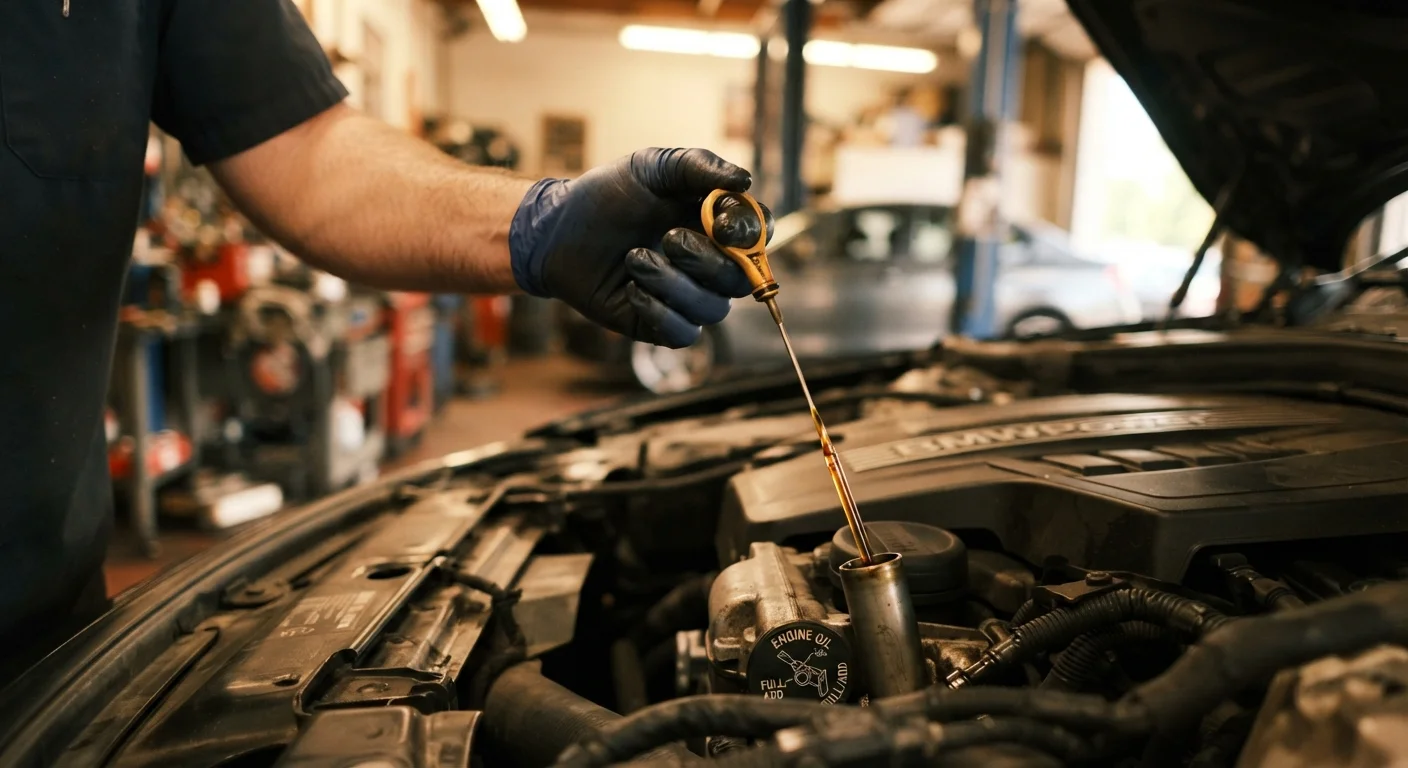
Park on a level surface, wait a few minutes after the engine has been running, then pull the dipstick, wipe it clean, reinsert it fully, and pull it again. The oil level should fall between the minimum and maximum marks. Also note the oil's colour and consistency — what you see tells you as much as the level itself.
For a fuller picture of how the engine itself uses this oil every cycle, see our explanation of the four-stroke combustion cycle.
The Real Cost of Neglecting Engine Oil
Oil-related engine damage is among the most expensive and avoidable repairs in automotive maintenance. The consequences of neglect are not always sudden — they often develop silently over thousands of miles before becoming undeniable.
#1
Cause of preventable engine damage
Oil neglect — including infrequent changes and low oil levels — is consistently cited by automotive repair data as the leading cause of avoidable engine failures.
$4,000+
Typical engine replacement cost
Replacing a failed engine in a typical passenger vehicle commonly runs between $4,000 and $8,000 or more depending on the make and model, according to automotive repair industry estimates.
~2 min
Time to check oil level
Checking engine oil with the dipstick takes approximately two minutes and is recommended by most manufacturers to be done at least once a month.
Increased wear is the first outcome. Without adequate lubrication, metal surfaces wear at an accelerated rate. Bearings, camshaft lobes, and cylinder walls are particularly vulnerable. This wear cannot be reversed — it accumulates permanently.
Sludge buildup is a well-documented consequence of infrequent oil changes. Oil sludge — a thick, tar-like deposit — can block oil passages and starve critical engine components. Clearing sludge from an engine can require disassembly; in severe cases, an engine replacement becomes the only practical option.
Engine seizure represents the worst-case outcome. When oil is critically low or completely degraded, metal-to-metal contact generates enough heat to fuse components together. A seized engine typically cannot be rebuilt economically.
High-mileage vehicles are especially sensitive to oil quality and consistency. If you are keeping an older car on the road long-term, our guide on maintaining high-mileage vehicles outlines the broader maintenance priorities that support longevity.
It is also worth knowing that many common beliefs about oil — including fixed change intervals and certain oil types — are outdated. The engine oil myths article separates evidence-based guidance from advice that has outlived its usefulness.
This article is for general informational purposes. Always consult your vehicle owner's manual and a qualified mechanic for guidance specific to your car's make, model, and condition.
Frequently Asked Questions
It depends on your vehicle, driving habits, and the type of oil used. Most modern vehicles using full synthetic oil can go 7,500 to 10,000 miles between changes, while older vehicles or those using conventional oil may need changes every 5,000 miles or fewer. Always follow your owner's manual rather than a generic mileage rule.
Low oil means less lubrication between metal parts, which dramatically increases friction and heat. Over even short distances, this can cause accelerated wear to the camshaft, crankshaft bearings, and cylinder walls. Severe cases can result in complete engine seizure, which is often not repairable.
Topping off addresses low oil level but not degraded oil quality. Old oil that has broken down chemically still circulates and provides inadequate protection even when the level is correct. Topping off between scheduled changes is appropriate; it is not a substitute for a full oil change.
Pull the dipstick and wipe it on a white cloth. Fresh oil is amber and translucent; degraded oil appears very dark, gritty, or milky. A milky or frothy appearance can signal coolant contamination — a serious issue requiring immediate professional attention.
Yes. Using the wrong viscosity grade or oil type can reduce protection and, in some cases, void warranty coverage. Your owner's manual specifies the correct grade; see our <a href="/cars-driving/car-maintenance/synthetic-vs-conventional-motor-oil-what-the-difference-actually-means-for-your-engine">guide to synthetic vs. conventional oil</a> for a deeper comparison.
Oil picks up combustion byproducts, metal particles from normal wear, and moisture as it circulates. Detergent additives in the oil suspend these contaminants so they can be captured by the oil filter. Over time, both the additives and the filter become saturated, reducing the oil's ability to clean and protect.
The content on this site is for informational purposes only and is not a substitute for professional advice. Always consult a qualified professional for guidance specific to your situation.