

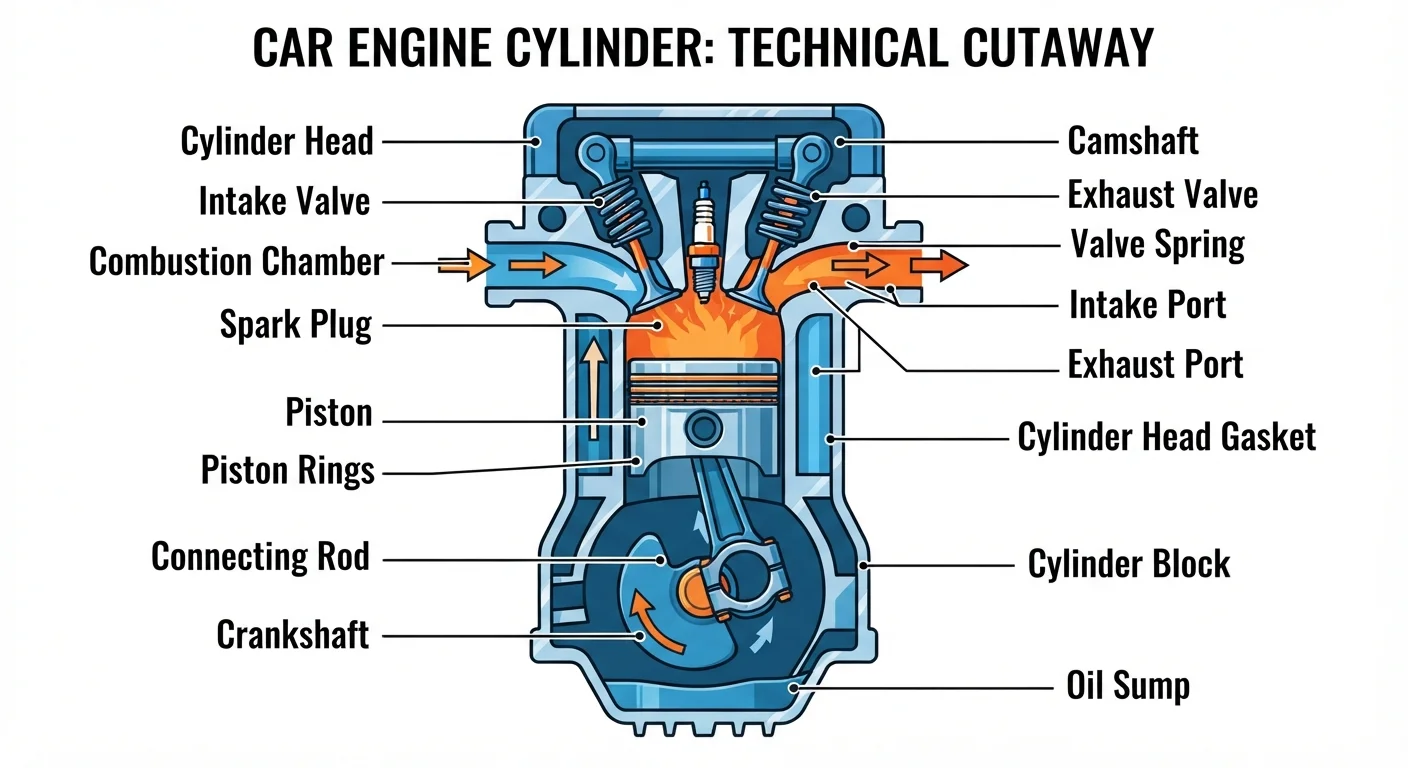
Stroke 1 — Intake: Drawing in the Fuel-Air Mix
The cycle begins as the piston moves downward from its highest point — called top dead center (TDC) — toward the bottom of the cylinder. This downward movement creates a drop in pressure, drawing a mixture of air and fuel (or air alone, in direct-injection systems) into the cylinder through the open intake valve.
In a gasoline engine, the fuel-air ratio is carefully metered by the fuel injection system to ensure efficient combustion. The intake valve closes once the piston reaches the bottom of its travel, sealing the mixture inside. A restricted air intake — caused by a clogged air filter, for example — reduces the volume of air entering the cylinder, which directly limits power output.
Stroke 2 — Compression: Squeezing for Power
With both valves now closed, the piston travels back upward, compressing the fuel-air mixture into a much smaller space. This is measured as the engine's compression ratio — a typical modern gasoline engine compresses the mixture to about one-tenth of its original volume (a 10:1 ratio). Diesel engines use ratios of roughly 14:1 to 25:1, which is high enough to raise air temperature beyond the fuel's ignition point without needing a spark.
Compression is critical to efficiency: the tighter the squeeze, the more energy is released during combustion. Worn piston rings or leaking valves reduce compression, causing noticeable drops in power and fuel economy — a symptom that a mechanic can diagnose with a compression test.
Compression Is a Health Indicator
If your engine feels sluggish or fuel economy has dropped without explanation, ask a mechanic to perform a cylinder compression test. It measures how well each cylinder seals during the compression stroke and can reveal worn rings, leaking valves, or a damaged head gasket before they become catastrophic failures.
Stroke 3 — Combustion (Power): The Stroke That Does the Work
At the top of the compression stroke, a spark plug fires (in gasoline engines), igniting the compressed mixture. The resulting rapid expansion of gases drives the piston forcefully downward — this is the power stroke, and the only one of the four that generates energy. The force of the piston's downward movement is transferred through the connecting rod to the crankshaft, converting linear motion into the rotational force that ultimately reaches your wheels.
This is also where torque and horsepower are generated. The violence and precision of this stroke explain why engine oil film thickness matters so much — metal components moving under extreme heat and pressure depend on a continuous lubricant barrier. For a deeper look at why oil degradation is a genuine risk, see our guide on engine oil and long-term engine health.
~2,500 RPM
Typical cruising engine speed on a highway
At this speed, each cylinder in a four-cylinder engine completes roughly 1,250 power strokes per minute.
10:1
Typical gasoline engine compression ratio
Higher compression ratios generally improve thermal efficiency; diesel engines commonly operate between 14:1 and 25:1.
~2,500°F
Peak combustion temperature inside a cylinder
Combustion temperatures this high make engine cooling systems and oil lubrication critical to preventing component damage.
Stroke 4 — Exhaust: Clearing the Chamber
After the power stroke, the exhaust valve opens and the piston travels upward again, pushing the spent combustion gases out of the cylinder and into the exhaust manifold. Clean, complete evacuation of exhaust gases matters because any residual gas dilutes the incoming fresh charge in the next intake stroke, reducing efficiency.
Those exhaust gases travel downstream through the exhaust system, where the catalytic converter chemically processes harmful byproducts — carbon monoxide, hydrocarbons, and nitrogen oxides — into less harmful compounds. Our explainer on what happens inside a catalytic converter covers that process in detail. Once the piston reaches TDC again, the exhaust valve closes, the intake valve opens, and the whole cycle repeats.
Why Multi-Cylinder Engines Feel Smooth
A single-cylinder engine firing once every two crankshaft rotations would feel rough and uneven — like a heartbeat with long pauses. Modern passenger vehicles use four, six, or eight cylinders timed to fire in an overlapping sequence, so power strokes follow one another in rapid, staggered succession. A four-cylinder engine, for example, spaces its power strokes evenly across 180° of crankshaft rotation, delivering a reasonably smooth output.
This mechanical choreography is why cylinder count and engine configuration (inline, V-shaped, flat) influence refinement as much as raw output. It also explains why a misfiring cylinder — caused by a failed spark plug, faulty injector, or loss of compression — produces a noticeable vibration: the engine's firing rhythm is broken. To understand how these principles apply across different fuel types, see our comparison of petrol, diesel, hybrid, and electric powertrains.
Hybrids Still Use the Four-Stroke Cycle
Hybrid vehicles pair a conventional four-stroke internal combustion engine with an electric motor and battery pack. The combustion engine in a hybrid operates on the same intake-compression-power-exhaust principles described here — the hybrid system simply reduces how often and how hard that engine needs to work, improving overall efficiency. This is distinct from battery-electric vehicles, which have no combustion engine at all.
Frequently Asked Questions
The four strokes are intake, compression, combustion (also called the power stroke), and exhaust. They occur in that sequence, with each stroke representing one up or down movement of the piston inside the cylinder.
At typical highway speeds, an engine may spin at 2,000–3,500 RPM. Because each cylinder fires once every two crankshaft rotations, a four-cylinder engine at 2,500 RPM completes roughly 5,000 power strokes per minute across all cylinders.
A two-stroke engine completes the intake, compression, combustion, and exhaust functions in just two piston strokes (one crankshaft rotation), making it simpler and lighter but less efficient and higher in emissions. Four-stroke engines are standard in cars because they run cleaner and last longer.
Both follow the same four-stroke sequence, but diesel engines compress air alone to a much higher ratio until it heats enough to ignite injected fuel spontaneously — no spark plug required. This compression-ignition process is why diesel engines typically produce more torque at lower RPM.
Each stroke depends on clean air, precise fuel delivery, effective sealing, and timely ignition. Dirty air filters restrict the intake stroke, worn spark plugs disrupt combustion, and degraded engine oil accelerates wear on every moving part. Knowing the cycle clarifies why routine maintenance directly protects engine performance.
The content on this site is for informational purposes only and is not a substitute for professional advice. Always consult a qualified professional for guidance specific to your situation.