

From Combustion to Cleaner Air
Every time your engine fires, it produces a mixture of exhaust gases — some harmless, some not. The combustion process that moves your car generates carbon monoxide (CO), unburned hydrocarbons (HC), and nitrogen oxides (NOx) as unavoidable byproducts. Without intervention, these gases would exit the tailpipe directly into the atmosphere, where they contribute to smog and respiratory harm.
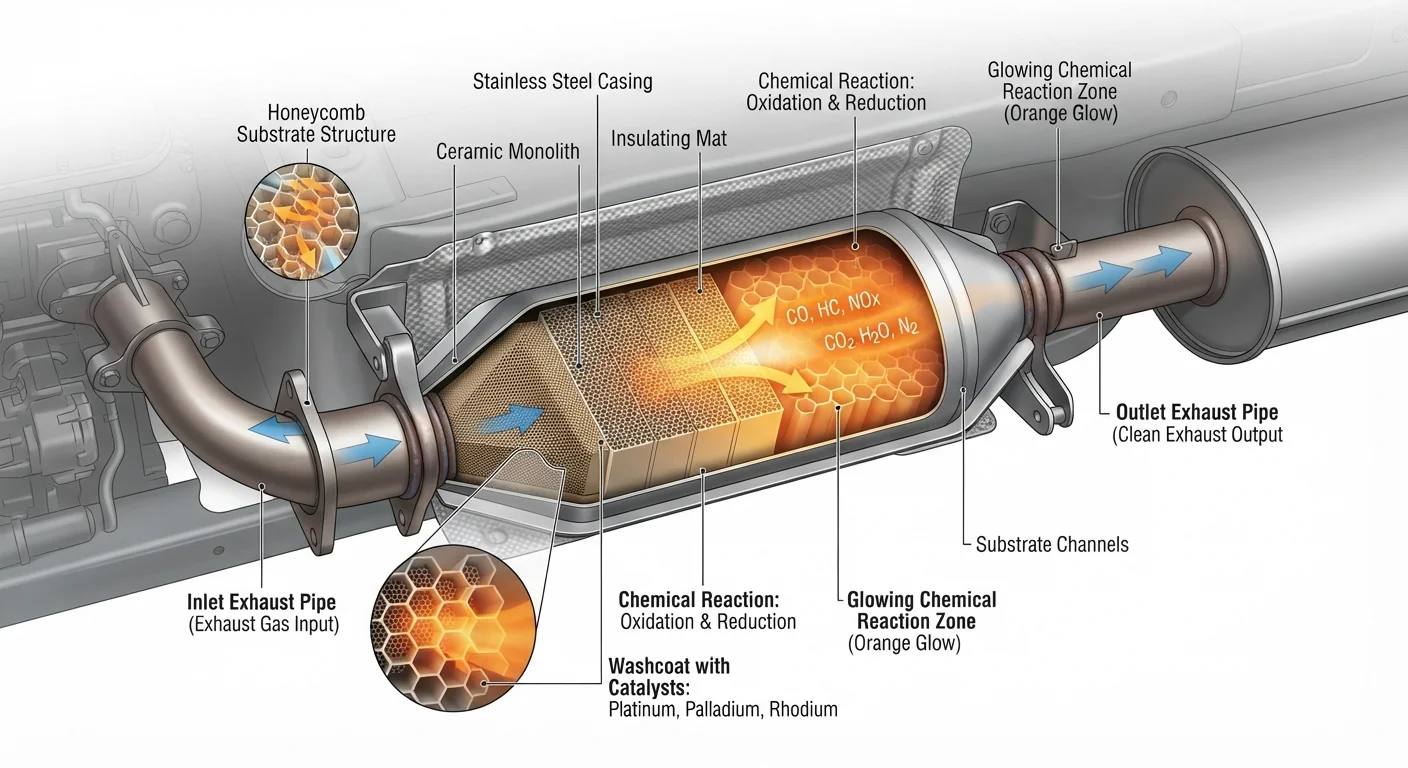
The catalytic converter sits in the exhaust stream between the engine and the muffler, acting as a chemical treatment chamber. Before those gases reach open air, they pass through the converter and emerge significantly cleaner. The device became mandatory on US passenger vehicles starting in 1975, following the Clean Air Act's tightening of emissions standards.
The Chemistry Inside: What Actually Happens
The interior of a catalytic converter is built around a substrate — most commonly a ceramic or metalite honeycomb structure with millions of tiny parallel channels. This design maximizes surface area: a converter the size of a small loaf of bread can have an internal surface area equivalent to several football fields.
That surface is coated with a thin wash of precious metals: typically platinum, palladium, and rhodium. These metals act as catalysts — substances that accelerate chemical reactions without being consumed in the process. As exhaust gases flow over the coated surface at high temperature, three distinct reactions occur:
- Oxidation of carbon monoxide: CO combines with oxygen to form carbon dioxide (CO₂).
- Oxidation of hydrocarbons: Unburned fuel molecules react with oxygen, producing water (H₂O) and CO₂.
- Reduction of nitrogen oxides: NOx is broken apart, releasing nitrogen (N₂) and oxygen (O₂) — both naturally occurring atmospheric gases.
This is why modern devices are called three-way converters: they address all three major exhaust pollutant families simultaneously.
90%+
Reduction in tailpipe pollutants
Modern three-way catalytic converters can reduce CO, HC, and NOx emissions by more than 90% compared to an uncontrolled engine, according to the U.S. Environmental Protection Agency.
1975
Year catalytic converters became mandatory in the US
The U.S. EPA required catalytic converters on all new passenger vehicles beginning with the 1975 model year as part of Clean Air Act compliance.
~400–600°F
Minimum operating temperature
Catalytic converters must reach this temperature range before the precious metal catalysts become active enough to trigger efficient emissions reduction.
Why Temperature and Engine Health Matter
Catalytic converters are not effective from a cold start. The precious metal catalysts require heat — typically around 400–600°F (204–315°C) — to initiate the chemical reactions. This warm-up window is known as the light-off period, and it explains why short urban trips produce proportionally more emissions than highway driving.
Engine condition is equally critical. The converter processes whatever the engine sends its way, and certain contaminants can permanently damage the catalyst coating:
- Oil burning: Engine oil entering the combustion chamber coats catalyst surfaces with residue, reducing effectiveness.
- Coolant leaks: Coolant reaching the exhaust can cause the substrate to crack or melt.
- Misfires: Unburned fuel entering the converter can ignite inside it, causing extreme heat that destroys the substrate structure.
- Leaded fuel or certain additives: These chemically deactivate the precious metal coating.
Address Engine Warning Signs Promptly
A misfiring engine or illuminated Check Engine light should never be ignored if you want to protect your catalytic converter. Misfires send raw, unburned fuel into the converter, where it can combust internally and destroy the substrate in a single event. Have the underlying cause diagnosed before it escalates into a far more expensive repair.
Keeping the engine in good mechanical health is the single most effective way to extend catalytic converter life.
Recognizing Failure and What to Do
When a catalytic converter fails, it typically does so in one of two ways: it becomes chemically poisoned (losing catalytic efficiency) or physically clogged (restricting exhaust flow). Both scenarios trigger the vehicle's onboard diagnostics. Oxygen sensors positioned before and after the converter monitor reaction efficiency; when the downstream sensor reads similarly to the upstream sensor, the system flags a problem — commonly stored as code P0420.
Physical symptoms may include sluggish acceleration, a rattling noise from under the vehicle (indicating a crumbled substrate), or a sulfur smell from the tailpipe. A clogged converter can also trap exhaust gases, raising backpressure and causing noticeable power loss.
Replacement is a job for a qualified mechanic. A new converter must be matched to the specific vehicle and comply with applicable state emissions regulations — California, for example, maintains stricter standards than federal minimums. Attempting to bypass or remove a catalytic converter is illegal under federal law and defeats the purpose of the system entirely.
This article is for general informational purposes. For diagnosis and repair of vehicle emissions components, consult a licensed automotive technician.
Frequently Asked Questions
It converts toxic exhaust gases into less harmful ones through chemical reactions. Carbon monoxide becomes carbon dioxide, unburned hydrocarbons are oxidized into water and carbon dioxide, and nitrogen oxides are broken down into nitrogen and oxygen.
Most catalytic converters are designed to last the life of the vehicle — commonly 100,000 miles or more under normal operating conditions. Premature failure is usually caused by engine problems, such as oil or coolant burning, that contaminate the catalyst.
A clogged or damaged converter can restrict exhaust flow, reduce engine power, and cause overheating. While a vehicle may still run, continuing to drive with a confirmed failed converter is not recommended and may worsen related engine damage. Consult a qualified mechanic.
They contain small but valuable quantities of platinum, palladium, and rhodium — precious metals whose market prices make the devices attractive targets for theft. Vehicles with higher ground clearance, such as trucks and SUVs, are particularly vulnerable because their converters are easier to access.
Common indicators include a Check Engine light (often code P0420), reduced acceleration, a sulfur or rotten-egg smell from the exhaust, rattling sounds from underneath the vehicle, and noticeably poor fuel economy.
The content on this site is for informational purposes only and is not a substitute for professional advice. Always consult a qualified professional for guidance specific to your situation.