

Start here
Why Scale Is the First Thing to Get Right
Next
Using Light and Color to Open Up a Room
Then
Storage That Works Without Crowding the Space
When you're ready
Visual Tricks That Genuinely Make a Difference
Wrap up
Putting It All Together
Why Scale Is the First Thing to Get Right
When a small room feels wrong, the culprit is usually scale. An oversized sofa that grazes both walls, a dining table that leaves no room to pull out chairs, a bookcase that looms over a modest alcove—each choice individually might look fine in a showroom, but together they make a compact room feel embattled rather than considered.
The remedy isn't to buy only miniature furniture. In fact, one generously sized statement piece—a proper sofa, a full-height wardrobe—often reads better than several small items competing for attention. The key is proportion: each piece should relate sensibly to the room's dimensions and to the other pieces around it. Measure your floor plan before purchasing anything, and use painter's tape to mark out footprints on the floor. What looks fine on a product page can be revealing when laid out in your actual space.
For a deeper grounding in how proportion and balance shape any room, see the core principles behind a well-decorated room—the same rules apply at every scale.
Scale
The size of a furniture piece or object relative to the room and to surrounding items. Poor scale—a piece too large or too small for its setting—is one of the most common decorating mistakes.
Visual weight
How heavy or dominant an object looks in a space, regardless of its physical weight. Dark colors, large patterns, and bulky shapes carry more visual weight and can overwhelm a small room.
Layered lighting
Using multiple light sources at different heights—overhead, table lamps, floor lamps, accent lights—to create a warmer, more dimensional effect than a single ceiling fixture provides.
Vertical storage
Storage that builds upward toward the ceiling rather than spreading across the floor, keeping walkways clear while maximizing available wall space.
Proportion
The size relationship between different elements in a room—furniture to room, furniture to furniture, accessories to furniture—that determines whether a space feels balanced and intentional.
Using Light and Color to Open Up a Room
Light is the most powerful tool in a small-space decorator's kit, and it costs nothing to manage well. Start by maximizing natural light: keep window treatments simple and hang them high and wide so that when open, curtains clear the glass entirely. Heavy drapes that stack over the window frame quietly steal daylight you can't afford to lose.
For artificial lighting, avoid relying on a single overhead fixture. A layered approach—ambient, task, and accent lighting from multiple sources at different heights—eliminates the flat, shadowy feel that makes compact rooms feel smaller than they are.
On color: pale, cool tones reflect light and make walls recede. That said, a considered deep tone used consistently on all four walls and the ceiling can actually feel intentional rather than cramped, because it removes the contrast between surfaces that makes boundaries obvious. What tends to fail in small rooms is a bold accent wall, which simply draws the eye to a boundary you'd rather it ignore.
Test paint colors in your actual light
Paint swatches look dramatically different under natural daylight, warm incandescent light, and cool LED light. Before committing to a wall color, paint a large sample patch—at least 12 inches square—and observe it at different times of day. What reads as a soft warm white in morning light can appear distinctly yellow by evening.
Storage That Works Without Crowding the Space
In a compact room, storage that lives on the floor competes with living space. The smarter direction is vertical: shelving that runs from waist height to the ceiling, built-in or freestanding cabinetry that makes use of otherwise dead wall space, and hooks and rails that move small everyday items off surfaces entirely.
Hidden storage—ottomans with lift-off lids, beds with under-mattress drawers, benches with hollow seats—is valuable not because it creates more cubic footage, but because it keeps surfaces clear. Visual clutter is the fastest way to make a well-proportioned room feel chaotic.
When deciding between open shelves and closed cabinetry, there are real trade-offs to consider. Open shelving adds visual interest but demands ongoing curation; closed cabinetry is forgiving but can feel heavy. Our companion piece on open shelving vs. closed cabinetry explores the practical and aesthetic considerations in depth. If you're renting, deposit-safe decorating solutions covers freestanding and removable alternatives that don't require drilling.
Avoid furniture pushed against every wall
It's a common instinct in small rooms to push all furniture against the walls to 'free up' the center, but this often makes a room feel institutional and oddly hollow. Floating seating slightly away from walls—even just a few inches—creates a more natural, gathered arrangement. Reserve wall-to-wall placement for storage pieces only.
Visual Tricks That Genuinely Make a Difference
Certain decorating moves create a reliable illusion of more space without structural changes. These are worth understanding because they're largely reversible and inexpensive:
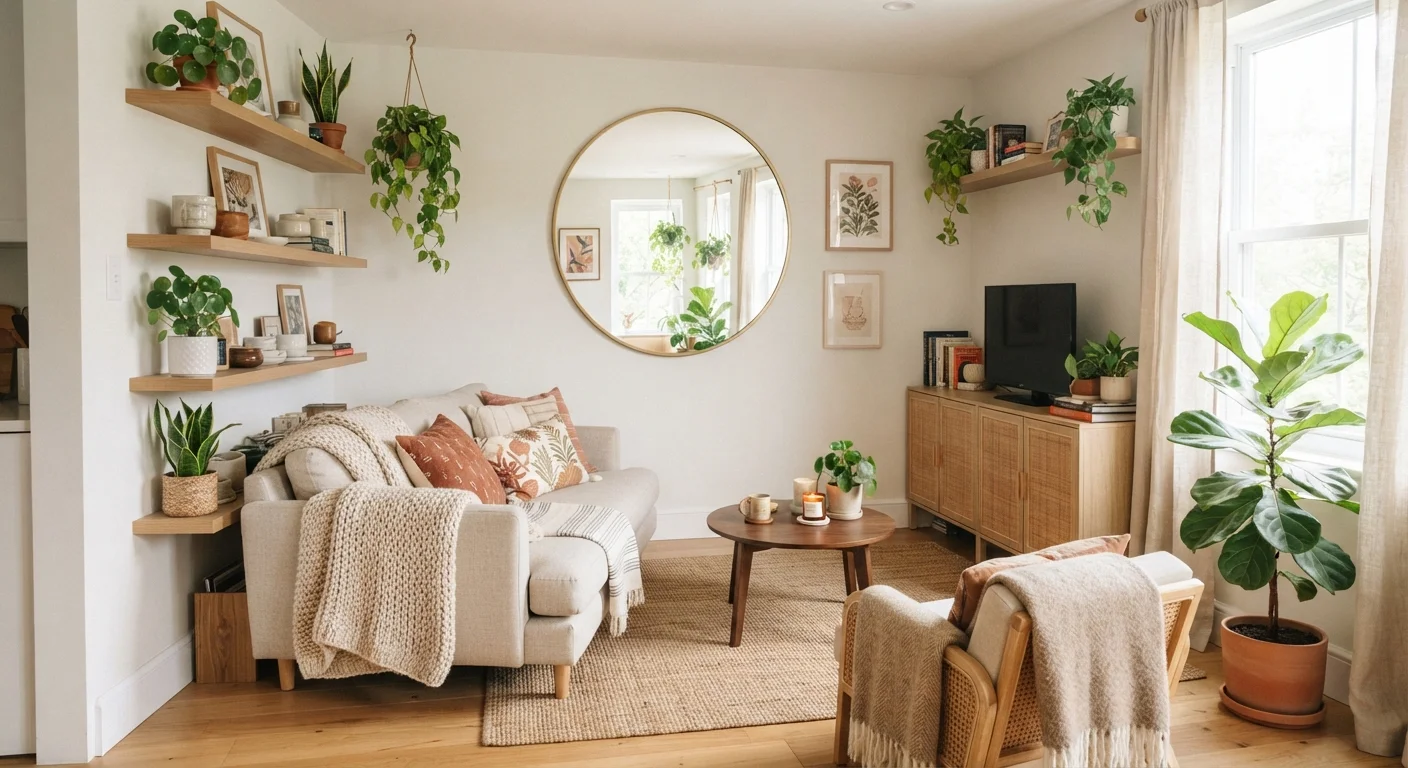
- Mirrors opposite or adjacent to windows reflect light back into the room and create a convincing sense of depth. One large, plain-framed mirror generally outperforms a gallery of smaller decorative ones for this purpose.
- Continuous flooring across connected areas—keeping the same material from a hallway into a living room, for instance—removes the visual interruption that makes each zone feel smaller in isolation.
- Low furniture profiles leave more wall visible above, which makes ceilings appear higher. A low-slung sofa or platform bed achieves this naturally.
- Vertical lines—tall bookshelves, floor-to-ceiling curtains, vertical paneling—draw the eye upward and emphasize ceiling height over floor area.
Plants can add warmth and texture without bulk, provided scale is respected. A single sculptural plant in a corner uses vertical space efficiently without encroaching on walkways. For a balanced look at where houseplants help and where they can overwhelm, see our guide to using indoor plants as décor.
Consistency matters more than minimalism
Small rooms don't require a purely minimalist approach to work well—they require consistency. A room with a clear palette, a repeated material or texture, and a defined purpose will feel cohesive even with multiple pieces in it. The problem is rarely 'too much stuff'; it's stuff that doesn't relate to anything else in the room.
Putting It All Together
Small-space decorating isn't about compromise—it's about intentionality. Every furniture placement, every storage decision, every paint choice either contributes to the room's coherence or subtracts from it. The rooms that feel genuinely considered aren't the ones with the most tricks applied; they're the ones where scale, light, storage, and visual flow have been thought through together.
A useful starting point before any refresh is an honest audit of what you have. The room-by-room décor refresh checklist gives a structured way to spot what's working, what's dated, and what's simply taking up space it hasn't earned.
If you're exploring where your own decorating instincts sit, minimalist vs. maximalist decorating is worth a read—the principles described there apply just as much in a 300-square-foot studio as in a sprawling family home. And for a comprehensive overview of every stage of decorating, from planning through to accessories, this end-to-end decorating resource provides the full picture.
Start with scale. Layer in light. Find storage that lives vertically. The rest follows more naturally than you might expect.
Frequently Asked Questions
Light, cool tones—soft whites, pale grays, and muted sage greens—reflect more light and tend to recede visually, making walls feel farther away. Painting the ceiling the same shade as walls, or slightly lighter, reinforces the effect. Avoid dark accent walls unless you're deliberately creating intimacy rather than perceived size.
A rug that's too small—one that only fits under a coffee table—tends to chop the floor into disconnected zones and can make the room feel more cluttered. A larger rug that extends under the front legs of seating unifies the space and makes it read as a single, cohesive area.
Multifunctional furniture helps when the dual purpose is something you actually use regularly—a storage ottoman, a sofa bed for frequent guests, or a dining table that folds against a wall. Avoid buying multifunctional pieces for features you're unlikely to use, as they often cost more and may compromise on quality for both functions.
There's no fixed number, but the guiding principle is that every piece should earn its place by serving a clear function or adding genuine visual value. Most small living rooms benefit from one sofa, one or two chairs maximum, and a compact surface for items at hand. Resist filling every corner.
Mirrors work by reflecting both natural and artificial light back into the room, doubling the perceived luminosity of a space. When placed opposite or adjacent to a window, they can significantly increase the sense of depth. Large, unfussy mirrors tend to be more effective than clusters of small decorative ones.
Yes, but scale and placement matter. A single tall floor plant in a corner adds life without crowding walkways, while a small potted plant on a shelf uses already-occupied vertical space efficiently. See our guide on <a href="/home-garden/home-decor-ideas/indoor-plants-as-decor-what-works-and-what-doesnt">decorating with indoor plants</a> for more detail.
The content on this site is for informational purposes only and is not a substitute for professional advice. Always consult a qualified professional for guidance specific to your situation.