

Our Verdict
Minimalism and maximalism are tools, not verdicts on taste. Minimalism rewards those who find calm in simplicity and prefer low visual upkeep; maximalism suits people energized by surrounding themselves with meaningful objects and bold expression. Most homeowners will find their comfort zone lies somewhere between the two registers — and that hybrid space is where genuinely personal interiors are made.
| Best for | Recommended |
|---|---|
| Those who prefer calm, uncluttered environments and easy maintenance | Minimalist Decorating |
| Those energized by color, pattern, and displaying cherished collections | Maximalist Decorating |
| Small-space dwellers needing to preserve visual breathing room | Minimalist Decorating |
| Homeowners who want their space to tell a layered personal story | Maximalist Decorating |
What Each Approach Actually Means
The terms get thrown around freely, but minimalism and maximalism describe genuine design philosophies with distinct guiding principles — not just how much stuff you own.
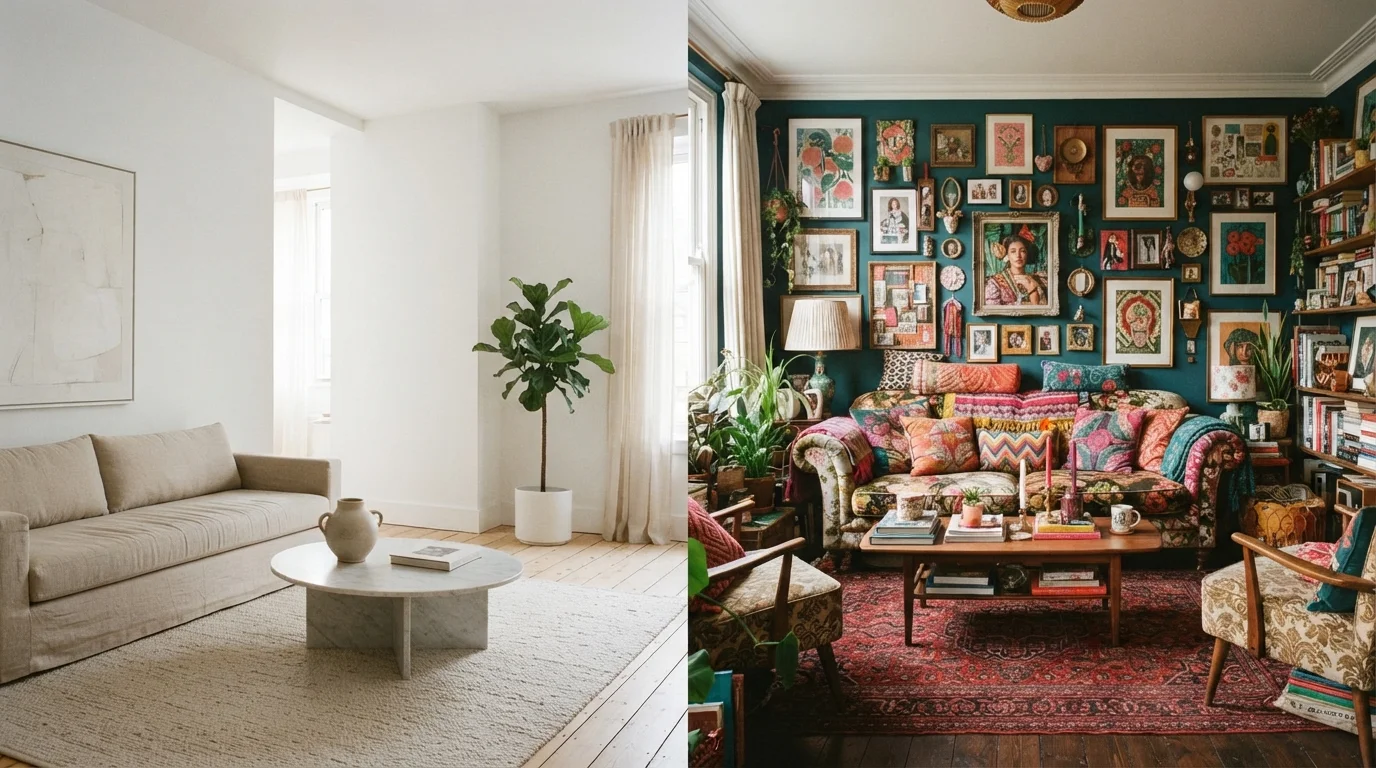
Minimalist decorating operates on the idea that every object in a room should earn its place. Spaces favor a restrained color palette, clear surfaces, and furniture chosen for both form and function. The goal is not emptiness for its own sake, but a room where nothing competes for attention. Breathing room is the point.
Maximalist decorating works from the opposite conviction: that rooms become meaningful through accumulation, layering, and personality. Pattern on pattern, collections on shelves, gallery walls packed edge to edge — maximalism treats every surface as an opportunity for expression. Done thoughtfully, it feels curated rather than chaotic.
Both styles can succeed or fail depending on execution. A minimalist room can feel cold and uninviting if warmth isn't deliberately introduced through texture and material. A maximalist room can feel exhausting if there's no visual hierarchy to guide the eye. Understanding the underlying logic of each approach is what separates intentional decorating from accidental outcomes. For a broader framework on pulling these ideas together across your home, see our complete decorating resource.
How the Two Approaches Compare
The practical differences between minimalism and maximalism show up most clearly when you examine specific decorating decisions — from color choices to storage habits to how a room functions day to day.
| Minimalist Decorating | Maximalist Decorating | |
|---|---|---|
| Color palette | Neutral, limited tones | Bold, layered, pattern-rich |
| Furniture quantity | Few, carefully selected pieces | More pieces; mixing styles encouraged |
| Wall treatment | Plain or single accent | Gallery walls, bold wallpaper, murals |
| Object display | Hidden storage preferred | Collections displayed openly |
| Maintenance demand | High editing discipline required | High dusting and organization time |
| Works best in | Small and large spaces alike | Rooms with generous scale and light |
| Emotional mood | Calm, restful, focused | Stimulating, expressive, layered |
One area where the contrast is especially telling is storage. Minimalist rooms tend to hide it; maximalist rooms often celebrate it. Open shelving styled with collected objects is a natural maximalist move, while closed cabinetry suits a minimalist preference for clean lines. Our guide on open shelving vs. closed cabinetry explores that specific decision in depth.
How to Identify Where You Actually Land
Knowing your decorating register is less about aesthetic preference boards and more about honest self-knowledge. Ask yourself a few practical questions before committing to either end of the spectrum.
- How do you feel in cluttered spaces? If visual noise raises your stress level, a more restrained approach will serve you better day-to-day.
- Do you have meaningful collections or objects? If you've accumulated art, travel souvenirs, or family pieces that matter to you, a maximalist framework lets those things breathe rather than forcing them into hiding.
- How much maintenance are you willing to do? Minimalist spaces require rigorous ongoing editing — every new object has to justify its presence. Maximalist spaces can absorb more, but dusting and organizing complex arrangements takes real time.
- What is the scale of your rooms? Very small rooms often benefit from restraint, not because maximalism can't work in compact spaces, but because scale matters more there. See our separate guide on small-space decorating for approaches that respect proportions.
Try a One-Room Experiment First
Before committing to a full-home aesthetic, test your instincts in a single room — ideally one you use daily. Live with it for a few weeks and notice whether the choices feel energizing or draining. Your reaction in practice is a more reliable guide than any mood board.
It's also worth examining what you find yourself drawn to in other people's homes — not what you think you should like, but what genuinely makes you feel comfortable and at ease.
The Case for a Middle Register
Most livable interiors don't sit at either extreme. A room can have the edited quality of minimalism in its furniture plan while using maximalist moves selectively — a single gallery wall, a dramatically patterned rug, or a shelf of objects arranged with intention.
This blending works because the underlying principles of both styles are actually compatible: minimalism asks you to be intentional; maximalism asks you to be expressive. You can be both at once. The key is choosing where to apply richness and where to let the room breathe. A maximalist corner in an otherwise restrained room draws the eye and gives it something to enjoy, without overwhelming the space overall.
For renters, this middle ground is especially practical. Commitment to a full maximalist scheme is harder when you're limited in what you can fix to walls or alter permanently. Our guide to decorating a rental without losing your deposit shows how expressive decorating is still achievable within those constraints.
One common pitfall on either path is over-coordination — the impulse to make everything match so perfectly that a room loses personality. Whether you're working with a spare or layered aesthetic, knowing when matching works against you is a useful check on any decorating decision.
62%
Homeowners preferring a blended style
A Houzz survey found the majority of respondents described their style as a mix rather than a single defined aesthetic.
3–5 items
Objects per surface in minimalist styling
Interior designers commonly recommend limiting vignettes to three to five objects to maintain visual clarity without feeling bare.
The content on this site is for informational purposes only and is not a substitute for professional advice. Always consult a qualified professional for guidance specific to your situation.