

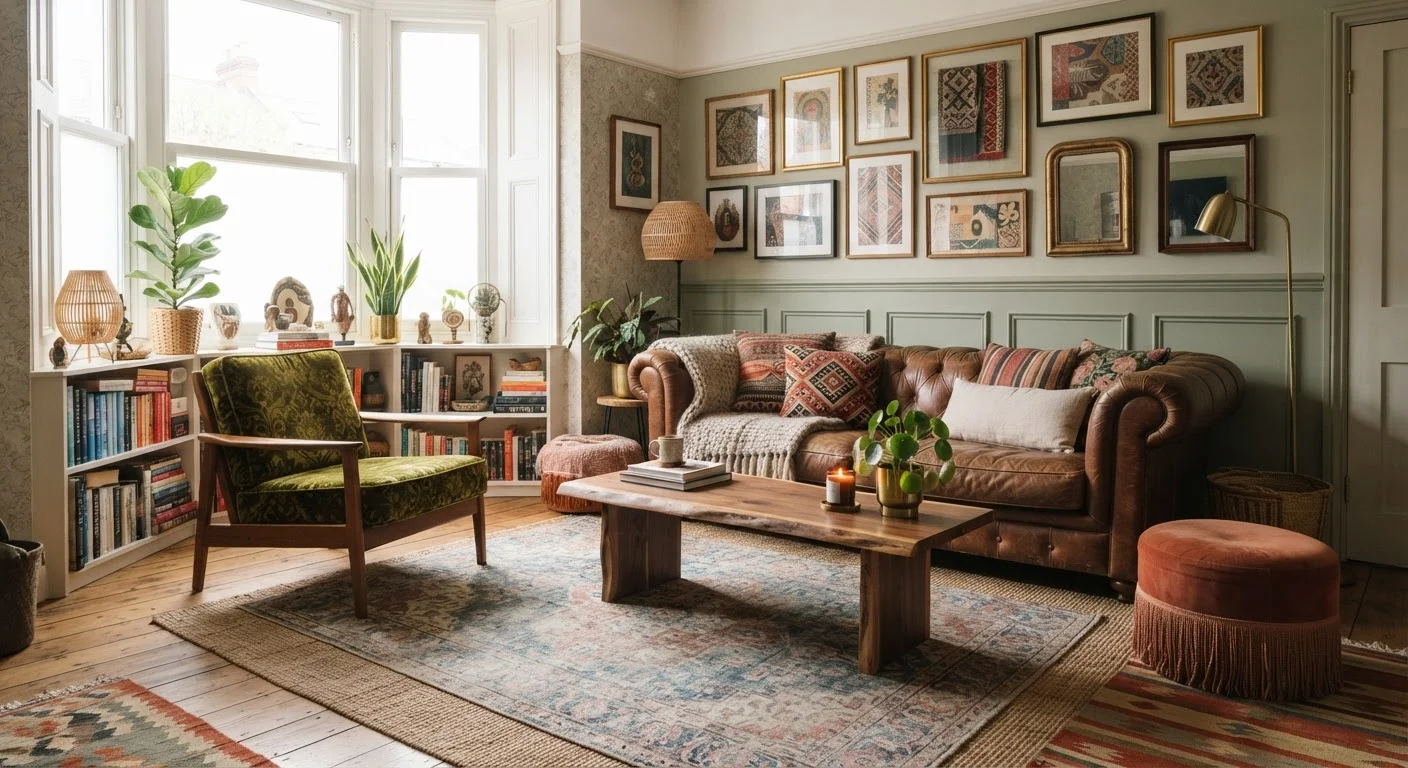
Why Over-Matching Happens in the First Place
The impulse to match everything in a room is understandable. Coordinated sets feel safe — they promise a finished look without the guesswork of mixing pieces yourself. Furniture retailers frequently reinforce this instinct by displaying complete room sets together, making it easy to buy an entire living room in one transaction.
The result, though, is often a space that looks more like a catalog page than a lived-in home. When every cushion, rug, curtain, and throw shares the exact same palette and finish, there's no tension, no surprise — and no real sense of the person who lives there. Understanding the principles behind a well-decorated room — balance, contrast, and rhythm — helps explain why visual variety matters so much.
Buying a complete matched furniture set and using every piece together.
Why it happens: Matched sets are marketed as a convenient, foolproof solution, making them tempting for first-time decorators or those short on time.
Using a single color throughout — walls, soft furnishings, and accessories all in the same hue.
Why it happens: Monochrome rooms look striking in design shoots, leading many homeowners to replicate the look without the tonal variation that makes it work professionally.
Matching all metal finishes in a room to a single tone, such as all-brass or all-chrome.
Why it happens: Consistency feels intentional and polished, so homeowners often assume mixed metals look unplanned or accidental.
Choosing artwork, cushions, and accessories that too precisely echo the wall or sofa color.
Why it happens: Shoppers often gravitate toward items that "match" what they already own, seeking safety over contrast.
Hanging curtains that match the walls exactly, causing them to disappear rather than frame the window.
Why it happens: The goal is often visual calm, but perfectly wall-matching drapes remove one of the most powerful structural elements in a room.
How to Break Free Without Starting Over
Avoiding the pitfalls of over-matching doesn't require a full renovation. In most cases, a few calculated swaps are enough to shift a room from stiff to relaxed. Start by identifying one element — a rug, a set of cushions, a side table — that could be swapped for something in a complementary but slightly unexpected tone or material.
60-30-10
Classic interior color ratio rule
Interior designers commonly recommend distributing room color as 60% dominant, 30% secondary, and 10% accent to prevent visual monotony.
3+
Recommended texture types per room
Design guidance consistently suggests incorporating at least three distinct textures — such as smooth, rough, and soft — to make a room feel layered and complete.
Introducing varied textures is one of the most effective tools available. A linen sofa with a chunky knit throw and a smooth ceramic lamp creates the kind of layered comfort that matched sets rarely achieve. Similarly, combining vintage pieces with contemporary décor is a reliable way to add authenticity that no coordinated retail set can replicate.
If you're unsure where your decorating style sits on the spectrum, finding your decorating register — whether minimal or maximal — can guide which contrasts feel right for your home. And if you want a structured starting point, the room-by-room décor refresh checklist helps you spot exactly what's working and what needs a shake-up before you spend a dollar.
Avoid Swapping Too Many Things at Once
When refreshing an over-matched room, change one or two elements at a time rather than replacing everything simultaneously. Making too many changes at once makes it difficult to evaluate what's working and can result in a room that swings from too uniform to too chaotic. Live with each change for a few days before moving on to the next.
Even small additions of life can help. Indoor plants used as décor introduce organic shapes and tones that no curated matching set can produce — just be mindful of scale and placement.
The content on this site is for informational purposes only and is not a substitute for professional advice. Always consult a qualified professional for guidance specific to your situation.