

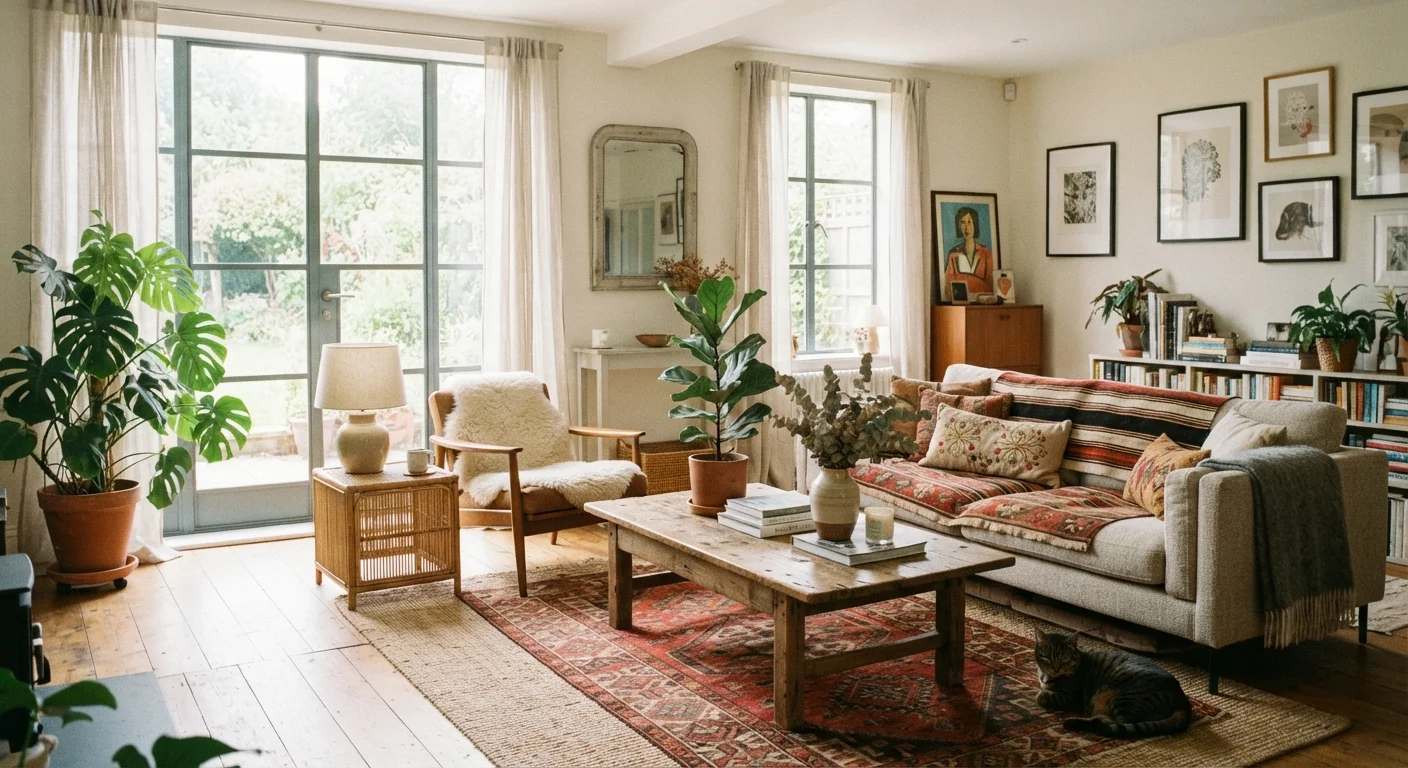
Start with a Decorating Plan
Every successful decorating project — whether you're furnishing a first apartment or refreshing a family home — begins on paper, not at a store. A plan clarifies priorities, prevents budget overruns, and keeps individual purchases from clashing with the overall vision.
Start by listing every room, ranking them by how much you use them and how urgently they need attention. Tackle high-traffic spaces first: a welcoming entryway and a functional living area do more for daily comfort than a perfectly styled guest room. Once you've set a sequence, sketch a rough floor plan for each room — even a hand-drawn rectangle with measured dimensions will do.
Set a realistic budget per room. A useful rule of thumb is to allocate a larger share to structural elements (sofa, bed, dining table) and a smaller share to accessories, since soft goods are easier to swap out later. Unfamiliar with design vocabulary? Our home décor glossary defines the terminology you'll encounter as you research ideas.
Build a Mood Board Before You Shop
Collect images of rooms you're drawn to — from magazines, design sites, or your own photos — and pin or arrange them together before buying anything. Patterns in what you consistently choose (colour family, furniture silhouette, texture) reveal your actual preferences more reliably than individual snap decisions. A mood board also helps you communicate your vision if you ever work with a painter, upholsterer, or contractor.
If your decorating plan will involve any structural changes — removing walls, moving electrical outlets, or significant plumbing shifts — consult a licensed contractor and check local permit requirements before budgeting. Those projects are separate from decorating and carry their own safety considerations. Our DIY Home Repair hub is a good companion resource for distinguishing cosmetic updates from work that needs a professional.
Choosing Colour with Confidence
Colour is the single decision with the greatest visual impact for the lowest cost. Yet it's also the most common source of decorating regret, usually because buyers focus on hue (blue, green, beige) and ignore undertone — the subtle cast that determines whether a shade reads warm or cool under your specific light.
Before committing to a colour, paint large swatches (at least 12 × 12 inches) directly on the wall and observe them at different times of day and under artificial light in the evening. North-facing rooms receive cool, indirect light and often benefit from warmer undertones; south-facing rooms can handle cooler shades without feeling cold.
90%
Of decorating regret linked to colour choices
Interior design surveys consistently show colour selection — particularly misjudging undertones in artificial light — is the most frequently cited decorating regret among homeowners.
3–4
Colours in a cohesive room palette
Design educators commonly recommend a palette of three to four colours — dominant, secondary, accent, and neutral — to achieve a coordinated look without professional help.
36 inches
Minimum clearance around a dining table
Ergonomics guidelines for residential spaces suggest 36 inches of clearance allows chairs to be pulled out comfortably and people to pass behind seated guests.
A cohesive palette typically uses three to four colours: a dominant wall colour, a secondary colour for larger furnishings, an accent for pillows and art, and a neutral anchor (often white or cream in trim and ceilings). This structure gives rooms a designed feel without requiring professional help.
Flat and matte finishes hide surface imperfections but are harder to clean — better for low-traffic bedrooms. Eggshell and satin finishes are more durable and easier to wipe down, making them practical choices for living rooms, kitchens, and hallways.
Furniture Fundamentals: Scale, Function, and Flow
The most common furniture mistake is buying pieces that are too small for a room. A sofa that floats in the middle of a large living room, or a dining table surrounded by chairs that don't fit, signals a mismatch in scale. Use your floor plan and measured dimensions to verify that key pieces fit before purchasing.
Aim to leave at least 18 inches of clearance between a sofa and a coffee table, and at least 36 inches of walking clearance around a dining table with chairs pulled out. These aren't rigid rules, but they represent comfortable real-world minimums.
Before buying a rug, tape out its dimensions on the floor with painter's tape to see exactly how it will sit in the room. This five-minute step prevents the most common (and expensive) sizing mistake.
Rugs are among the harder items to return and among the most visually impactful in any room — a wrong size undermines the entire furniture arrangement.
When hanging art, aim to position the centre of the piece at approximately 57–60 inches from the floor — roughly average eye level — rather than centring it on the wall height.
Gallery curators use this standard because it keeps artwork in the viewer's natural sightline; hanging art too high is one of the most frequently repeated decorating errors.
Anchor each seating area with a rug large enough for at least the front legs of every major piece to rest on it. A rug that's too small visually fragments the room. In a typical living room, a 8×10 or 9×12 foot rug usually works well, but always measure your specific layout first.
Prioritise durability in pieces you use daily. For a family home especially, upholstery fabrics rated for high wear cycles, solid-wood or plywood frames, and removable, washable covers are worth seeking out. Think of the sofa and bed as long-term investments; side tables and accent chairs can be updated more affordably over time.
Lighting as a Design Tool
Most rooms rely on a single overhead fixture — which is the least flattering and least flexible form of lighting available. Professional designers use three layers: ambient (general room illumination), task (focused light for reading, cooking, or working), and accent (directional light that highlights art, architecture, or texture).
Recessed ceiling lights, pendants, and flush mounts handle ambient needs. Table lamps and floor lamps deliver task and accent light while adding warmth at eye level — important because overhead light alone casts shadows that make rooms feel flat. Wall sconces are an often-overlooked way to add layered light without floor space.
“Lighting is to a room what weather is to a landscape — it changes everything, and yet it's the last thing most people think about when decorating.”
— Margaret Roper, Architectural lighting educator and author of residential design curricula
Installing dimmer switches on ambient circuits costs relatively little and transforms how a room functions across different times of day. Check that the bulbs you're using are rated as dimmable — LED bulbs, which are the most energy-efficient option, are not all compatible with dimmer switches by default.
Colour temperature matters too. Bulbs labelled 2700K–3000K emit warm white light suited to living rooms and bedrooms; 3500K–4000K is a cooler, crisper tone better suited to kitchens and home offices.
Accessories, Textiles, and the Finishing Layer
Accessories are where personal style becomes visible. Art, mirrors, plants, books, ceramics, and family objects tell the story of who lives in a space. But without intention, they create clutter rather than character.
A useful editing principle: group odd numbers of objects (three, five) in varying heights to create visual interest; keep the tallest item roughly two-thirds the height of the surface or wall space it occupies. Mirrors can be positioned to reflect a window or a light source, making rooms feel larger and brighter at no structural cost.
Textiles — cushions, throws, curtains, and rugs — introduce softness, sound absorption, and seasonal flexibility. Curtains hung close to the ceiling and extending well past the window frame (rather than just framing it) make ceilings appear higher and windows appear larger, a simple trick with outsized effect.
Indoor plants add life and colour in a way no object can replicate. Even low-maintenance varieties such as pothos, snake plants, or ZZ plants soften hard edges and improve the visual texture of a room. For those who also enjoy outdoor spaces, our Garden & Outdoors hub covers landscaping and planting ideas that extend your style beyond the front door.
Decorating for Every Life Stage
A first flat calls for versatility and affordability: multifunctional furniture (storage ottomans, sofa beds, extendable dining tables), renter-friendly solutions (removable wallpaper, adhesive hooks rated for weight, freestanding shelving), and a limited palette that can evolve without wholesale replacement.
As households grow, durability and practicality rightly take precedence. Slipcover sofas, performance fabrics, washable rugs, and robust storage systems accommodate children and pets without sacrificing style. Designate zones — a reading corner, a craft area, a play space — to maintain order in shared rooms.
Don't Decorate Over Unresolved Repairs
Fresh paint and new cushions cannot mask underlying problems — and decorating over moisture damage, peeling ceilings, or failing fixtures means those repairs become more disruptive later. Address structural and maintenance issues before investing in décor. If you're unsure what counts as a DIY-safe repair versus a job for a licensed professional, err on the side of caution, particularly for anything involving electrical wiring, gas lines, or load-bearing elements.
Empty-nester and retirement-stage decorating often involves right-sizing: simplifying, reducing maintenance burdens, and investing in comfort (better mattresses, ergonomic seating, improved lighting). This can also be the moment to address deferred repairs. Our complete first-project repair guide and basic plumbing repairs guide are useful companions for homeowners catching up on maintenance before embarking on a decorating refresh.
At every stage, the principle remains the same: buy fewer things, but choose them deliberately. A room with ten objects you love is almost always more satisfying than one with forty you're indifferent to.
Decorating Is an Ongoing Process
Even professional designers rarely finish a room in one go. Living in a space reveals how light moves through it, which surfaces attract clutter, and which furniture arrangements actually feel comfortable day-to-day. Give yourself permission to make gradual changes over months and years rather than trying to achieve a finished room all at once. This approach also spreads costs naturally and allows your taste to inform decisions rather than rushing them.
The content on this site is for informational purposes only and is not a substitute for professional advice. Always consult a qualified professional for guidance specific to your situation.