

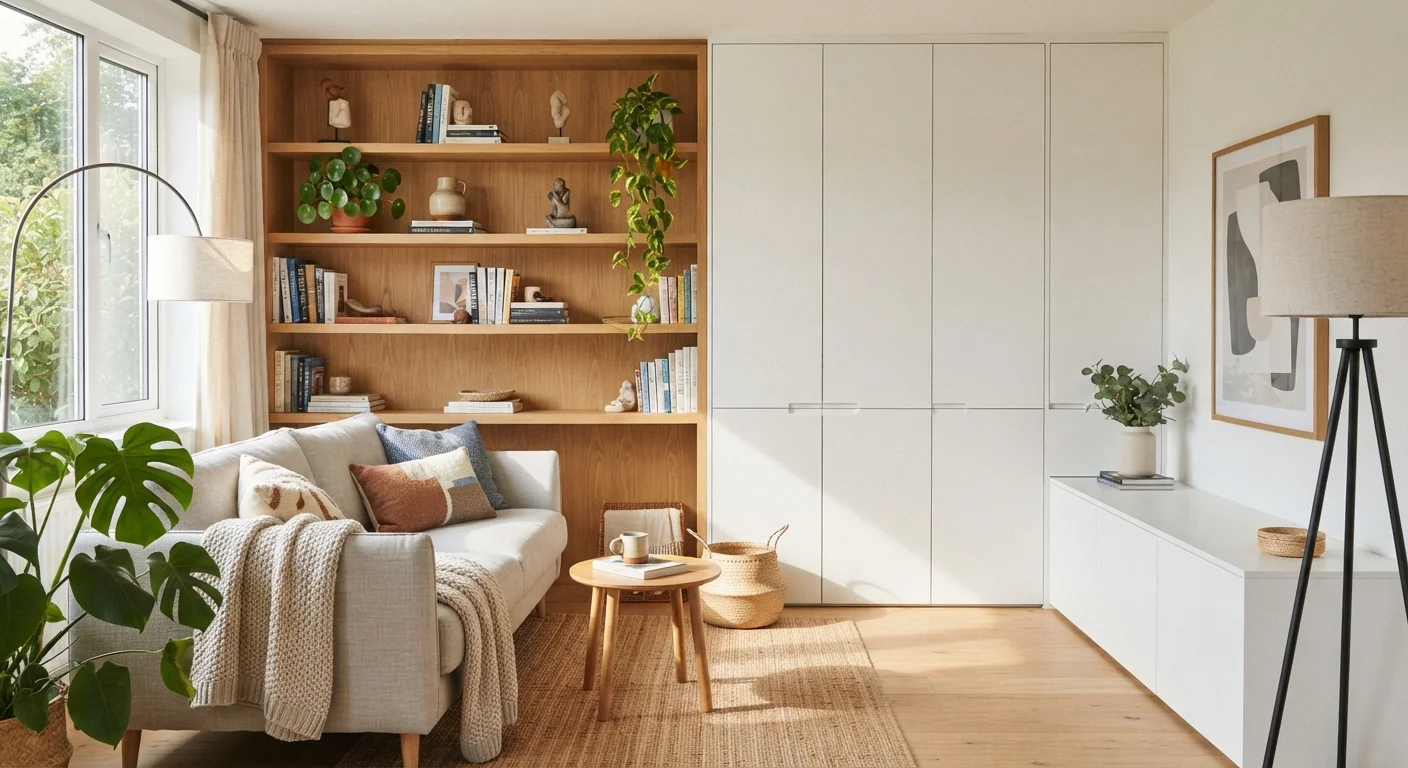
Option A
Open Shelving
The visually expressive, display-forward choice.
Best for: Homeowners who enjoy curating displays and want storage that doubles as décor.
Option B
Closed Cabinetry
The tidy, concealment-first storage solution.
Best for: Anyone who prioritises a clutter-free look and needs flexible, adaptable storage.
What Each Approach Actually Offers
Open shelving turns storage into scenery. Brackets and boards — whether floating or freestanding — put your belongings on show, so the objects themselves contribute to the room's character. Closed cabinetry, by contrast, prioritises containment: doors, drawers, and panels create a uniform surface that hides whatever sits behind it.
Neither is simply superior. The right choice depends on what you store, how you maintain your space, and the visual atmosphere you're aiming for. Many homeowners find the smartest solution is a deliberate combination of the two — which is easier to plan once you understand where each approach genuinely shines.
If you're navigating a smaller room, our guide on small-space decorating explores how storage choices interact with scale and light.
| Criterion | Open Shelving | Closed Cabinetry |
|---|---|---|
| Visual impact | Displays items as décor | Creates a clean, uniform backdrop |
| Maintenance demand | Regular dusting and tidying needed | Low — wipe door fronts only |
| Clutter tolerance | Low — everything is visible | High — mess stays hidden |
| Room size effect | Can lighten visual weight | Can feel heavier in small rooms |
| Flexibility over time | Display must be actively managed | Interior can change without visual impact |
| Installation complexity | Generally simpler and lower cost | Higher — especially for fitted units |
Style, Visual Weight, and Room Atmosphere
Open shelves reduce visual mass. A wall of floating shelves reads as lighter than the same wall fitted with solid cabinetry, which can be a meaningful advantage in compact living rooms. However, what sits on those shelves matters enormously — a chaotic arrangement can feel busier and more claustrophobic than a closed cabinet would.
Closed cabinetry offers a cleaner, more consistent backdrop. It works particularly well in rooms where the furniture or textiles carry the decorative weight, since the storage recedes rather than competes. This approach also ages well: as your style evolves, the cabinet fronts remain neutral while you change what's inside.
If you're drawn to layering different styles and periods in your living space, the principles in mixing vintage with contemporary décor apply directly to how open shelving can anchor or clash with surrounding pieces.
60%
Homeowners preferring concealed storage
A National Association of Home Builders survey found roughly 60% of buyers ranked ample, out-of-sight storage among their top priorities for living spaces.
3×
Faster dust accumulation on open surfaces
Home maintenance resources consistently note that exposed shelving accumulates dust significantly faster than enclosed cabinetry, requiring more frequent cleaning.
Practical Realities: Maintenance and Organisation
Open shelving is honest about your habits. Dust settles visibly on every surface; items shift out of alignment; an impromptu stack of mail or chargers becomes part of the display whether you intended it or not. If you enjoy regular tidying and find organisation satisfying, this transparency works in your favour — the shelves become a living, evolving arrangement.
Closed cabinetry is considerably more forgiving. A quick wipe of the door fronts is often all the maintenance a tidy-looking room requires, regardless of what's stored inside. This makes it especially practical for households with children, pets, or simply busy schedules.
Dust and allergens also accumulate on open shelves at a higher rate than on enclosed surfaces — worth considering if anyone in your household has respiratory sensitivities.
A Note on Wall Anchoring and Safety
Floating shelves and freestanding bookcases must be properly anchored to wall studs or masonry to bear weight safely — this is especially important in homes with children or pets. For heavy shelf runs or built-in cabinetry, consider consulting a carpenter or contractor to ensure the installation meets local building standards. Incorrectly anchored shelving is a genuine safety risk and not a DIY shortcut worth taking.
Combining Both for a Balanced Result
The most versatile living rooms often use open and closed storage in deliberate conversation with each other. A common approach is to run closed lower cabinetry — which keeps everyday clutter out of the sightline — with open shelves above, where curated objects, plants, and books can be displayed intentionally.
This layered strategy also lets you match storage type to content: things you want to show off live on the open shelves, while functional but visually chaotic items (remote controls, cables, board games) go behind doors. You get the warmth and personality of display storage without the maintenance demands of exposing everything.
For readers thinking about how strongly to commit to a particular decorating register — spare and minimal or rich and layered — minimalist vs. maximalist decorating offers a useful framework that applies directly to how much open storage you might want to live with.
The content on this site is for informational purposes only and is not a substitute for professional advice. Always consult a qualified professional for guidance specific to your situation.