

Our Verdict
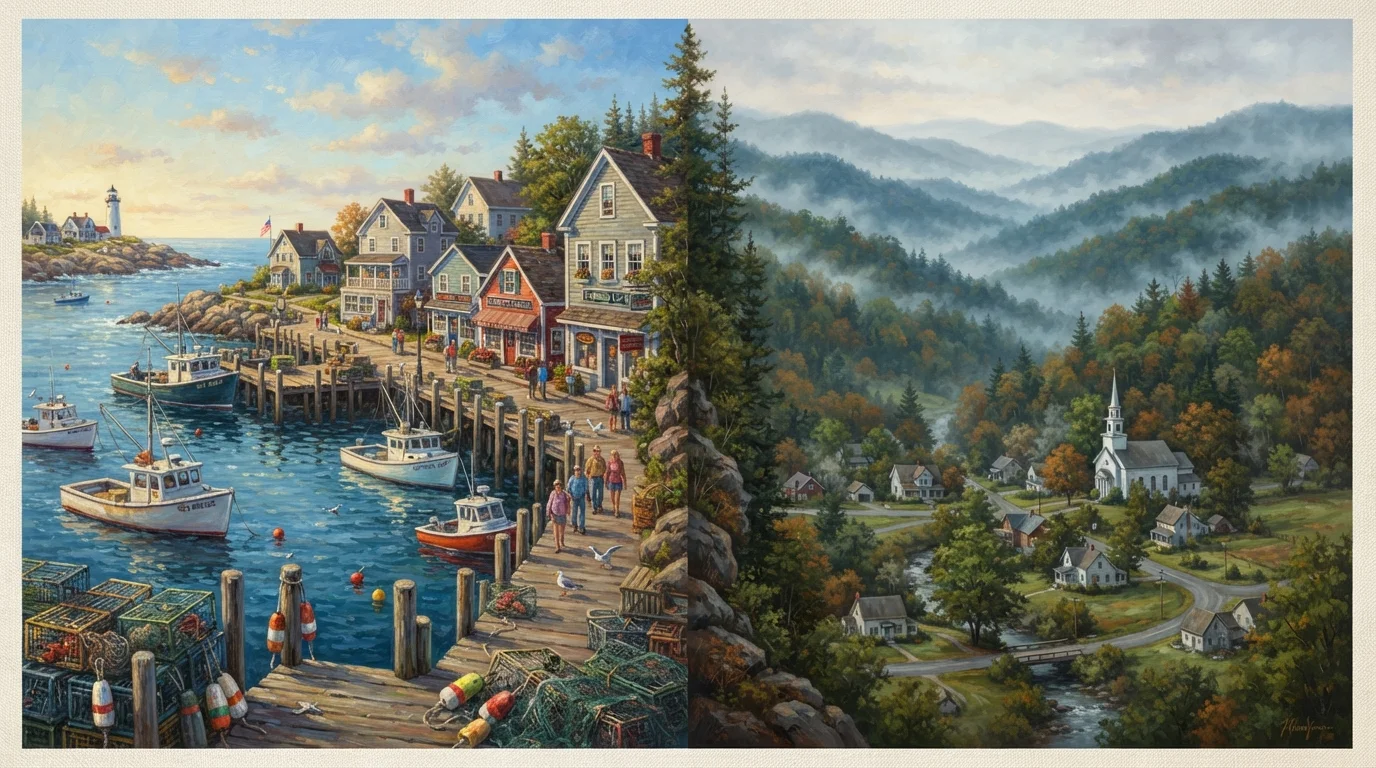
Coastal towns and mountain towns each deliver a complete, immersive travel experience — just through entirely different physical and cultural lenses. Coastal destinations suit those drawn to tidal rhythms, seafood culture, and open-horizon light, while mountain towns reward travelers who want elevation, trail access, and a quieter kind of grandeur. Neither is objectively superior; the decision turns on which landscape speaks to a traveler's instincts.
| Best for | Recommended |
|---|---|
| Travelers who want water-facing scenery and marine activity | Coastal Towns |
| Hikers, cyclists, and those seeking forested solitude | Mountain Towns |
| Families with mixed interests and flexible schedules | Coastal Towns |
| Visitors who thrive on shoulder-season quiet and cooler air | Mountain Towns |
What Geography Does to a Town's Personality
Stand in the middle of Rockport, Massachusetts, at low tide, and the whole town smells of brine and kelp. Stand in Brevard, North Carolina, at dawn, and the air carries pine resin and cool elevation mist. Geography isn't just scenery — it shapes what locals do for work, what visitors eat, how quickly life moves, and what the light looks like at 6 a.m.
American coastal towns are fundamentally organized around water access. Harbors anchor economic history; fishing schedules, ferry departures, and storm warnings still shape daily life in places like Stonington, Maine, or Apalachicola, Florida. Mountain towns, by contrast, are organized around terrain. The road into Ouray, Colorado, closes or narrows in winter. The trailhead parking in Brevard fills by 7 a.m. on summer weekends. Elevation governs.
Understanding this geography-first logic makes a traveler far more prepared — and far more curious — before the first mile is driven. For broader trip-planning context, the trip planning hub is a useful starting point.
The Coastal Town Experience: Tides, Trade Winds, and Open Horizons
Coastal towns tend to have a particular looseness to their schedule. Tides set natural punctuation marks throughout the day — the best clamming, kayaking, or tidepooling windows shift by roughly fifty minutes daily, which means even relaxed travelers end up consulting a tide chart. That's not an inconvenience; it's a different way of paying attention to place.
Culturally, coastal towns in the US span an enormous range. The working-waterfront towns of the Gulf Coast operate very differently from the arts-colony feel of Marfa-on-the-water communities in coastal Maine, or the surf-and-taco culture of Southern California's smaller beach cities. What they share is a relationship with open light and visible weather — you can watch a squall build forty miles offshore and have forty minutes to decide whether to stay on the beach.
Let the Local Market Tell You the Season
Whether you're in a coastal or mountain town, visiting a local food market on your first morning is one of the quickest ways to read the place. Coastal markets reveal what the fleet is landing; mountain markets show what's ripening at elevation. Both anchor a visitor in real local time rather than tourist-brochure time.
Seafood culture is one of the most readable expressions of coastal identity. Local food markets in harbor towns often reveal exactly what's in season and what the local fleet actually catches — a far richer window into a place than any restaurant menu.
Accessibility varies considerably by season. Many smaller coastal towns see dramatic swings in population between July and September and the quieter months. For travelers who want the scenery without the crowds, shoulder season coastal travel offers fog, migratory birds, and a more authentic pace — though some services do scale back.
The Mountain Town Experience: Altitude, Trails, and Layered Seasons
Mountain towns operate on a more vertical logic. Elevation affects everything from how quickly afternoon thunderstorms arrive to how a first-time visitor's lungs feel on the first uphill walk. Towns above 7,000 feet — common across Colorado, Wyoming, and parts of New Mexico — can trigger mild altitude adjustment symptoms in visitors arriving from sea level, so a slower first day is simply smart travel, not timidity.
The trail culture surrounding mountain towns creates a deeply participatory atmosphere. In places like Damascus, Virginia — one of the iconic stops on the Appalachian Trail — the relationship between town and trail is almost constitutional. The communities that grew up around the Appalachian Trail have developed entire economies, personalities, and seasonal calendars built around through-hiker traffic and weekend visitors seeking day hikes.
| Coastal Towns | Mountain Towns | |
|---|---|---|
| Primary natural feature | Ocean, bays, tidal zones | Peaks, ridges, forest trails |
| Daily rhythm driver | Tides and marine weather | Sunrise, trail conditions, altitude |
| Typical activities | Kayaking, beachcombing, fishing, sailing | Hiking, cycling, wildlife watching, skiing |
| Accessibility | Often reachable by train or bus | Usually requires a car |
| Peak season | Summer through early fall | Summer (hiking) and winter (skiing) |
| Key planning consideration | Tide charts, storm windows | Elevation, road closures, altitude adjustment |
| Cultural flavor | Maritime history, seafood, open light | Trail culture, outdoor community, forest quiet |
Seasonality in mountain towns is less forgiving of last-minute decisions. A road that's open in September may require chains or be closed entirely by November. Wildflower meadows peak in narrow windows. Conversely, mountain towns often offer remarkable shoulder-season value precisely because their busiest periods are more compressed than coastal towns, whose appeal extends across warm months.
For travelers who enjoy destinations that reveal themselves slowly, both coastal and mountain towns reward patience — a point explored in depth in this look at US destinations built for longer stays.
Choosing Your Rhythm: Practical Considerations
The choice between a coastal and mountain itinerary often comes down to a few honest questions: Do you want to watch a horizon or be inside one? Are you energized by water sounds or forest sounds? Does altitude excite or concern you? Neither setting requires special expertise — both welcome curious, moderately prepared travelers.
Logistics differ, though. Coastal towns tend to be easier to access by rail or bus, especially along the Northeast and Pacific corridors. Mountain towns frequently require a car and some comfort with winding roads; if that sounds daunting, driving a scenic coastal route may offer mountain-adjacent scenery with more forgiving roads.
Both settings contrast sharply with urban travel. If you're weighing either against a city-focused trip, the small-town versus major-city trade-offs are worth understanding before committing. The density and variety of a city gives way, in both coastal and mountain towns, to texture and slowness — and that shift requires a different kind of traveler mindset, not just a different packing list.
The content on this site is for informational purposes only and is not a substitute for professional advice. Always consult a qualified professional for guidance specific to your situation.