

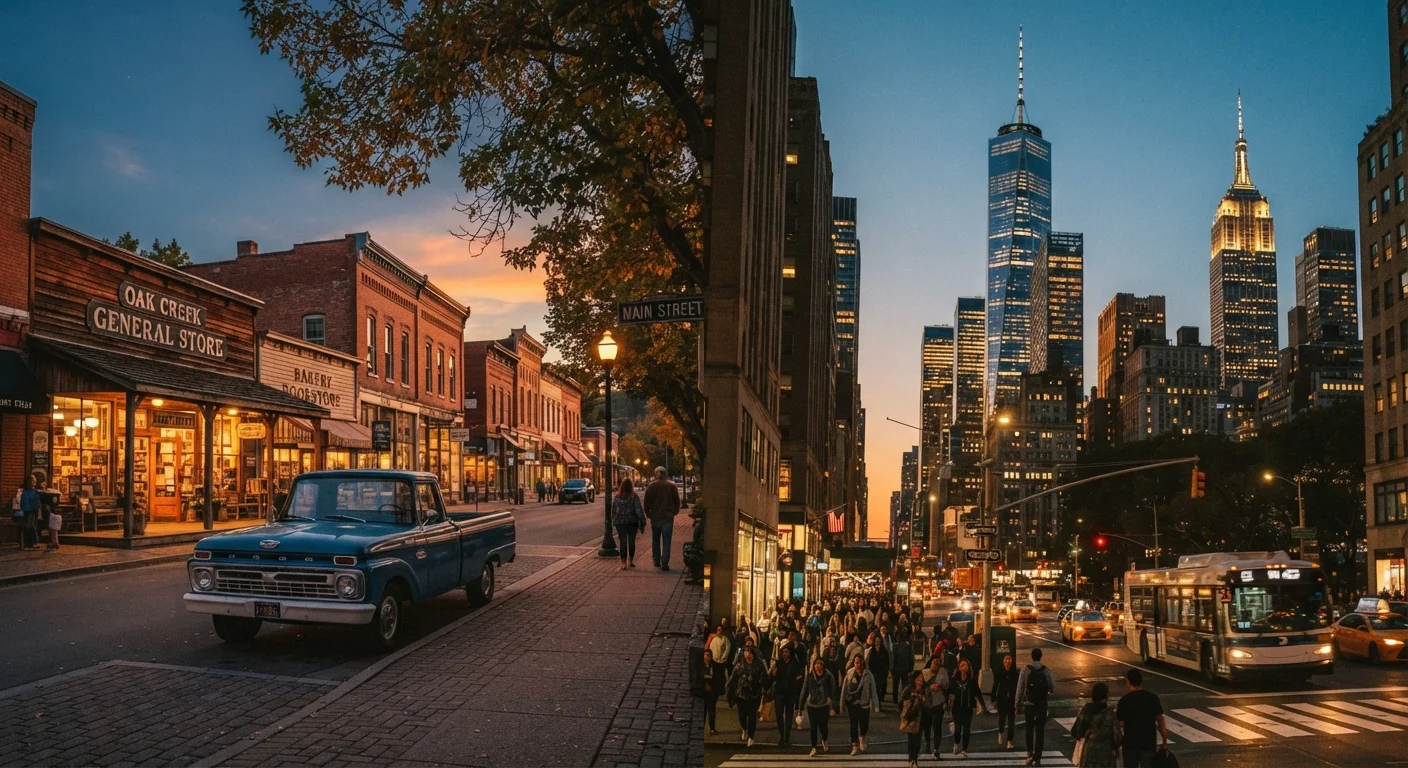
Option A
Small-Town America
The slow, textured, and genuinely local alternative.
Best for: Travelers who want unhurried immersion, authentic community character, and landscapes that don't require a reservation.
Option B
Major US Cities
The dense, dynamic, and endlessly layered choice.
Best for: Travelers who want cultural density, diverse dining, world-class museums, and reliable transit within walking distance.
What Each Travel Style Actually Offers
The choice between a small town and a major city isn't really about which is better — it's about what kind of experience you're building. These two settings operate on fundamentally different logics, and matching your expectations to that logic determines whether you leave feeling satisfied or slightly off.
Small-town travel rewards curiosity about the ordinary. When you spend time in a place like Marfa, Texas or Galena, Illinois, you're not ticking off a list — you're absorbing atmosphere. The diner with the same regulars every morning, the local bookstore with hand-written staff picks, the county fair that's been running for decades: these details accumulate into something that feels genuinely distinct from anywhere else. Some destinations reward exactly this kind of slower visit, where spending more time matters more than covering more ground.
Cities, meanwhile, are built for compression. A single neighborhood in Chicago, New Orleans, or Portland can contain more cultural and culinary variety than an entire rural county. For travelers who want to move fast and absorb broadly, cities deliver — but that density has a cost in noise, expense, and the constant sense that you could always be somewhere else.
| Criterion | Small-Town America | Major US Cities |
|---|---|---|
| Pace | Slow, unhurried, ambient | Fast, stimulating, event-driven |
| Transportation | Car typically required | Transit and walkability available |
| Accommodation cost | Generally more affordable | Higher, especially peak seasons |
| Cultural density | Specific and local in character | Broad, diverse, layered |
| Dining variety | Limited but often regional | Extensive, international options |
| Crowd levels | Low to moderate | High in popular areas |
| Solo traveler ease | Can feel insular initially | Anonymous but event-rich |
| Nature access | Often immediate proximity | Requires travel beyond city limits |
The Practical Trade-Offs Worth Knowing Before You Go
Logistics shape the experience as much as scenery does. In major cities, you can usually arrive without a car, navigate by subway or bus, and walk between neighborhoods in an afternoon. Getting oriented in an unfamiliar city takes real effort, but the infrastructure supports it once you do. Accommodation ranges from hostels to hotels to short-term rentals — usually at higher prices than rural equivalents.
Small towns require more planning precisely because they offer less infrastructure. A car is typically essential. Dining options thin out after 8 p.m. Cell service can be spotty in more remote areas. That said, the trade-off is real: accommodation is often more affordable, the pace is gentler, and the interactions — with shopkeepers, innkeepers, locals at a roadside café — tend to be warmer and less transactional.
~19,500
Incorporated small towns in the US
The US Census Bureau defines places with populations under 5,000 — of which there are roughly 19,500 — as small towns, representing the majority of American municipalities.
Top 10
US cities absorb most domestic tourism
According to the US Travel Association, a handful of major metropolitan areas consistently capture the largest share of domestic overnight leisure visits each year.
2–3x
Average urban hotel cost premium
Industry lodging data consistently shows major US city hotel rates running two to three times higher than comparable accommodations in small-town and rural markets.
Trip theme matters here too. If your travel is organized around a central theme like food, nature, or regional history, that lens will naturally pull you toward one setting or the other. History buffs may find small towns preserve more layered, undisturbed context. Food travelers may find city neighborhoods offer more range, while rural markets offer more provenance — and reading a place through its food markets works powerfully in both settings.
Finding the Right Fit — Or Combining Both
The most interesting American itineraries often resist the binary altogether. A long weekend in Nashville can pair with a half-day drive through the hill towns of middle Tennessee. A week in the Pacific Northwest might split between Portland's neighborhoods and the slower tempo of a coastal fishing community. Coastal and mountain small towns each carry their own distinct rhythm, and knowing that geography further sharpens your planning.
Solo travelers should think carefully about this choice too. Solo travel across the US carries genuine advantages and real friction in both settings — but the nature of that friction differs. Cities are anonymous and event-rich; small towns are intimate but can feel harder to break into as a stranger.
Whichever direction you lean, the goal is alignment: between what the place actually offers and what you're genuinely seeking. A city trip where you wish for quiet is exhausting. A small-town trip where you need stimulation feels dull. Honest self-assessment — about tempo, logistics, and what you actually want from a trip — is the real planning tool here.
A Note on 'Hidden Gems' and Expectations
Not every small town is an undiscovered paradise, and not every city neighborhood is worth your time. Learning to evaluate a destination before you arrive — rather than relying on viral recommendations — saves real disappointment. Understanding the difference between a tourist trap and a genuine find applies whether you're browsing a city itinerary or a rural road-trip forum.
The content on this site is for informational purposes only and is not a substitute for professional advice. Always consult a qualified professional for guidance specific to your situation.