

How Right-of-Way Logic Works
Right-of-way rules exist for one reason: to prevent two vehicles from occupying the same space at the same time. They don't grant permission — they assign responsibility. When you have the right of way, other road users are expected to yield to you, but that never removes your own duty to drive safely and respond to what's actually happening around you.
In the US, right-of-way rules are set by individual states, but the underlying logic is consistent. Priority flows from the type of junction, the road markings present, the direction of travel, and — when everything else is equal — from established conventions such as yielding to the right. Knowing which rule applies in which situation is the foundation of confident, predictable driving.
For a deeper look at how conditions change these calculations, see how wet and low-visibility conditions affect right-of-way decisions.
Roundabouts: Who Goes First?
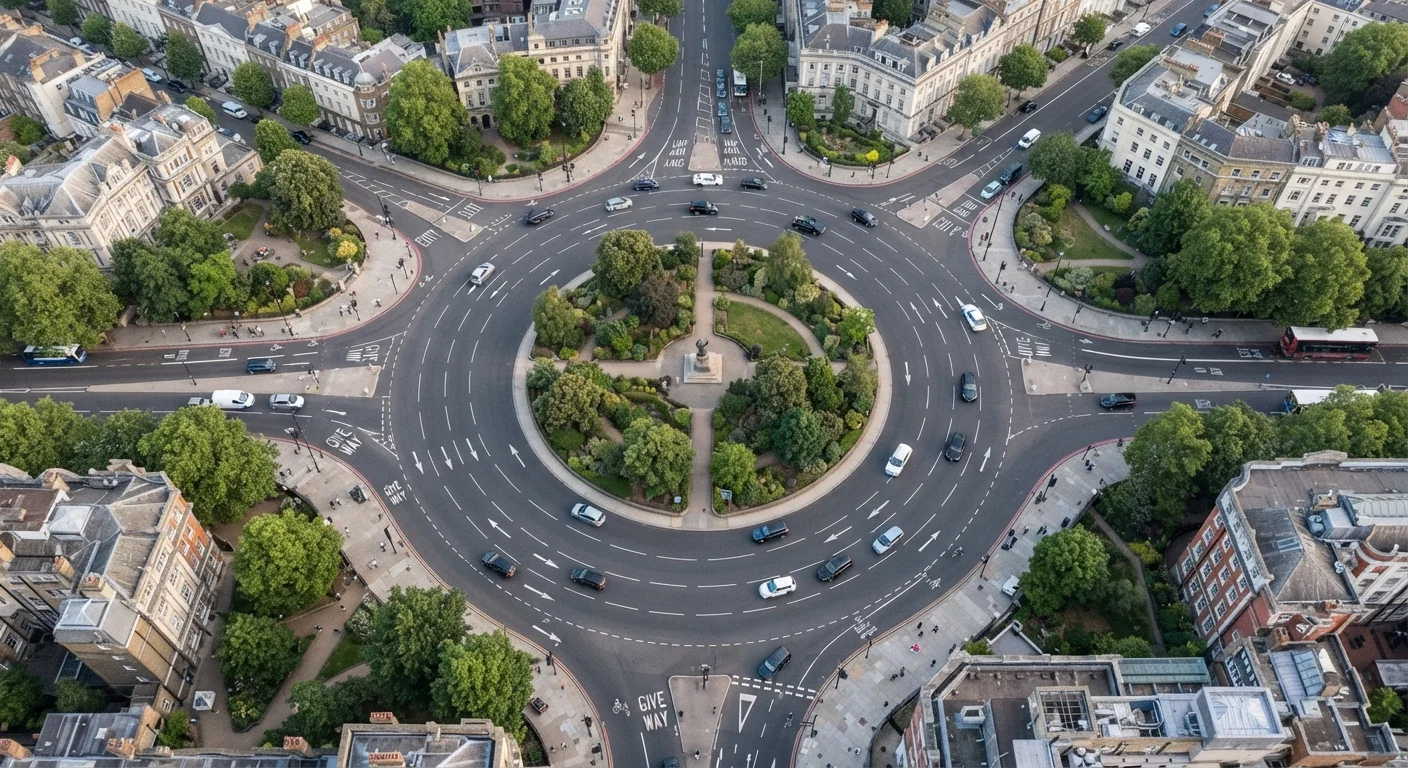
Modern US roundabouts follow a single, consistent rule: yield to traffic already in the circle. Vehicles approaching on the entry road must wait for a safe gap before entering. There is no traffic light to manage priority — the roundabout itself is the control device.
Key Points for Roundabout Entry
- Yield at the dashed line, not at the centre island. You must stop if traffic is circulating, even if the approach looks clear.
- Do not stop inside the roundabout unless there is an obstacle ahead. Stopping mid-circle blocks other users and can cause rear-end collisions.
- Multi-lane roundabouts: Choose your lane before you enter. Right lane is typically for exits within the first half of the circle; left lane for exits in the second half or for continuing around. Lane markings and signs will specify where required.
- Pedestrians and cyclists crossing entry and exit roads have priority in many states — check the markings and local rules.
Roundabouts are statistically safer than traditional signalized intersections because they eliminate high-speed perpendicular (T-bone) conflicts. The Insurance Institute for Highway Safety (IIHS) has documented significant injury-crash reductions at converted sites.
Right of Way
The legal right to proceed through a junction or road section before another road user. It is assigned by signs, signals, or traffic law — not seized by speed or size.
Yield
To slow or stop and allow another road user to proceed first. Yielding does not mean stopping completely — it means giving priority.
Roundabout
A circular junction where traffic flows counterclockwise around a central island. Entering vehicles must yield to vehicles already circulating within the ring.
All-Way Stop
An intersection where every approach has a stop sign. Priority is determined by arrival order, or by yielding to the right when vehicles arrive simultaneously.
Unmarked Crossroad
An intersection with no signs, signals, or road markings. Drivers must treat it as a mutual yield situation, proceeding with caution.
T-Junction
A junction where one road ends by meeting another at a right angle. Drivers on the ending (minor) road must yield to all traffic on the through road.
Give-Way Signs, Stop Signs, and Unmarked Crossroads
Beyond roundabouts, three junction types generate the most confusion.
Give-Way (Yield) Signs
A triangular yield sign requires you to slow and be prepared to stop, giving priority to cross traffic or merging traffic on the main road. You may proceed without stopping if the road is clear, but you must not force other drivers to brake or swerve for you.
Stop Signs
A stop sign requires a full stop at the marked line — or, if no line is present, before the junction. At a four-way stop (all-way stop), the driver who arrived first goes first. When two vehicles arrive simultaneously, yield to the driver on your right. When facing each other going straight, both may proceed; when one is turning left, the turning driver yields.
Unmarked Crossroads
At an intersection with no signs or signals, treat it as a four-way yield situation. Yield to any vehicle already in the intersection and — when entering at the same time — yield to the vehicle on your right. Approach slowly enough that you can stop safely if another driver misreads the situation.
Unmarked junctions appear frequently on rural roads, where traffic is light but speeds can be high — a combination that demands extra caution.
Special Cases Worth Knowing
Several scenarios fall outside the standard categories and trip up even experienced drivers.
T-Junctions
The driver on the minor road (the stem of the T) always yields to traffic on the through road, regardless of direction. This applies even when there are no markings — the minor road relationship is structural.
Merging onto a Highway
Contrary to a common misconception, vehicles merging from an on-ramp do not automatically have right-of-way. You must match speed and find a gap. Drivers already on the highway are not legally required to move over, though many will do so as a courtesy. Motorway driving for new licence holders covers merging techniques in detail.
Emergency Vehicles
Any vehicle with active lights and sirens has priority. Pull as far right as safely possible and stop until the vehicle has passed. This applies at intersections too — do not proceed through a green light if an emergency vehicle is approaching.
Pedestrians and Crosswalks
Pedestrians in a marked or unmarked crosswalk have the right of way in most states. When turning at an intersection, you must yield to any pedestrian crossing the road you are turning onto, even on a green light. City driving adds layers to this — urban driving hazards covers the full picture.
This article provides general driving education for informational purposes. Always consult your state's official driver handbook and applicable traffic laws for guidance specific to your location.
The content on this site is for informational purposes only and is not a substitute for professional advice. Always consult a qualified professional for guidance specific to your situation.