

Our Verdict
Each budgeting method has genuine strengths, and none is universally superior. The right choice depends on your income pattern, spending habits, and how much time you're willing to invest in money management. Many people land on a hybrid approach after experimenting with one or two structured methods first.
| Best for | Recommended |
|---|---|
| Those who overspend in specific categories like dining or shopping | Envelope Method |
| Detail-oriented planners who want every dollar accounted for | Zero-Based Budgeting |
| Those who want to prioritize saving with minimal ongoing effort | Pay Yourself First |
| Beginners or those who prefer a broad, flexible framework | 50/30/20 Rule |
Why the Method Matters as Much as the Budget Itself
Plenty of people know they should budget — but never get traction because they pick a system that conflicts with their personality or lifestyle. A rigid, line-item plan can feel suffocating to someone with irregular income, while a loose percentage framework may leave a chronic overspender with no real guardrails. Understanding the structural differences between methods helps you choose one you'll actually maintain.
If you've never made a budget before, see our practical starting guide for beginners before diving into method comparisons. For a broader end-to-end framework, the personal budgeting ground-up guide covers the full lifecycle of a budget.
| Envelope Method | Zero-Based Budgeting | Pay Yourself First | 50/30/20 Rule | |
|---|---|---|---|---|
| Core principle | Cash limits per category | Every dollar assigned a job | Save first, spend the rest | Fixed percentage splits |
| Time commitment | Low–Medium | High | Low | Low |
| Detail level | High (per category) | Very high (every dollar) | Low (savings only) | Low (three buckets) |
| Best income type | Regular/salaried | Regular/salaried | Any income type | Regular/salaried |
| Savings discipline | Moderate | High | Very high | Moderate |
| Flexibility | Low | Low | High | High |
| Works digitally | With adaptation | Yes | Yes | Yes |
The Envelope Method: Physical Spending Limits
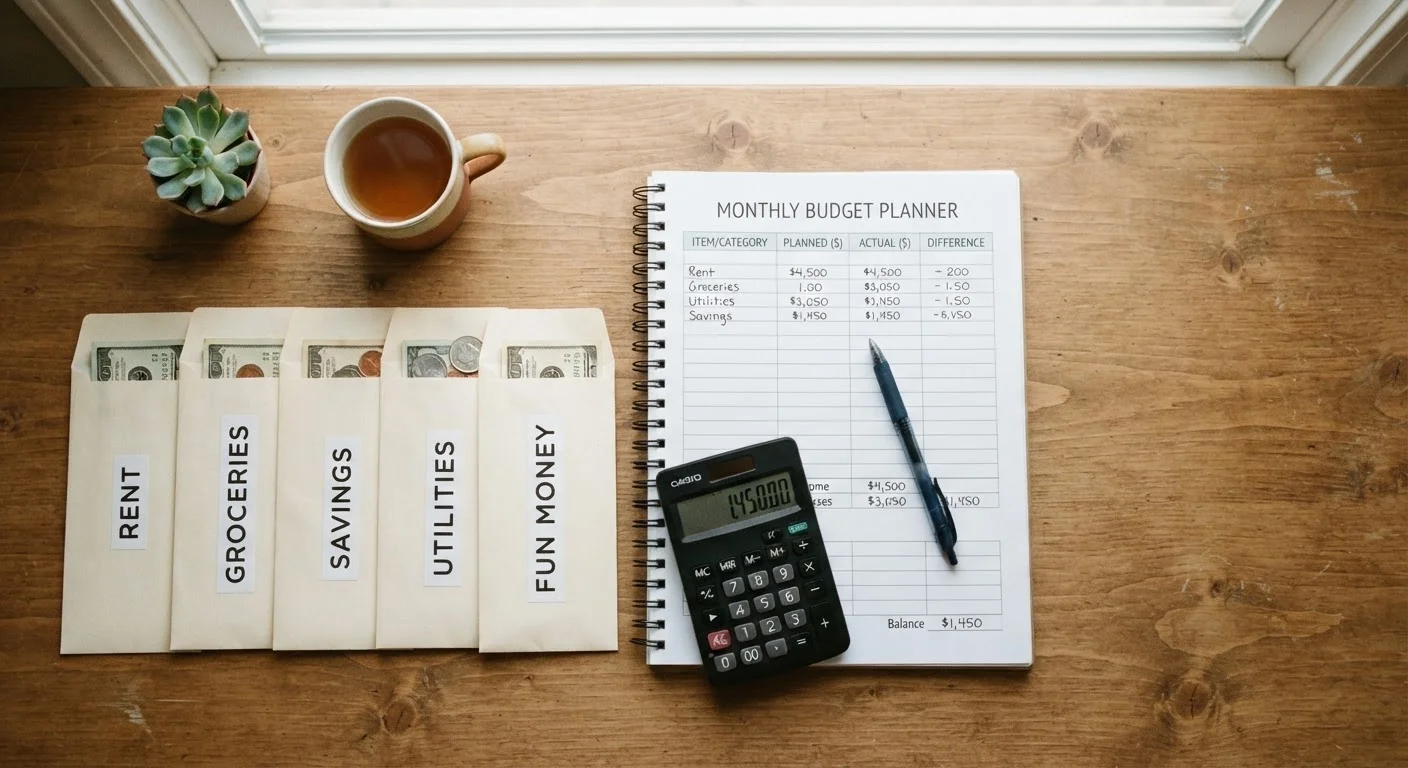
The envelope method assigns cash to labeled envelopes — one per spending category — at the start of each pay period. When an envelope is empty, spending in that category stops until the next refill. Its power lies in tangibility: handing over physical cash creates a psychological friction that swiping a card does not.
Research into payment psychology suggests cash spending can feel more «real» than card payments, which may help some people moderate discretionary spending. Curious about that dynamic? Our article on cash vs. card spending research explores what the evidence actually shows.
Adapting Envelopes for the Digital Age
Many banks and budgeting apps allow you to create named sub-accounts or spending «pots» that replicate the envelope concept without cash. Allocate funds to each pot at the start of the month and treat the balance as your hard limit — the behavioral effect is similar to physical envelopes while remaining practical for card and online transactions.
Limitation: The envelope method becomes awkward for online bills, subscriptions, and any purchase where cash isn't practical. Many people adapt it digitally — using separate sub-accounts or budgeting app «envelopes» to replicate the same boundary-setting logic without physical bills.
Zero-Based Budgeting: Every Dollar Gets a Job
Zero-based budgeting (ZBB) means your income minus your planned expenses equals zero at the start of each month. Every dollar is assigned a purpose — housing, groceries, debt repayment, savings, entertainment — before the month begins. Nothing is left floating.
This method offers the tightest control of any approach. It forces you to confront trade-offs explicitly: if you want to spend more in one category, you must reduce another. For someone paying down debt aggressively or saving for a specific goal, that granular awareness can be powerful. For a direct comparison of ZBB against another popular framework, see Zero-Based Budgeting vs. the 50/30/20 Rule.
Limitation: ZBB requires rebuilding the budget from scratch each month, which takes real time. It can be especially frustrating for people with variable income, since the entire allocation must shift when earnings fluctuate.
Pay Yourself First: Savings as a Non-Negotiable
Pay Yourself First (PYF) flips the traditional budgeting sequence. Instead of saving whatever is left after expenses, you move a predetermined amount to savings or investments immediately when income arrives — then live on the remainder. The approach automates the hardest part of saving: the decision itself.
PYF works especially well when paired with automatic transfers timed to your paycheck date. It doesn't require detailed category tracking, making it low-maintenance. The trade-off is that it provides no visibility into where the remaining spending money goes, which can allow overspending in day-to-day categories to go unnoticed.
Don't Underestimate Your Baseline Expenses First
Before committing to Pay Yourself First, calculate your fixed monthly obligations — rent, utilities, insurance, minimum debt payments — to make sure your savings transfer leaves enough to cover essentials. Setting the savings amount too high can lead to overdrafts or reliance on credit to fill spending gaps, which offsets the saving benefit entirely.
PYF pairs naturally with savings-focused goals and is a solid method for households managing joint finances. See our guide on budgeting approaches for couples for how different methods adapt to shared-income situations.
The 50/30/20 Rule and Hybrid Approaches
The 50/30/20 rule allocates after-tax income into three broad buckets: 50% to needs (rent, utilities, groceries), 30% to wants (dining, entertainment, hobbies), and 20% to savings and debt repayment. Its simplicity is its main appeal — no category-level tracking required, just a periodic check that spending roughly aligns with the percentages.
The percentages are guidelines, not rigid rules. High cost-of-living areas may make a 50% needs allocation unrealistic; someone with significant debt may choose to expand the 20% bucket at the expense of wants. The framework is most useful as a diagnostic tool — a quick way to spot whether your spending is broadly in balance.
Hybrid approaches are common and often sustainable. A typical example: use PYF to automate savings transfers, apply ZBB discipline to three or four high-risk overspending categories, and let the 50/30/20 percentages serve as a monthly sanity check. Once you've settled on a structure, the challenge shifts to consistency — our guide on building a budget you'll actually stick to addresses exactly that. You'll also find practical daily habits in the Everyday Money Tips hub.
This article is for general informational and educational purposes only and does not constitute personalized financial advice. Consult a qualified financial professional for guidance specific to your circumstances.
The content on this site is for informational purposes only and is not a substitute for professional advice. Always consult a qualified professional for guidance specific to your situation.