

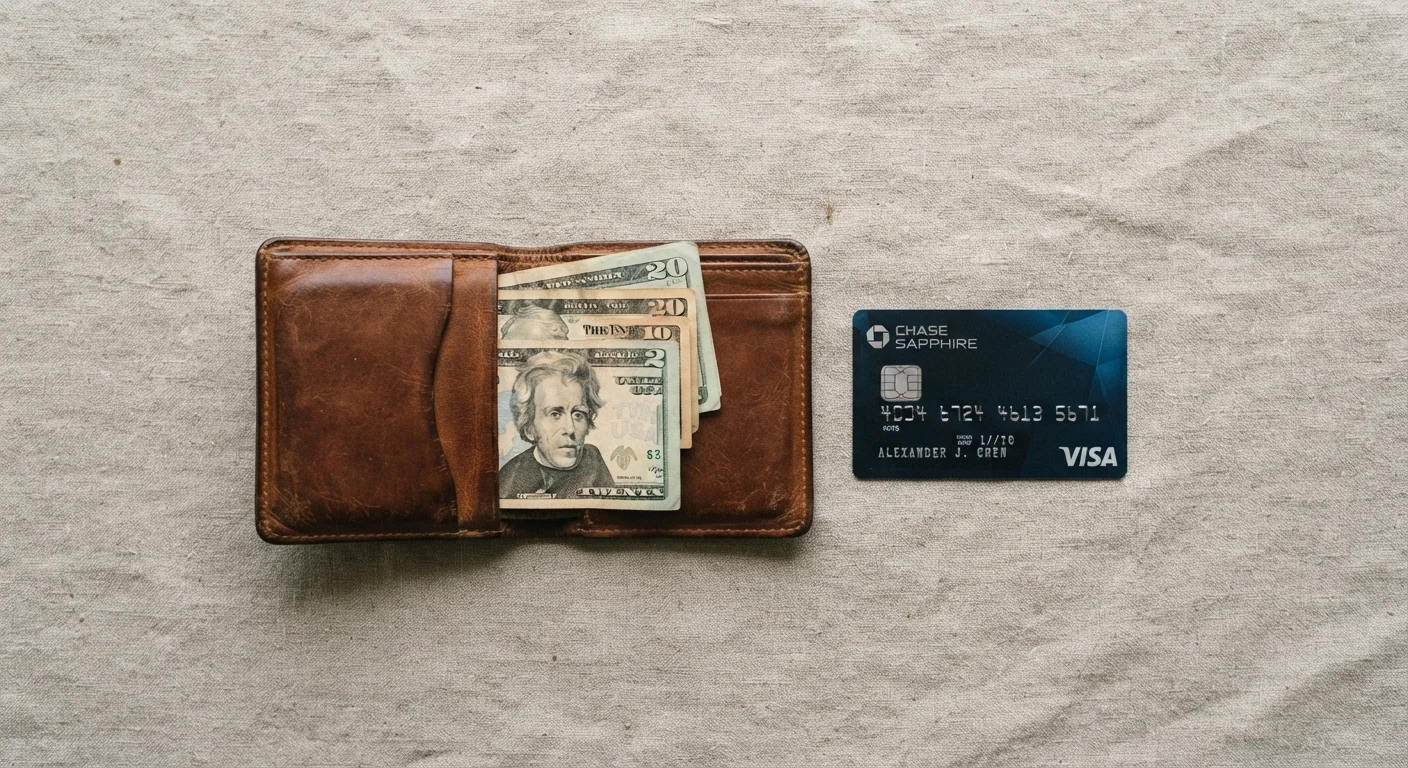
Option A
Cash
The tactile, friction-based spending method.
Best for: Shoppers who want a physical spending limit and benefit from the psychological 'pain of paying' to curb impulse purchases.
Option B
Card (Debit or Credit)
The convenient, trackable digital payment method.
Best for: Organized spenders who actively monitor statements, want purchase protections, and need the flexibility of digital transactions.
What Behavioural Research Actually Says
The idea that cash makes you spend more carefully isn't folk wisdom — it has measurable support in behavioural economics. Researchers Drazen Prelec and Duncan Simester introduced the concept of the 'pain of paying': the psychological discomfort triggered when parting with money. Their work showed that this discomfort is significantly higher when paying with physical currency than with a card, because cash makes the loss tangible and immediate.
Follow-up studies have reinforced this finding. A widely cited study published in the Journal of Consumer Research found that card users are more likely to add unhealthy or indulgent items to shopping baskets compared to cash payers — suggesting that the reduced friction of card payment loosens spending constraints in subtle ways. Card transactions feel more abstract, which can make large amounts feel less significant in the moment.
Research Shows Tendencies, Not Guarantees
Behavioural studies on payment methods capture average patterns across groups — they describe tendencies, not certainties for any individual. Someone who reviews their card app daily and sets spending alerts may experience little or no overspending effect. Context, category of purchase, and individual financial habits all moderate the research findings. Use the evidence as a diagnostic starting point, not a verdict.
This doesn't mean cards are inherently harmful. The research identifies a tendency, not a certainty. Individuals who actively track their spending can often neutralize the overspending bias associated with cards by maintaining close awareness of their balances.
Head-to-Head: Cash vs. Card Across Key Criteria
Choosing between cash and card involves more than spending psychology. Security, convenience, and record-keeping all factor in. Here's how the two methods compare across dimensions that matter for everyday financial health.
| Criterion | Cash | Card (Debit or Credit) |
|---|---|---|
| Spending friction | High — physical handover feels like loss | Low — tap or swipe feels abstract |
| Fraud protection | None — lost cash is gone permanently | Strong — zero-liability policies are standard |
| Spending records | Manual — requires receipts or note-keeping | Automatic — categorized digital statements |
| Impulse spending risk | Lower — finite bills enforce a hard stop | Higher if not actively monitored |
| Acceptance and convenience | Limited — not usable online or at some retailers | Universal — accepted in-person and online |
| Rewards and benefits | None | Potential cashback, points, or travel miles |
| Budget enforcement | Mechanical — spending stops when cash runs out | Requires self-discipline or app-based limits |
As the table shows, neither option dominates across all dimensions. Cash wins on behavioural spending control; card wins on security, tracking, and flexibility. Understanding your own habits is the deciding factor — see the budgeting methods guide for frameworks that match different personality types.
Why Cards Don't Have to Mean Overspending
The behavioural risk of cards is real, but it's not inevitable. The overspending effect is strongest when a cardholder pays little attention to their running balance and reviews statements only at month's end — by which point the damage is done. Active card users who check their app weekly or set transaction alerts operate very differently.
~83%
US transactions using non-cash payment
According to the Federal Reserve's Diary of Consumer Payment Choice, the large majority of US transaction volume by value now flows through cards and digital methods rather than cash.
12–18%
Estimated spending increase with card vs. cash
Multiple consumer behaviour studies, including research summarized in MIT Sloan Management Review, have estimated that card users tend to spend meaningfully more than cash users in comparable purchase scenarios.
Cards also offer structural advantages that cash cannot replicate: purchase protection, zero liability on fraudulent charges, and an automatic categorized record of every transaction. For anyone building a personal cash flow statement, a card statement is far easier to analyze than reconstructed cash receipts.
The practical risk with cards is the same as with any financial tool: it amplifies existing habits, good or bad. If impulse spending triggers are already a challenge, a card removes friction at exactly the wrong moment.
A Practical Hybrid Approach
For most people, the evidence doesn't support going all-cash or all-card — it supports being deliberate about which method suits which spending category. A straightforward approach used by many budgeters: use cash for discretionary, variable categories (dining out, entertainment, personal spending) and cards for fixed, predictable bills (utilities, subscriptions, groceries where you have a firm list).
This mirrors the logic behind envelope budgeting — a method covered in the budgeting methods comparison — while preserving card benefits for categories where overspending is less likely. The friction of cash keeps discretionary categories in check; the tracking capability of cards keeps recurring costs visible and documented.
Whatever method you use, the underlying discipline matters more than the payment format. Daily money habits — checking balances, reviewing transactions, aligning spending with stated priorities — are what produce long-term financial progress. The payment method is a tool in service of those habits, not a substitute for them.
If you're evaluating whether your current approach is quietly working against your savings goals, the habits that undermine savings article is a useful next read.
This article provides general financial information for educational purposes only. It is not personalised financial advice. Consult a qualified financial professional for guidance specific to your circumstances.
The content on this site is for informational purposes only and is not a substitute for professional advice. Always consult a qualified professional for guidance specific to your situation.