

Start here
What Is a Personal Cash Flow Statement?
Next
The Two Sides: Income and Outflows
Then
How to Build Your Own in Four Steps
When you're ready
Reading the Numbers: What Your Net Cash Flow Tells You
Apply it
Putting the Statement to Work
What Is a Personal Cash Flow Statement?
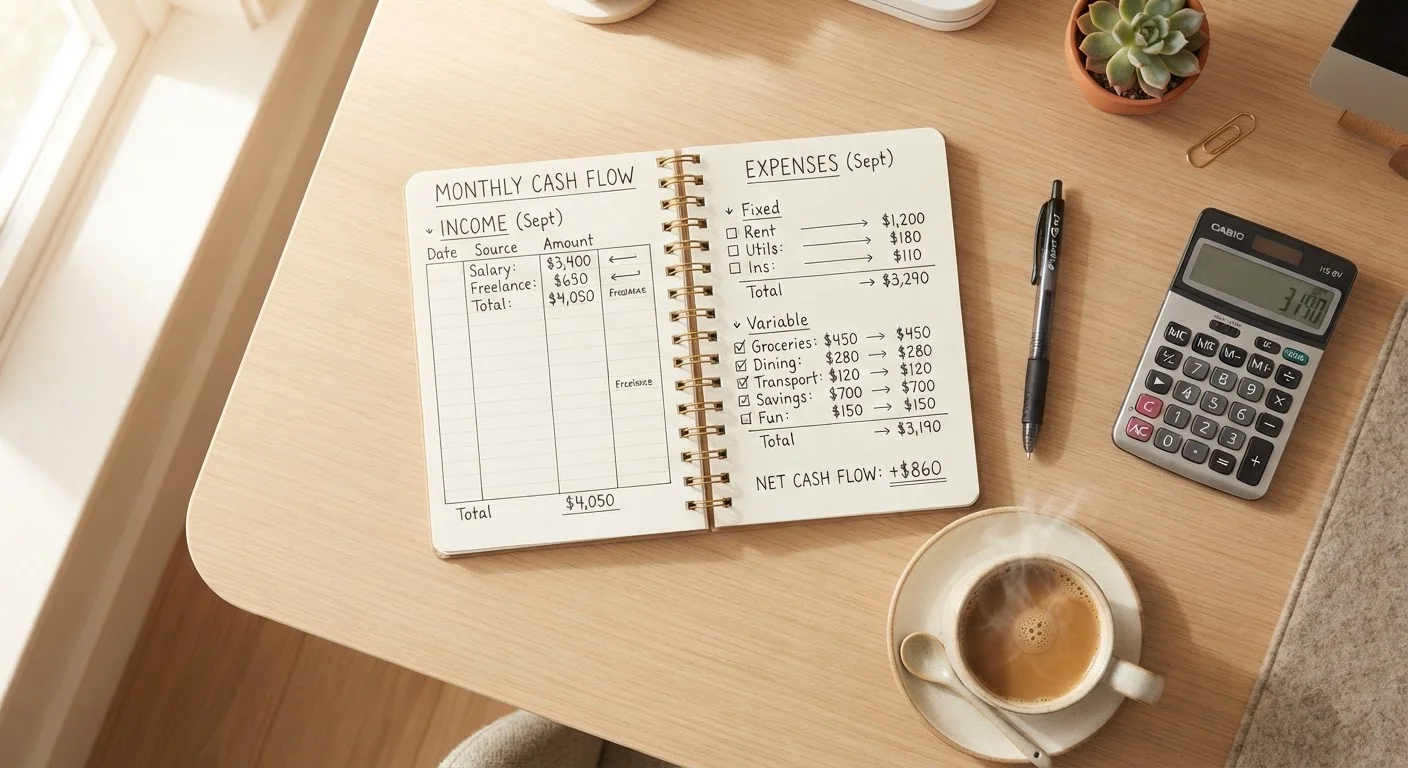
A personal cash flow statement is a simple financial document that records all money flowing into and out of your life over a specific period — typically one month. It answers one direct question: did more money arrive than leave?
Unlike a net worth statement (which is a snapshot of assets and debts at a single moment), a cash flow statement is about movement. It shows patterns, habits, and gaps that a bank balance alone cannot reveal. For anyone building financial awareness from scratch, it's often the most immediately useful tool available. It's also a foundational concept covered in end-to-end personal budgeting guides.
Cash flow
The movement of money into and out of your finances over a given period. Positive cash flow means more came in than went out.
Net cash flow
Total income minus total outflows for the period. This single number summarizes whether your finances are growing, breaking even, or shrinking.
Fixed expense
A recurring cost that stays the same amount each month, such as rent, a car payment, or a fixed insurance premium.
Variable expense
A cost that changes from month to month based on your choices or circumstances, such as groceries, gas, or dining out.
Net income
The amount of money you actually receive after taxes and other deductions are taken out — the figure that lands in your bank account.
Discretionary spending
Money spent on non-essential wants rather than needs — entertainment, eating out, hobbies, and similar categories.
The Two Sides: Income and Outflows
Every cash flow statement has two columns: money in (income) and money out (outflows).
Income
List every source of money that entered your accounts during the period. Use net amounts — the actual dollars deposited after taxes and deductions — not gross salary figures. Common sources include:
- Take-home pay from employment
- Freelance or self-employment income received
- Rental income collected
- Interest, dividends, or investment distributions received
- Government benefits (Social Security, disability, etc.)
Outflows
Outflows split into two categories that behave very differently:
- Fixed expenses
- Amounts that stay the same each month — rent or mortgage, car loan payments, insurance premiums, and subscription services with a set fee.
- Variable expenses
- Amounts that shift month to month — groceries, dining out, gas, clothing, and entertainment. These are usually where the biggest surprises live.
Separating these two categories matters because they require different strategies when your cash flow is tight. Fixed expenses often take negotiation or a lifestyle change to reduce; variable expenses can be trimmed more quickly.
Start With Your Bank Statement
Your bank and credit card statements are the most accurate record of actual spending — far more reliable than memory. Download or print the previous month's statements before you start categorizing. If most spending flows through one or two accounts, you can complete a basic cash flow statement in under an hour.
How to Build Your Own in Four Steps
You don't need specialized software. A notebook, a spreadsheet, or a basic budgeting app all work.
- Choose your period. Start with the most recent complete calendar month. Consistency matters more than perfection — pick one month and work it fully.
- List all income. Pull your pay stubs, bank deposit records, or payment platform statements. Add every net dollar received during that month.
- List all outflows. Go through your bank statement and credit card statements line by line. Categorize each transaction as fixed or variable. Don't skip small recurring charges — streaming services, cloud storage fees, and app subscriptions add up quickly.
- Calculate net cash flow. Subtract total outflows from total income. The result is your net cash flow for the period.
For a structured review process once you've built your first statement, see the monthly budget review checklist.
Reading the Numbers: What Your Net Cash Flow Tells You
Your net cash flow lands in one of three zones:
| Result | What it means | Immediate priority |
|---|---|---|
| Positive | Income exceeds spending | Direct the surplus intentionally — savings, debt paydown, or investments |
| Zero | Every dollar is spoken for | Build a small buffer; zero margin leaves no room for irregular expenses |
| Negative | Spending exceeds income | Identify the gap source immediately — is it a one-time event or a recurring pattern? |
A single month's statement is a data point. Three or more months in a row reveal a trend. The monthly budget audit checklist is a useful companion for spotting leaks across multiple months.
Don't Ignore Irregular Income or Expenses
If you received a one-time payment (a tax refund, a freelance project, a gift) during your chosen month, note it separately rather than folding it into recurring income. Similarly, flag one-time large expenses like a car repair. Mixing irregular items into your baseline distorts the picture and can give a falsely optimistic or pessimistic result.
Putting the Statement to Work
A cash flow statement is only useful if it informs a decision. Here are three direct applications:
- Identify your largest variable expense category. If dining out or subscriptions account for a disproportionate share of outflows, you've found your highest-leverage adjustment point.
- Set a savings target grounded in reality. Rather than saving what's left over at month's end (which is often nothing), use your positive net cash flow figure to set a specific, automatic transfer amount.
- Spot irregular expenses before they blindside you. Annual fees, car registration, and holiday spending all appear as spikes in a multi-month cash flow view. Seeing them in advance lets you smooth them into a monthly savings plan.
Understanding the cash flow statement is one piece of the broader picture. For plain-language definitions of terms like net income, liquidity, and discretionary spending, the personal finance glossary is a helpful reference. And if you want to explore how payment method affects your daily spending habits, research on cash versus card spending offers useful context.
This article is for general informational and educational purposes only and does not constitute personalized financial advice. For guidance specific to your situation, consider consulting a qualified financial professional.
Frequently Asked Questions
A budget is a plan for future spending; a cash flow statement records what actually happened. Think of a budget as your intention and the cash flow statement as the receipt. Using both together gives you the clearest financial picture.
Monthly is the most practical cadence for most people. It aligns with pay cycles, bill due dates, and credit card statements, making it easier to gather accurate data without too much lag.
Include all money that actually enters your accounts: wages, freelance payments, rental income, government benefits, and interest or dividends received. Use net (after-tax) figures so comparisons to real spending are apples-to-apples.
No — they answer different questions. A cash flow statement shows money movement over a period; a net worth statement is a snapshot of assets minus liabilities at one point in time. Together they give a more complete financial picture.
Yes. Many budgeting apps generate a cash flow view automatically by syncing to your accounts. The important thing is understanding what the numbers mean, not which tool you use to produce them.
First, verify that all income sources are captured — a missing paycheck or irregular income can distort the picture. If the deficit is real, prioritize reducing variable expenses before targeting fixed costs, since variable items usually offer more immediate flexibility.
The content on this site is for informational purposes only and is not a substitute for professional advice. Always consult a qualified professional for guidance specific to your situation.