

Start here
What a Budget Actually Is (and Isn't)
Build the base
Step 1: Know Your Take-Home Income
Map your spending
Step 2: List Every Expense
Choose a structure
Step 3: Apply a Simple Framework
Make it a habit
Step 4: Track, Review, Adjust
Set realistic expectations
What to Expect in Your First Month
What a Budget Actually Is (and Isn't)
A budget is a written plan that tells your money where to go before the month begins. That's it. It is not a punishment, a sign of financial struggle, or a promise to stop enjoying life. If you've held off on budgeting because it sounds restrictive or complicated, you're not alone — common budgeting myths keep a lot of people from ever starting.
Think of a budget the way you'd think of a travel itinerary. You can deviate from it, adjust it mid-trip, and still arrive somewhere useful. What it gives you is a starting point and a sense of direction — both of which are more valuable than a perfect plan you never act on.
Net income
The amount of money you actually receive after taxes and deductions are taken out — what hits your bank account.
Fixed expense
A recurring cost that stays the same each month, such as rent or a car loan payment.
Variable expense
A cost that changes from month to month, like groceries, gas, or entertainment spending.
Irregular expense
A predictable cost that doesn't occur every month — like an annual insurance premium or holiday gifts — but should still be planned for.
50/30/20 rule
A budgeting guideline that divides take-home pay into three categories: 50% for needs, 30% for wants, and 20% for savings and debt repayment.
Discretionary spending
Money spent on non-essential items or experiences — things you choose to buy rather than must buy.
Step 1: Know Your Take-Home Income
Your budget begins with one number: what actually lands in your bank account each month after taxes and deductions. This is called your net income — not your salary, not your hourly rate times hours, but the actual deposit amount.
If you receive a regular paycheck, check your pay stub. If your income varies — freelance work, tips, seasonal jobs — use a conservative estimate based on your lowest recent months. Overestimating income is one of the most common first-budget errors, and a conservative baseline protects you from shortfalls. You can always revise upward once income confirms.
Use Pay Stubs, Not Estimates
When calculating your monthly income, pull the actual net deposit amount from your most recent pay stubs rather than estimating. If you're paid biweekly, multiply one paycheck by 26 and divide by 12 to get a monthly average. This prevents the common mistake of budgeting more than you actually earn.
Step 2: List Every Expense
Go through the last two to three months of bank and credit card statements and write down every category you spend in. Group them into two types:
- Fixed expenses — amounts that stay the same each month, like rent, loan payments, or insurance premiums.
- Variable expenses — amounts that shift, like groceries, gas, dining out, or entertainment.
Critically, don't forget irregular expenses — things that don't hit every month but are predictable: car registration, annual software subscriptions, holiday gifts, back-to-school costs. Divide annual amounts by 12 and set that sum aside monthly so the charge never catches you off guard.
For a full reference on the vocabulary used in budgeting, the plain-language budgeting glossary is a helpful companion read.
Don't Skip Irregular Expenses
Annual and semi-annual costs are the most common reason first budgets fall apart mid-year. Car registration, dental visits, holiday spending, and subscription renewals are all predictable — they simply don't appear every month. List every irregular cost you can think of, add them up, and divide by 12 to find your monthly set-aside amount.
Step 3: Apply a Simple Framework
Once you know your income and expenses, you need a structure. For beginners, the 50/30/20 rule is a reliable starting point:
- 50% of take-home pay toward needs — housing, utilities, groceries, transportation, minimum debt payments.
- 30% toward wants — dining out, streaming services, hobbies, non-essential shopping.
- 20% toward savings and debt repayment — emergency fund, retirement contributions, extra debt payments.
These percentages are guidelines, not rigid rules. Your rent-to-income ratio may make 50% for needs unrealistic in a high-cost city. Adjust the split to fit your reality, and consider the 50/30/20 a target direction rather than a pass/fail test. The end-to-end budgeting guide explores additional frameworks if this one doesn't feel like the right fit.
Step 4: Track, Review, Adjust
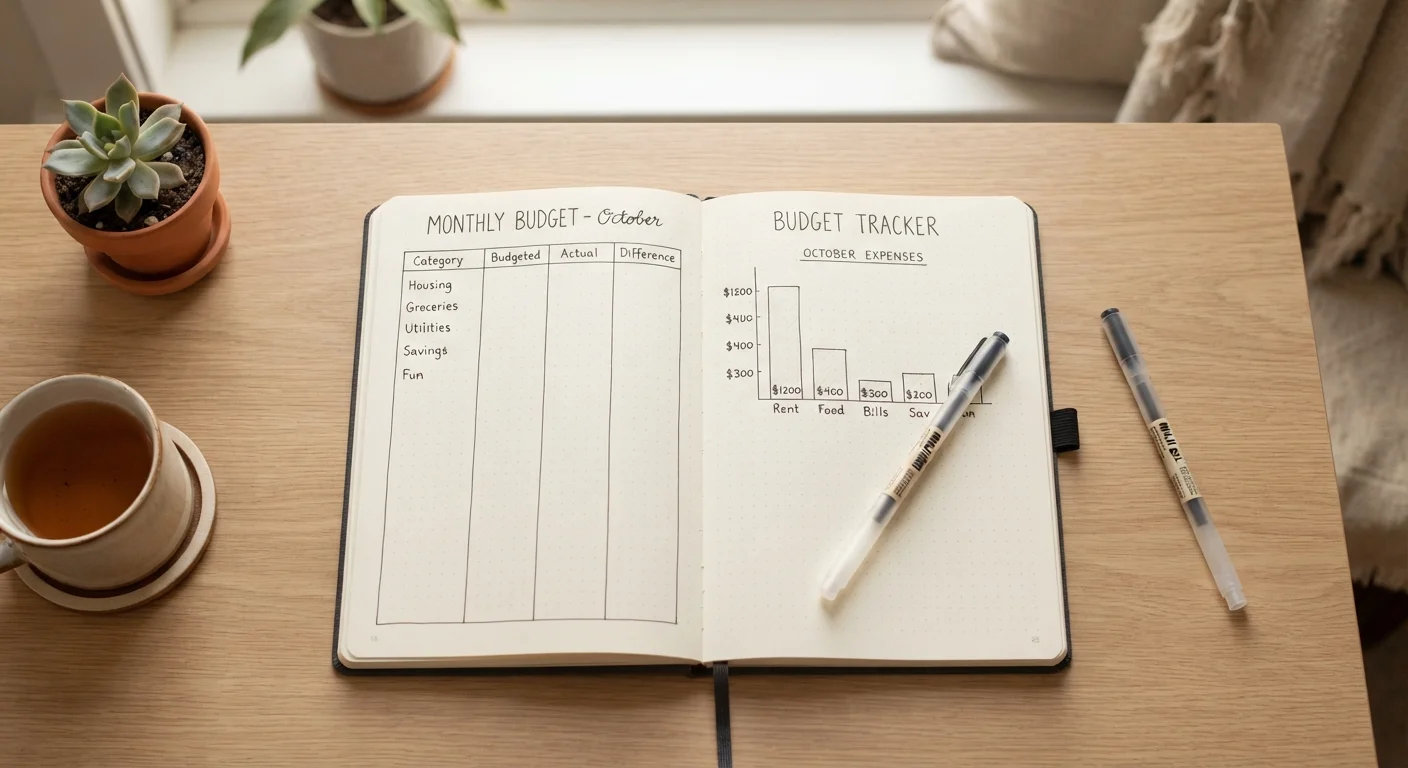
Building the plan is step one. Tracking what actually happens is where the habit forms. At a basic level, this means recording your spending throughout the month — in a notebook, a spreadsheet, or an app — and comparing it to your plan at month's end.
A monthly review should answer three questions: Where did I overspend? Where did I underspend? What do I need to change next month? This loop of plan → track → review → adjust is what makes a budget a living tool rather than a one-time exercise.
If consistency is a challenge, strategies for building a budget you'll stick to offer evidence-informed approaches for real life — not just ideal conditions.
What to Expect in Your First Month
Your first budget will almost certainly be imperfect. You'll underestimate some categories, forget an expense entirely, and possibly overspend somewhere you didn't expect. That's normal, and it doesn't mean the budget failed — it means you gathered real data.
Most people need two to three months before their budget starts to feel accurate. Treat the first month as a diagnostic tool: you're learning your own spending patterns, not grading yourself. Resist the urge to quit after one rough month; common first-budget mistakes and how to recover are far more fixable than most beginners expect.
Once your budget feels stable, the natural next step is building a savings cushion. Building a savings habit from zero shows how to start even when margins feel tight.
This article provides general financial education and is not personalized financial advice. For guidance specific to your situation, consider consulting a qualified financial professional.
Frequently Asked Questions
There is no minimum income required to make a budget. A budget is simply a plan for whatever money you have. Even a modest income benefits from a spending plan, because it helps you prioritize what matters most.
The 50/30/20 rule is widely recommended as a starting point: 50% of take-home pay toward needs, 30% toward wants, and 20% toward savings and debt repayment. It's flexible enough to adjust as your situation changes.
No. A pen and notebook or a basic spreadsheet works perfectly well for a first budget. Apps and tools can be helpful, but the habit of budgeting matters far more than the tool you use.
If your income is irregular, base your budget on a conservative estimate — either your lowest recent month or a rolling average. Plan essential expenses first, then allocate any surplus once you know what actually came in.
A monthly review is the standard starting rhythm. At the end of each month, compare what you planned to spend with what you actually spent, then adjust category amounts for the next month accordingly.
Not at all. Budgeting is a tool for anyone who wants clarity about where their money goes — regardless of income level. It supports goals like saving for a vacation, paying off debt, or simply feeling less financially anxious.
The content on this site is for informational purposes only and is not a substitute for professional advice. Always consult a qualified professional for guidance specific to your situation.