

Our Verdict
Drip irrigation excels in vegetable gardens, raised beds, and water-restricted climates where precision matters. Sprinkler systems remain the practical choice for established lawns and large-area plantings where even coverage trumps water economy. Neither system is universally superior — the best fit depends on your garden's layout, plant types, and local water conditions.
| Best for | Recommended |
|---|---|
| Vegetable and herb gardens | Drip Irrigation |
| Lawns and large open planting areas | Sprinkler Systems |
| Water-restricted or drought-prone climates | Drip Irrigation |
| Low-maintenance, large-scale coverage | Sprinkler Systems |
How Each System Works
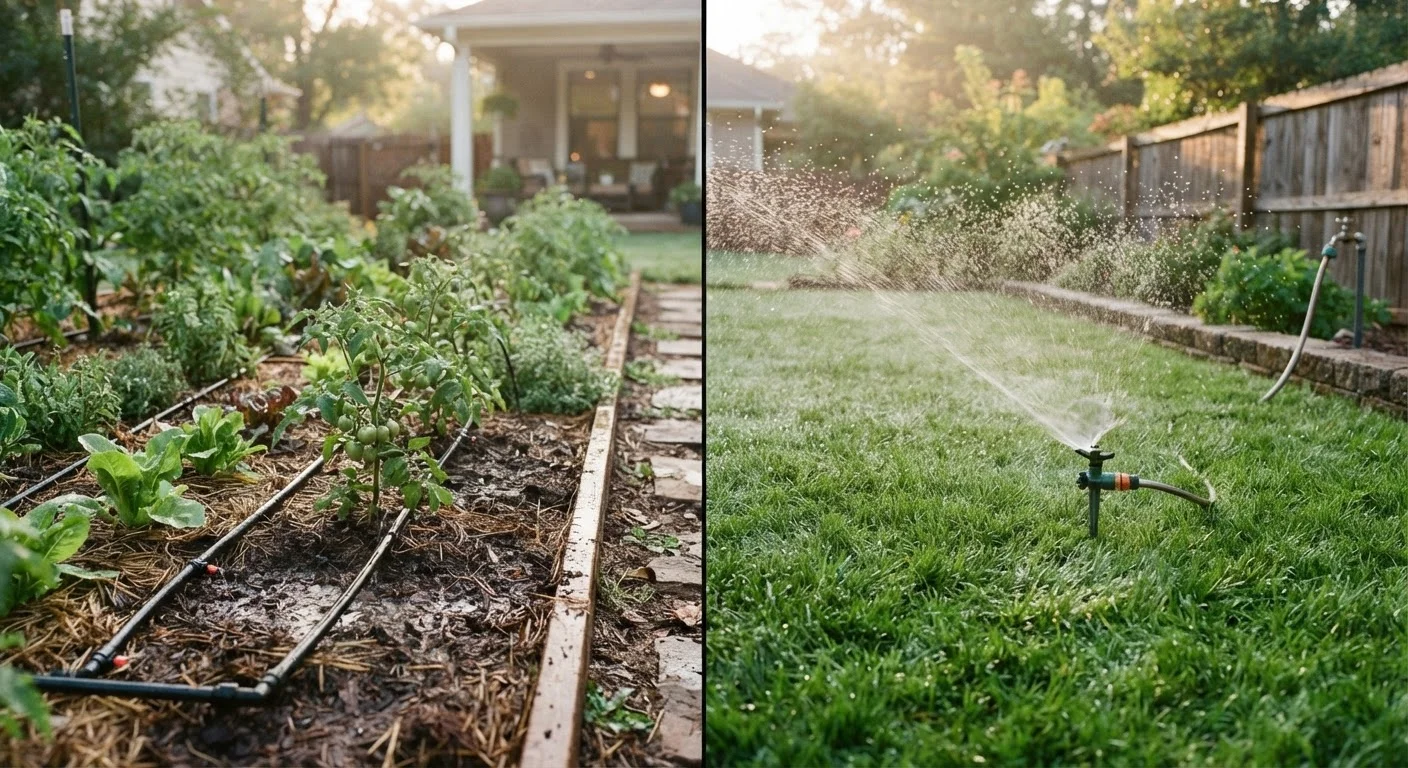
Understanding the mechanics of each system helps clarify where they perform best. Drip irrigation uses a network of tubing and emitters to deliver water slowly and directly to the soil at each plant's root zone. Flow rates are measured in gallons per hour rather than per minute, meaning plants receive a slow, steady supply that soil can absorb without runoff.
Sprinkler systems distribute water through overhead heads or rotating nozzles, broadcasting it across a wide area in a pattern similar to rainfall. Pop-up in-ground heads are common for lawns, while oscillating and impact sprinklers are frequently used for above-ground setups in garden beds.
Both systems can be connected to a timer or smart controller, allowing automated watering schedules. If you're planning a new growing space, our guide to starting a vegetable garden covers how watering fits into the broader setup.
Water Efficiency and Plant Health
Water efficiency is one of the clearest differentiators between the two systems. Drip irrigation minimizes evaporation because water is applied at ground level rather than broadcast into the air. Foliage stays dry, which can reduce the incidence of fungal diseases like powdery mildew and leaf blight — conditions that thrive when leaves stay wet.
Sprinklers, by contrast, wet the entire canopy. While plants can tolerate this in most climates, watering in the evening with sprinklers can leave leaves damp overnight, creating conditions favorable to disease. Morning watering is generally recommended when using sprinklers. For more on common watering pitfalls, see garden watering myths that may be harming your plants.
Drip systems also suppress weed growth more effectively: by watering only where plants are, bare soil between rows stays drier and less hospitable to weed seeds.
30–50%
Water savings with drip vs. sprinklers
The U.S. Environmental Protection Agency estimates drip irrigation can reduce outdoor water use by 30–50% compared with conventional sprinkler systems in comparable garden settings.
50%
Outdoor water use lost to inefficiency
According to the EPA's WaterSense program, roughly half of outdoor residential water use is lost to evaporation, wind drift, or runoff due to inefficient irrigation methods.
Installation, Cost, and Maintenance
Installation effort varies considerably. A basic drip system for a small raised bed or vegetable garden can be assembled from a kit using simple hand tools in a few hours. Larger layouts with multiple zones and automated timers require more planning but remain within reach for confident DIYers. Tubing, emitters, and connectors are the primary materials.
In-ground sprinkler systems involve trenching, PVC pipe runs, and in many cases permits or inspections — work that often warrants a licensed irrigation professional. Above-ground sprinkler setups are simpler and less costly to install but require seasonal storage in cold climates to prevent freeze damage.
| Drip Irrigation | Sprinkler Systems | |
|---|---|---|
| Water efficiency | High — targets root zone directly | Moderate — loses water to evaporation |
| Best garden type | Vegetables, shrubs, raised beds | Lawns, groundcovers, large open areas |
| Installation complexity | Low to moderate, DIY-friendly | Moderate to high; in-ground needs pros |
| Upfront cost | Lower for small gardens | Higher, especially in-ground systems |
| Weed suppression | Good — keeps inter-row soil dry | Poor — waters entire surface evenly |
| Foliar disease risk | Low — leaves stay dry | Higher if timed poorly |
| Maintenance needs | Emitter flushing each season | Head adjustments, winterization |
Ongoing maintenance differs too. Drip emitters can clog with mineral deposits or debris and should be flushed and inspected at least once per season. Sprinkler heads are susceptible to mechanical damage from lawn equipment and may need head adjustments to maintain proper coverage patterns over time.
Which Garden Types Benefit Most?
Garden layout and plant type are the strongest predictors of which system fits best. Drip irrigation is particularly well-suited to row vegetables, fruiting plants, and shrubs — any situation where watering can be targeted precisely. It pairs naturally with raised bed growing setups, where the confined root zone benefits from slow, even moisture delivery.
Sprinklers suit lawns, wildflower meadows, and densely planted groundcovers where uniform coverage across a broad area is the goal. They're also practical for newly seeded areas where keeping the soil surface consistently moist aids germination — a task drip systems aren't designed for.
Container gardens on patios and balconies represent a special case. Dedicated drip emitters sized for pots work well, but hand-watering remains common for smaller collections. Our container gardening guide explores moisture management in pots in more detail.
Combine Systems for Complex Gardens
If your yard includes both a lawn and planted beds, consider running separate irrigation zones — sprinklers for turf and drip lines for beds. Most multi-zone controllers support this hybrid approach and let you program different watering schedules for each zone. This prevents overwatering sensitive vegetables while keeping grass adequately hydrated.
For mixed gardens combining a lawn with vegetable beds, a hybrid approach — sprinklers for turf zones and drip for planting beds — often delivers the most practical solution.
The content on this site is for informational purposes only and is not a substitute for professional advice. Always consult a qualified professional for guidance specific to your situation.