

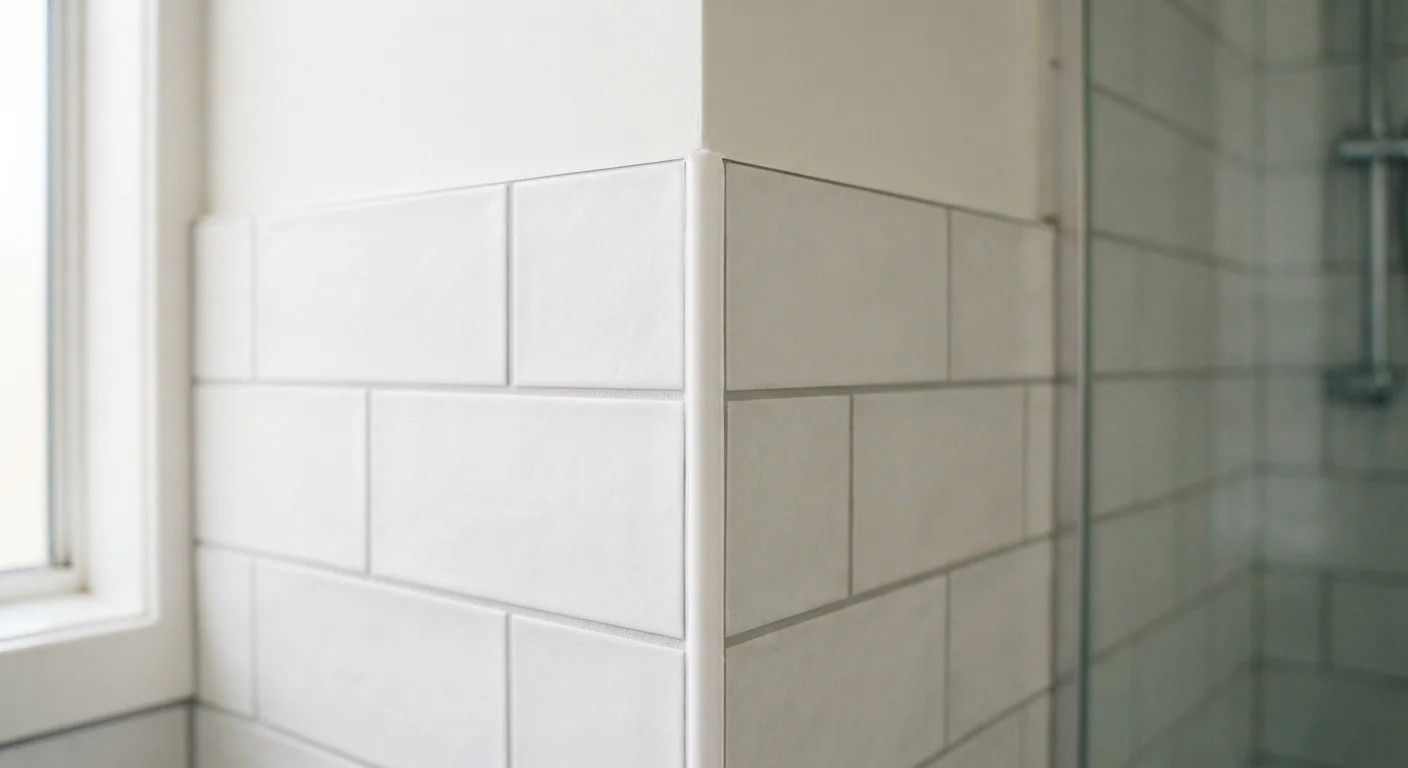
Option A
Grout
The rigid, durable filler for static tile fields.
Best for: Filling uniform joints between tiles on flat, stable surfaces such as floors and wall fields.
Option B
Caulk
The flexible sealant for movement-prone joints and transitions.
Best for: Sealing corners, perimeter edges, and any joint where two different surfaces or planes meet.
What Each Material Is — and Why It Matters
Grout and caulk are both joint fillers, but they are engineered for fundamentally different jobs. Grout is a cement-based (or sometimes epoxy-based) compound mixed to fill the consistent gaps between tiles. Once cured, it becomes hard and rigid — ideal where tiles sit on a stable substrate and the joint doesn't need to flex.
Caulk is a flexible polymer sealant — typically silicone, latex-acrylic, or a hybrid blend. It cures into a rubbery bead that can compress and stretch slightly without cracking. That flexibility is exactly what you need wherever two surfaces meet at a corner, wherever different materials join, or wherever a structure experiences thermal or load-related movement.
Confusing the two creates predictable problems. Grout placed at a change of plane will crack as the building moves. Caulk used in open tile field joints collects debris, loses adhesion over time, and is difficult to keep clean. Understanding each material's physical properties helps you choose correctly the first time — avoiding costly rework. For a parallel decision-making framework with wood repairs, see our guide to wood filler vs. epoxy filler.
Head-to-Head: How Grout and Caulk Compare
The table below captures the key differences at a glance. Keep these distinctions in mind as you plan any tile project.
| Criterion | Grout | Caulk |
|---|---|---|
| Composition | Cement- or epoxy-based | Silicone, latex-acrylic, or hybrid polymer |
| Flexibility when cured | Rigid — does not flex | Flexible — compresses and stretches |
| Best location | Tile-to-tile field joints | Corners, transitions, and perimeter edges |
| Movement tolerance | None — cracks under structural flex | Designed to absorb minor movement |
| Water resistance | Good when sealed; porous if unsealed | Excellent — forms a continuous watertight bead |
| Durability in open field joints | Decades with proper sealing | Poor — traps dirt, degrades faster |
| Color matching | Wide range of standard colors | Color-matched sanded options available |
| Skill level required | Moderate — mixing and timing matter | Beginner-friendly with practice |
One point worth emphasizing: color matching is no longer a barrier to using caulk where it belongs. Manufacturers produce sanded caulk in dozens of grout-coordinated colors, so a properly caulked corner joint can be nearly invisible against the surrounding grout lines.
~30%
Tile failures linked to wrong joint filler placement
Industry tile installers and remodeling contractors commonly attribute roughly a third of premature tile joint failures to using grout at changes of plane instead of flexible sealant.
8–12 ft
Recommended spacing for soft expansion joints in large tile floors
The Tile Council of North America (TCNA) Handbook recommends soft joints at changes of plane and approximately every 8–12 feet in large floor installations to accommodate movement.
Where Each Material Belongs: A Practical Placement Guide
Use grout for:
- Tile-to-tile joints across floors, wall fields, and backsplashes on stable substrates
- Consistent-width joints set with tile spacers, where uniform coverage is needed
- High-traffic horizontal surfaces where abrasion resistance matters most
Use caulk for:
- All interior corners — inside corners of tub surrounds, shower stalls, and tiled niches
- Perimeter joints where tile meets the tub deck, shower pan, or floor transition strip
- Countertop-to-backsplash joints, where counter flex is common
- Expansion joints in large floor installations where tile manufacturers specify a soft joint every 8–12 feet
Industry Standard: Change of Plane = Caulk
The Tile Council of North America (TCNA) and most tile manufacturer installation guidelines are explicit: any joint at a change of plane must be filled with an appropriate flexible sealant, not grout. This includes every interior corner in a wet area. Following this standard protects your tile investment and helps maintain waterproofing integrity over time.
When caulk fails prematurely, the cause is often surface prep or formulation choice rather than the material itself. Our article on why caulk keeps cracking covers the most common culprits and how to fix them.
Not all caulk behaves the same either — silicone and latex-acrylic formulas have very different performance profiles in wet areas. Our silicone vs. latex caulk comparison explains which formulation is best suited to each scenario.
The content on this site is for informational purposes only and is not a substitute for professional advice. Always consult a qualified professional for guidance specific to your situation.