

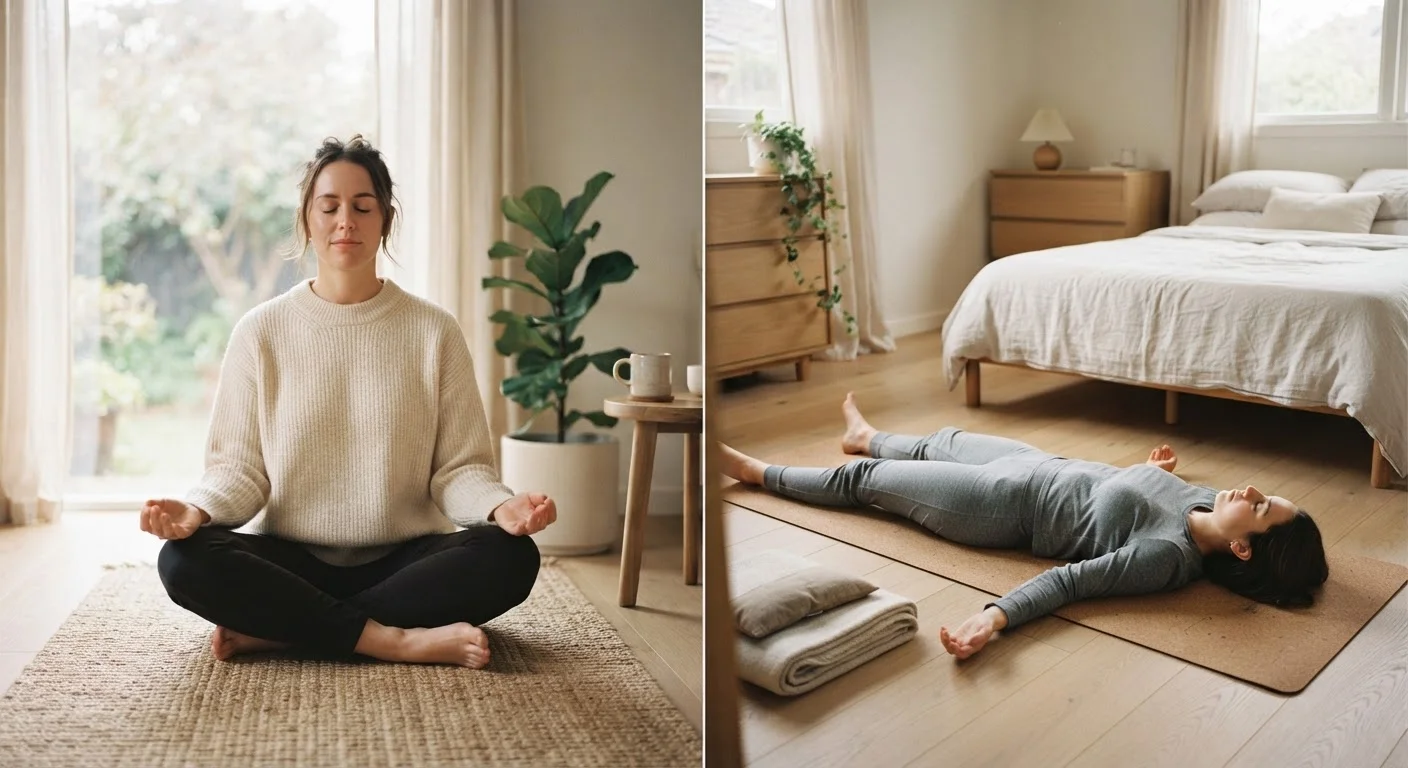
Option A
Deep Breathing
The fast-acting, breath-first approach to calming the body.
Best for: People who want a discreet, portable technique they can use mid-day or in public settings.
Option B
Progressive Muscle Relaxation (PMR)
A systematic, body-scan method for releasing physical tension.
Best for: People who carry chronic muscle tension or want a structured wind-down practice before sleep.
How Each Technique Works
Both deep breathing and progressive muscle relaxation (PMR) reduce stress by engaging the body's parasympathetic nervous system — often called the "rest and digest" system — which counteracts the fight-or-flight response. To understand why stress accumulates in the first place, see what the science of stress actually tells us.
Deep breathing works through a direct physiological pathway. Slow, diaphragmatic breathing stimulates the vagus nerve, which in turn lowers heart rate, reduces cortisol output, and shifts the nervous system toward a calmer state. Techniques vary — box breathing (inhale, hold, exhale, hold in equal counts), 4-7-8 breathing, and resonance breathing are among the most studied — but the common denominator is extending the exhale relative to the inhale, which amplifies the parasympathetic response.
Progressive Muscle Relaxation, developed by physician Edmund Jacobson in the 1920s, operates on a different principle: deliberate muscular tension followed by controlled release. By tensing individual muscle groups — hands, forearms, shoulders, face, abdomen, legs — for several seconds before releasing, the technique teaches the body to recognize and deepen the contrast between tension and relaxation. Over time, this awareness helps practitioners identify unconscious holding patterns they may have carried for years.
| Criterion | Deep Breathing | Progressive Muscle Relaxation |
|---|---|---|
| Primary mechanism | Vagal nerve stimulation via breath | Muscle tension-release contrast |
| Time required | 1–5 minutes | 15–30 minutes |
| Equipment needed | None | None (mat or surface helpful) |
| Portability | Highly portable; usable anywhere | Requires quiet space and lying down |
| Best evidence for | Acute anxiety, heart rate variability | Sleep onset, chronic muscle tension |
| Learning curve | Very low | Moderate; improves with repetition |
| Caution areas | Respiratory conditions, hyperventilation risk | Musculoskeletal injuries |
Evidence Base and Practical Limits
Both techniques have meaningful research support, though the depth and scope of evidence differs by application.
Deep breathing's effects on acute anxiety and heart rate variability are well-documented in peer-reviewed literature. Studies published in journals such as Frontiers in Psychology have found that slow-paced breathing can measurably reduce self-reported anxiety and improve physiological markers of calm within a single session. It is also commonly integrated into clinical programs for stress management.
PMR has similarly robust support, particularly for sleep-related outcomes. Research has found PMR effective at reducing sleep-onset latency — the time it takes to fall asleep — and lowering pre-sleep arousal. It also appears in clinical guidelines for generalized anxiety as a complementary intervention alongside cognitive behavioral therapy.
~60%
Reduction in pre-sleep anxiety with PMR
A review in the journal Sleep Medicine Reviews found PMR among the most consistently effective non-pharmacological interventions for reducing sleep-onset arousal.
< 5 min
Time for measurable heart rate reduction via paced breathing
Research in Frontiers in Psychology found that slow diaphragmatic breathing produced measurable parasympathetic activation within a single brief session.
Neither technique is universally effective. Deep breathing can feel counterproductive for individuals with certain respiratory conditions or those who are highly anxiety-prone and prone to hyperventilation. PMR is generally contraindicated for people with certain musculoskeletal injuries; tensing affected muscles can aggravate pain rather than relieve it. Those managing diagnosed anxiety disorders or chronic stress should treat these as adjuncts to — not replacements for — professional support. For a broader perspective, the hidden cost of chronic low-grade stress is worth understanding alongside any self-care approach.
Choosing the Right Fit — or Combining Both
The most practical answer for many people is not either/or. Deep breathing can serve as an immediate, on-demand tool for moments of acute tension, while PMR functions well as a longer evening practice. Pairing them within a wind-down routine — for example, starting with five minutes of paced breathing, then moving into a PMR body scan — layers complementary mechanisms.
A Note on Consistency
Both deep breathing and PMR tend to produce stronger, more reliable results with regular practice rather than occasional use. Most researchers and clinicians recommend daily sessions — even short ones — for at least two to four weeks before assessing whether a technique is working for you. If one approach feels frustrating or unhelpful after a reasonable trial period, switching or combining methods is entirely reasonable.
For those comparing these approaches to mindfulness-based practices, it's worth noting key distinctions. Mindfulness often involves observing thoughts without engaging in a specific physiological technique, whereas both deep breathing and PMR involve deliberate physical actions with predictable physiological effects. Mindfulness meditation has real benefits but also meaningful trade-offs worth understanding before committing to any single path.
If you are unsure which stressors are driving your need for relaxation techniques, a structured stress audit can help you identify patterns before deciding where to focus your effort.
This article is for general informational purposes only and is not medical advice. If you are experiencing significant anxiety, chronic stress, or any health condition, please consult a qualified healthcare professional before starting a new wellness practice.
The content on this site is for informational purposes only and is not a substitute for professional advice. Always consult a qualified professional for guidance specific to your situation.