

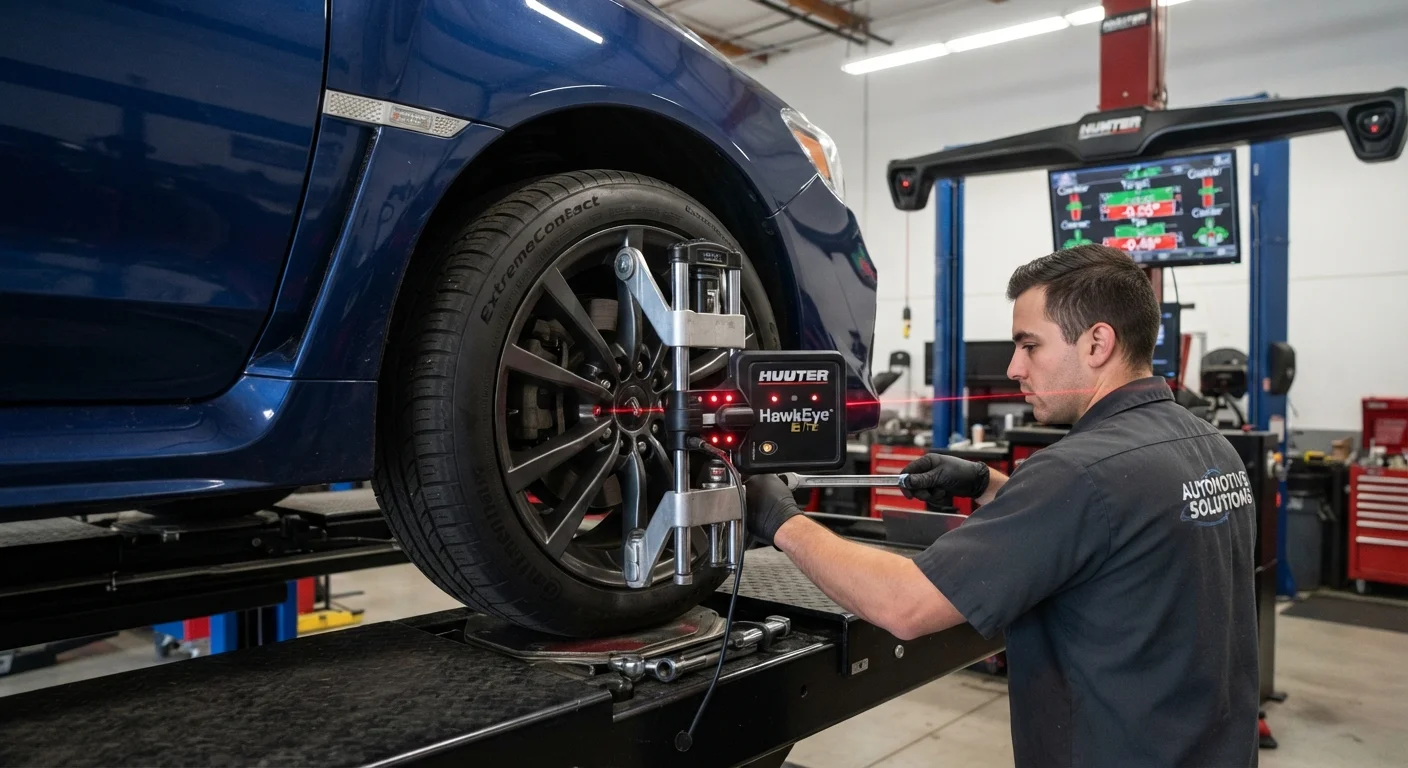
Option A
Wheel Alignment
The geometry correction that keeps your car tracking straight.
Best for: Drivers noticing steering pull, uneven tyre wear, or a crooked steering wheel on a straight road.
Option B
Tyre Balancing
The weight correction that eliminates vibration at speed.
Best for: Drivers experiencing steering wheel shimmy or seat vibration, especially at highway speeds.
Two Different Problems, Two Different Fixes
Wheel alignment and tyre balancing are often mentioned in the same breath at the service counter, but they address entirely different mechanical problems. Confusing the two can lead drivers to approve the wrong service — or skip a necessary one.
Wheel alignment refers to the angular relationship between your tyres and the road surface, and between the tyres themselves. Specifically, mechanics adjust three key angles: camber (how much the tyre tilts inward or outward when viewed from the front), toe (whether the tyres point slightly inward or outward when viewed from above), and caster (the steering axis angle viewed from the side). When these angles drift out of the manufacturer's specification — due to hitting a pothole, worn suspension components, or gradual settling — tyres no longer contact the road as intended.
Tyre balancing addresses something different entirely: the distribution of mass around the tyre and wheel assembly as a unit. Even a new tyre mounted on a new wheel will have slight variations in weight around its circumference. When those variations are significant enough, they create a wobbling force at speed that drivers feel as vibration. Technicians correct this by attaching small lead or zinc weights to specific points on the wheel rim.
| Criterion | Wheel Alignment | Tyre Balancing |
|---|---|---|
| What it corrects | Tyre angles relative to road and vehicle | Uneven weight in tyre-wheel assembly |
| Primary symptom | Steering pull, crooked wheel, uneven wear | Vibration at speed |
| Equipment used | Alignment rack with angle sensors | Spin balancer machine |
| Common trigger | Pothole, curb impact, worn suspension | New tyre fitment, normal tyre wear |
| Effect on tyre wear | Causes edge or diagonal wear patterns | Can cause cupping or scalloping |
| Typical service interval | Every 1–2 years or after hard impact | At new tyre fitment; with each rotation |
How Each Service Is Performed
The equipment and process for each service are completely distinct, which is why one cannot substitute for the other.
Alignment is performed on a dedicated alignment rack. The vehicle is driven onto the rack and sensors — usually laser or camera-based — are attached to each wheel. The system reads the current angles and compares them to the vehicle manufacturer's specifications. A technician then adjusts the relevant suspension components (such as tie rods for toe, or camber bolts where present) until all angles fall within tolerance. The process typically takes 30–60 minutes.
Balancing requires a spin balancer machine. The tyre and wheel are removed from the vehicle and mounted on the machine's spindle. The machine spins the assembly at speed and detects where mass is unevenly distributed. The technician then places appropriately sized balance weights at specific positions on the rim — either clipped to the inner edge or applied as adhesive weights on alloy wheels. The tyre is then remounted on the vehicle.
~$75–$100
Typical cost of a four-wheel alignment
Prices vary by region and vehicle type; performance or luxury vehicles may cost more due to additional adjustment points.
45–50%
Tyre life reduction from persistent misalignment
Industry estimates suggest significantly misaligned tyres can lose nearly half their expected tread life compared to properly aligned ones.
Understanding tyre pressure and tread depth is equally important, since both misalignment and imbalance interact with inflation levels to accelerate wear.
Symptoms, Timing, and What to Tell Your Mechanic
Knowing which symptoms point where helps you have a more productive conversation at the shop — and avoid being upsold on a service you don't need.
Signs you need an alignment check:
- The vehicle consistently drifts or pulls to one side on a straight, level road
- Your steering wheel is noticeably off-center when driving straight
- Tyre wear is visibly uneven — one edge worn significantly more than the other
- After a significant impact (large pothole, curb strike, or minor collision)
Signs you need tyre balancing:
- A steering wheel shimmy or vibration that appears or worsens at specific speeds (commonly 50–70 mph)
- Vibration felt through the seat or floorboard rather than the steering wheel (often indicates a rear wheel imbalance)
- New tyres have just been mounted
Can You Have Both Problems at Once?
Yes — and it's common. A pothole hard enough to knock an alignment angle out of spec can also unsettle a wheel's balance weights. If you've experienced a significant impact, having both checked at the same visit is a practical approach. A qualified technician can assess each issue independently with the appropriate equipment.
For a fuller picture of tyre health, consider reviewing how tyre pressure affects road safety and what the markings on your tyre sidewall mean — both factors interact with alignment and balance in how a tyre ultimately wears and performs.
As a general guideline, alignment is typically recommended every one to two years or after any significant suspension impact. Balancing is usually performed whenever new tyres are fitted and may be advisable every 5,000–7,500 miles as part of a tyre rotation service. Always follow your vehicle manufacturer's recommendations and consult a qualified mechanic if you're uncertain which service your situation warrants.
The content on this site is for informational purposes only and is not a substitute for professional advice. Always consult a qualified professional for guidance specific to your situation.