

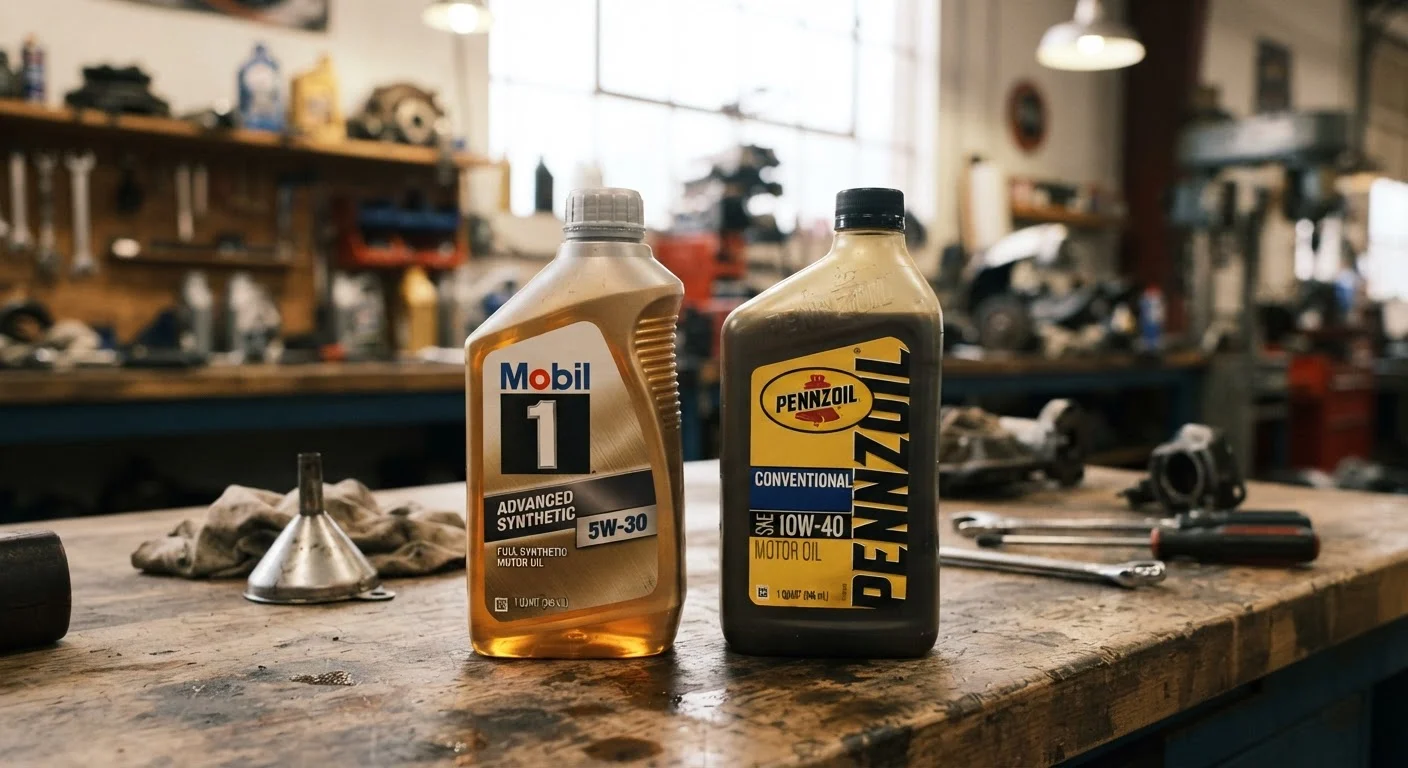
Option A
Synthetic Motor Oil
The engineered, high-performance formulation.
Best for: Drivers with modern vehicles, turbocharged engines, extreme climates, or longer intervals between oil changes.
Option B
Conventional Motor Oil
The time-tested, widely available standard.
Best for: Owners of older vehicles with simple engines operating under mild, predictable driving conditions.
Where Each Oil Comes From
Conventional motor oil starts life as crude petroleum extracted from the ground. It goes through a refining process that removes many impurities, but natural hydrocarbon molecules of varying sizes and shapes remain. Those irregularities mean the oil behaves somewhat unpredictably under stress — it thickens in cold weather and thins in heat faster than ideal.
Synthetic motor oil is manufactured from chemically modified base stocks, often starting with crude oil but processed far beyond conventional refining, or built from entirely synthesized compounds. The result is a fluid made of highly uniform molecules engineered to behave consistently across a much wider range of conditions. For a broader look at how engine oil fits alongside other fluids in your car, see our plain-English guide to car fluids.
| Criterion | Synthetic Motor Oil | Conventional Motor Oil |
|---|---|---|
| Base material | Chemically engineered compounds | Refined crude petroleum |
| Molecule uniformity | Highly uniform — predictable behaviour | Variable — less consistent performance |
| Cold-start protection | Flows quickly in freezing temps | Slower to circulate when cold |
| Heat resistance | Resists breakdown at high temps | Oxidizes faster under sustained heat |
| Typical change interval | 7,500–15,000 miles (per manufacturer) | 3,000–5,000 miles |
| Cost per change | Higher upfront cost | Lower upfront cost |
| Best engine type | Modern, turbocharged, tight-tolerance | Older, simpler engine designs |
How Each Oil Performs in Real Driving Conditions
The practical differences show up most clearly at the extremes. On a cold winter morning, conventional oil can be sluggish for the first 30–60 seconds of engine operation — that cold-start period is when a disproportionate share of engine wear occurs. Synthetic oil flows more readily from the moment the engine turns over, coating critical components faster.
At the other extreme, engines running hard in summer heat, towing a load, or fitted with a turbocharger generate sustained high temperatures. Conventional oil oxidizes and breaks down more quickly under those conditions, leaving behind sludge and varnish deposits. Synthetic oil's molecular stability gives it significantly better resistance to thermal breakdown.
~30%
Engine wear occurs at cold start
Engineering research consistently identifies the first seconds after a cold start as the period of highest wear risk, before oil fully circulates.
15,000 mi
Max synthetic interval (some vehicles)
Some vehicle manufacturers approve extended drain intervals up to 15,000 miles when using approved full-synthetic oil — always verify in your owner's manual.
~75%
New US vehicles factory-filled with synthetic
Industry estimates suggest the majority of new passenger vehicles sold in the US are factory-filled with full-synthetic or synthetic-blend oil.
For everyday commuting under mild conditions, both oils will protect a well-maintained engine. The gap widens as conditions become more demanding — which is why turbocharged engines, common in modern vehicles, almost universally require synthetic oil. Understanding how your engine generates and uses power can help put these needs in context; our article on torque and horsepower explains the forces your oil must manage.
Oil Change Intervals, Cost, and Practical Tradeoffs
Conventional oil is typically changed every 3,000–5,000 miles, though many modern vehicles on conventional oil can safely go to 5,000 miles. Synthetic oil, depending on the vehicle and manufacturer guidance, is often rated for 7,500–15,000 miles between changes. Always follow the interval your owner's manual specifies — not the sticker your service shop puts on the windshield.
Synthetic oil costs more per quart, but fewer changes per year can narrow the annual cost gap considerably. The math varies by vehicle and driving habits, so no universal claim about savings is accurate — but the higher per-change cost is rarely as significant as it first appears when spread across the year.
Always Defer to Your Owner's Manual
Neither oil type is universally superior for every vehicle. Your owner's manual specifies the oil viscosity grade (e.g., 5W-30) and type your engine was designed for. Using an oil that doesn't meet the manufacturer's specification — regardless of whether it's synthetic or conventional — can affect engine performance and may affect warranty coverage. When in doubt, a qualified mechanic can help interpret the spec for your specific vehicle.
One persistent myth worth addressing: switching from conventional to synthetic will not cause leaks in a properly maintained engine. Modern synthetic oils are compatible with contemporary engine seals. For a full rundown of oil misconceptions, our article on common engine oil myths covers the most widespread ones. And if you want to understand the broader world of vehicle fluids in context, the Understanding Your Car hub is a useful starting point.
The content on this site is for informational purposes only and is not a substitute for professional advice. Always consult a qualified professional for guidance specific to your situation.