

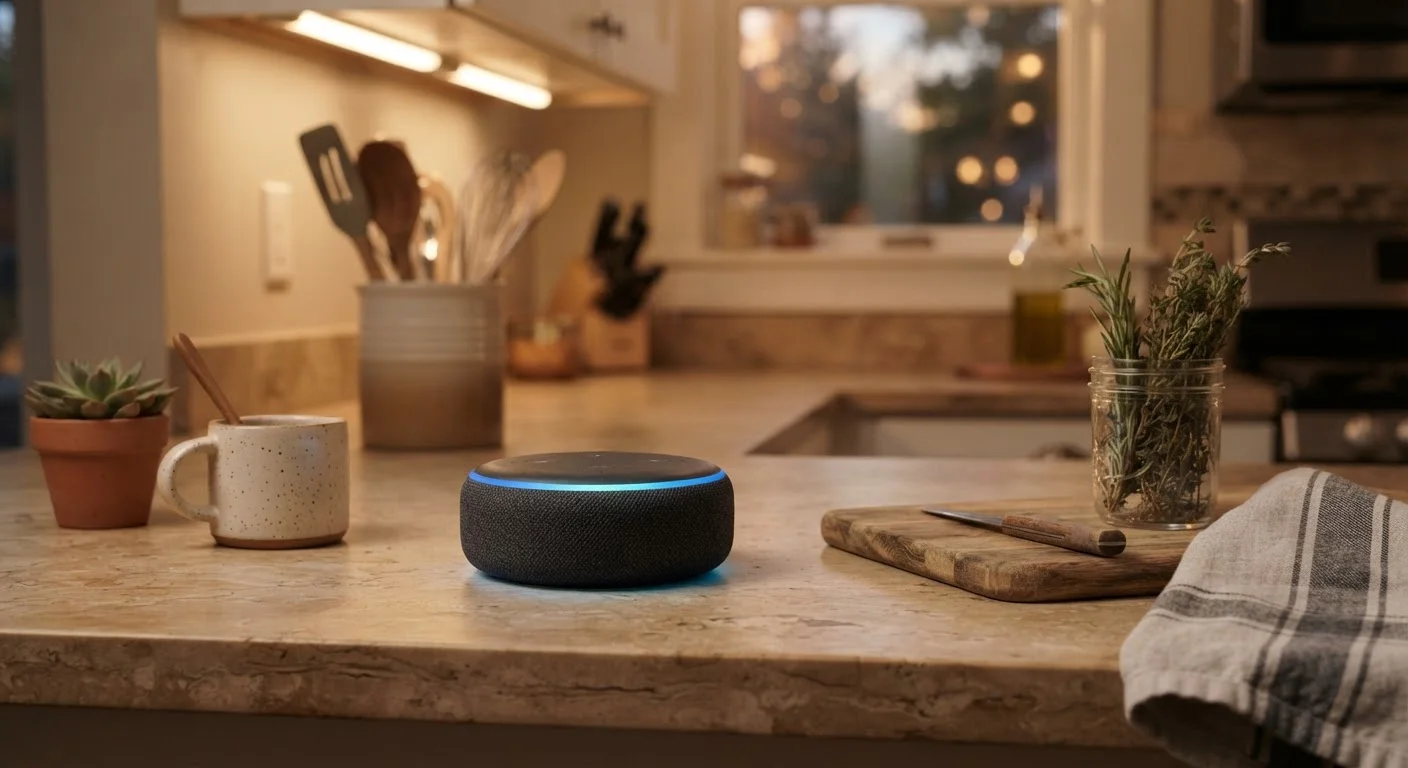
How Smart Speakers Actually Work
The phrase "always listening" is technically accurate but routinely misunderstood. Smart speakers do maintain a constant low-level audio watch — but that watch happens entirely on the device itself, using a small, dedicated processor that scans incoming sound for a specific trigger phrase called a wake word (for example, "Hey Alexa" or "OK Google").
Until that wake word is detected, audio is processed locally and discarded in a rolling buffer — it is never packaged and sent to the manufacturer's servers. Only after a successful wake-word detection does the device begin recording and transmitting your voice to the cloud for interpretation. This distinction — local processing versus cloud transmission — is the crux of what most privacy concerns get wrong.
This is meaningfully different from how other connected devices behave. For context on the broader wireless ecosystem your home devices rely on, see our explainer on Wi-Fi, Bluetooth, and NFC.
Common Myths — and What the Evidence Actually Shows
Public concern about smart speakers often rests on a cluster of persistent misconceptions. The myth-fact pairs below address the most widespread ones, grounded in how these devices are actually engineered.
Myth
My smart speaker records every conversation happening in the room and sends it to the company.
Fact
Audio is only transmitted to the cloud after the device detects its designated wake word — not before.
The microphone is always active, but the processing pipeline has two distinct stages. Stage one is entirely local: a small on-device chip listens for the wake word and discards everything else. Stage two begins only after a wake-word match, at which point audio is streamed to remote servers for natural language processing. Continuous room recording would require vastly more bandwidth and battery power than smart speakers consume — and independent network traffic analyses have consistently failed to find evidence of it.
Myth
The company can listen to my conversations in real time whenever they want.
Fact
Manufacturers do not have a live audio feed into your home; access is limited to recordings triggered by wake-word events.
Some manufacturers have acknowledged using human reviewers to audit a small sample of voice recordings — a practice used to improve transcription accuracy. This was controversial and prompted policy changes at several companies. However, this is fundamentally different from real-time eavesdropping: reviewers hear short, wake-word-triggered clips, often stripped of account-identifying information, not ongoing room audio. Many platforms now make opting out of human review straightforward.
Myth
Unplugging my smart speaker is the only way to guarantee privacy.
Fact
A hardware mute button physically disconnects the microphone circuit, providing strong assurance without unplugging the device.
Most smart speakers include a dedicated mute button that cuts the microphone at the hardware level — meaning the connection to the microphone is physically broken, not just toggled in software. When muted this way, the device cannot detect wake words or record audio regardless of what software is running. This is a meaningful privacy control that many users overlook. Unplugging is certainly more absolute, but the hardware mute on most devices offers genuine, not merely cosmetic, protection.
Myth
Smart speakers are uniquely dangerous compared to other connected devices I own.
Fact
Smartphones, smart TVs, and other connected devices collect comparable or greater amounts of personal data through different mechanisms.
Smart speakers attract disproportionate concern partly because of their microphones, but the data ecosystem around them is not uniquely invasive. Smartphones with voice assistants operate on similar wake-word principles and additionally track location, app usage, and browsing behavior. Smart TVs use a technology called Automatic Content Recognition (ACR) to log what you watch in fine-grained detail. Understanding risk across all connected devices — rather than singling out one category — gives a more accurate picture of the modern home data environment.
Myth
Once a recording is sent to the cloud, I have no control over it.
Fact
Most major platforms provide tools to review, play back, and permanently delete your stored voice recordings.
Voice history dashboards are now a standard feature across major smart speaker ecosystems. Through companion apps or web interfaces, users can typically browse individual recordings by date, listen to them, and delete individual clips or their entire history. Automatic deletion policies — where all recordings older than a set timeframe are erased — are also commonly available. While the defaults vary by platform and are not always privacy-forward, these controls are real and accessible to anyone willing to spend a few minutes in the settings.
False Activations: The Real Privacy Gap
The genuine privacy concern with smart speakers isn't a secret recording pipeline — it's false activations. Wake-word detection is a probabilistic process. Phonetically similar phrases (a word that sounds like "Alexa," a TV advertisement mentioning a trigger phrase) can occasionally fool the local processor into beginning a recording session.
False Activations Can Capture Unintended Audio
If your smart speaker mishears a trigger phrase, it begins recording and transmitting just as it would for an intentional command. These clips are typically short — a few seconds — but they can include fragments of private conversation. Placing smart speakers away from rooms where sensitive discussions regularly occur is a practical precaution worth considering.
Research from academic groups studying voice assistant privacy has confirmed that false wake-word events occur with measurable regularity, though rates vary by device and environment. When they do occur, a short audio clip — typically a few seconds — is transmitted to the cloud just as an intentional command would be.
This is a design trade-off, not a deliberate surveillance feature. Engineers tune wake-word sensitivity to balance missed detections against false positives, and no current system eliminates false activations entirely.
What Happens to Recordings — and What You Can Do
When a recording reaches a manufacturer's servers, it is used to process your request and may be retained to improve speech recognition models. Most major platforms provide user-facing dashboards where you can review, play back, and permanently delete stored voice recordings. Automatic deletion settings — where recordings are erased after a set period — are also widely available.
Review Your Voice History Regularly
Most smart speaker platforms retain voice recordings by default unless you actively manage them. Take a few minutes to locate the voice history settings in your device's companion app. Enabling automatic deletion — so recordings are erased after a short period — significantly limits how long any captured audio is stored, without affecting day-to-day functionality.
Placement also matters. A smart speaker in a bedroom or near sensitive conversations deserves more thought than one in a kitchen used mainly for timers and music. Mute buttons, which physically disconnect the microphone circuit on most devices, offer a hardware-level assurance that no audio is being captured at all.
Smart speakers aren't the only home devices raising data questions. Our article on what smart TVs know about you covers how viewing data is collected through a separate system entirely. And if you use video calling apps, how those platforms handle audio and video data is equally worth understanding.
The content on this site is for informational purposes only and is not a substitute for professional advice. Always consult a qualified professional for guidance specific to your situation.