

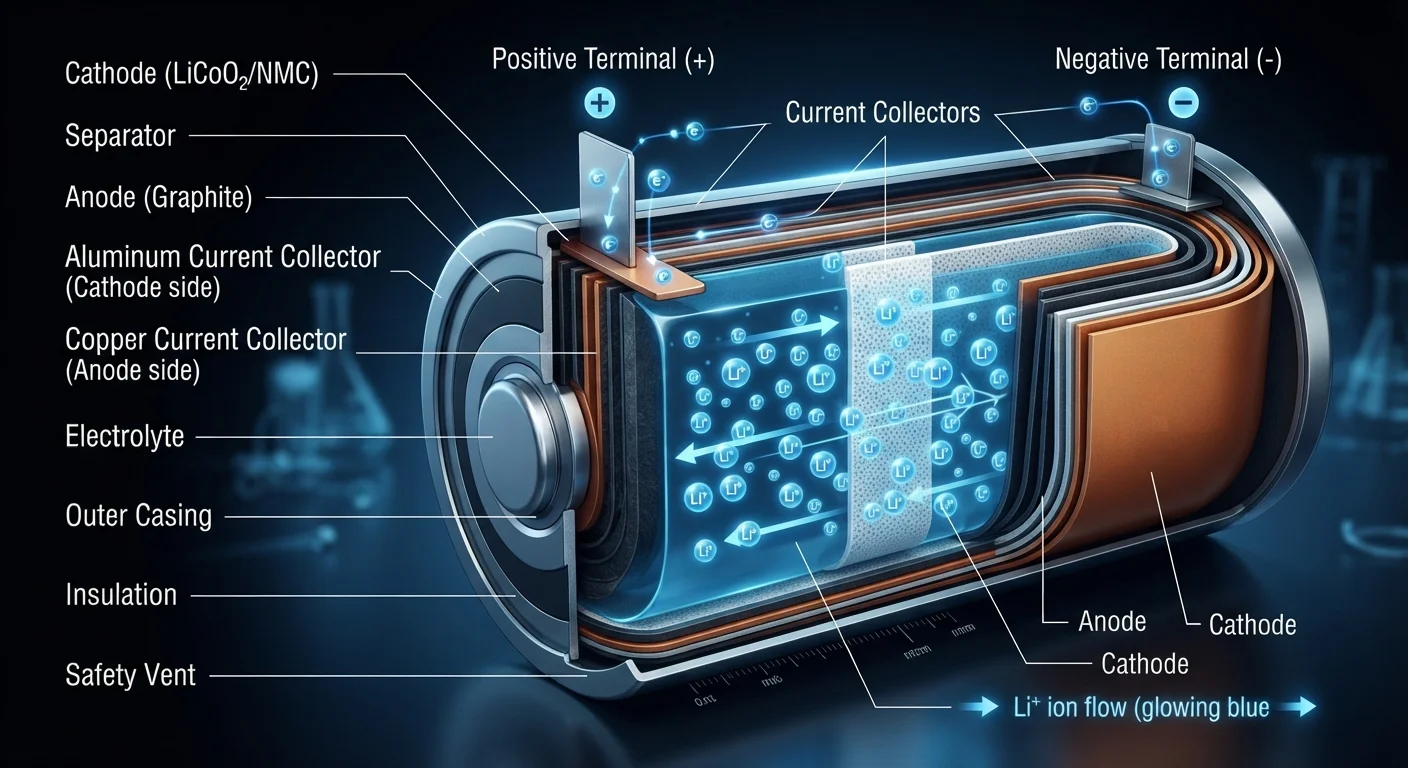
What's Actually Happening Inside the Battery
A lithium-ion battery works by shuttling lithium ions between two electrodes — the anode (typically graphite) and the cathode (a lithium metal oxide compound) — through a liquid or gel electrolyte. When you charge the battery, ions move to the anode and are stored there. When you use the device, they flow back to the cathode, releasing energy in the process.
This back-and-forth sounds simple, but it takes a toll. Each cycle slightly stresses the electrode materials, causing microscopic physical changes. The graphite anode expands and contracts as ions enter and leave, leading to tiny cracks over many cycles. The cathode material can also lose structural integrity as lithium is repeatedly extracted and reinserted.
Simultaneously, a chemical layer called the solid electrolyte interphase (SEI) forms and grows on the anode surface. This layer is partly protective — it prevents the electrolyte from reacting destructively with the electrode — but it also consumes lithium ions permanently, reducing the amount available to carry charge. As the SEI thickens with age, internal resistance rises, and the battery delivers less usable energy per cycle.
“The battery doesn't wear out in one dramatic moment — it's a slow accumulation of small chemical changes, each one nearly invisible, that eventually add up to something you notice.”
— Battery Research Community, Electrochemical engineering consensus on lithium-ion aging mechanisms
Why Heat Is the Battery's Biggest Enemy
Of all the variables that affect how quickly a lithium battery ages, temperature is the most significant. Heat accelerates virtually every degradation mechanism simultaneously: it speeds up electrolyte decomposition, promotes unwanted side reactions at the electrodes, and causes the SEI layer to grow faster than it otherwise would.
Leaving a phone on a car dashboard in summer, charging a laptop on a bed that traps heat underneath, or running a device hard in a hot environment all contribute to this accelerated aging. The damage is cumulative and largely invisible until capacity loss becomes noticeable in everyday use.
300–500
Typical rated full cycles before 20% capacity loss
Most lithium-ion battery manufacturers rate cells to retain approximately 80% of original capacity within this cycle range under standard conditions.
~20%
Capacity loss accelerated by sustained high heat
Research published in battery science literature consistently shows that operating temperatures above 40°C (104°F) measurably accelerate lithium battery aging compared to room-temperature use.
Cold temperatures have the opposite effect on degradation chemistry but create their own problems: they reduce ionic conductivity in the electrolyte, meaning the battery temporarily can't deliver its rated capacity. Charging a battery in very cold conditions can also trigger lithium plating — a process where lithium deposits as metal on the anode surface rather than intercalating properly into the graphite. Lithium plating is particularly harmful because it permanently removes lithium from the active cycle and can create structural risks in the cell.
Charge Levels and Why Partial Charges Are Easier on the Battery
The state of charge at which a lithium battery spends most of its time matters significantly. Holding a battery at very high charge (near 100%) or very low charge (near 0%) for extended periods increases the electrochemical stress on the electrodes. The sweet spot, according to battery researchers and device manufacturers, is somewhere in the middle — roughly between 20% and 80% of capacity.
This is why some manufacturers offer "optimized charging" modes that stop charging at 80% unless the user requests full charge, and why storing a device long-term at around 50% is generally recommended over storing it fully charged or fully depleted.
A practical rule for everyday charging
If your device supports it, enable any built-in battery protection or optimized charging mode — these features are designed around exactly this research. For devices without such options, simply avoiding leaving them plugged in indefinitely after reaching full charge is a reasonable, low-effort habit that reduces long-term stress on the cell.
It's also worth understanding what a "charge cycle" actually means. One full cycle equals 100% of the battery's total capacity discharged and recharged — but this doesn't have to happen in a single session. Discharging 50% and recharging, then doing it again, counts as one full cycle. Partial, frequent top-ups are generally gentler on the battery than deep discharge-recharge cycles, and they count proportionally toward the cycle total.
For more on how software and usage patterns interact with device performance, see how app habits affect your phone's overall performance.
Charging Speed, Battery Design, and What You Can Control
Fast charging works by pushing more electrical current into the battery in a shorter time. This is convenient but comes with trade-offs. Higher current generates more heat inside the cell and can increase the rate of lithium plating, particularly when the battery is cold or already stressed. Most fast-charging systems taper the current as the battery approaches full charge to reduce this risk, but the early phase of fast charging is inherently more aggressive.
Occasional fast charging is considered low-risk by most device manufacturers. Relying on it exclusively — especially in warm environments — may add cumulative stress over the battery's lifetime compared to standard charging. The practical impact for most users is modest, but it becomes more relevant for people who keep devices for many years.
Battery design itself also plays a role. Manufacturers vary the chemistry, electrode coatings, and electrolyte formulations to optimize for different priorities — energy density, longevity, charge speed, or safety. Consumers have limited visibility into these choices, but they do mean that two batteries with the same nominal capacity from different manufacturers may age at noticeably different rates under identical conditions.
The principles of managing lithium battery aging share some parallels with how other systems degrade on a schedule — much like mechanical car components that wear out predictably, lithium cells follow a trajectory shaped by both design limits and how they're used. And if you're looking for broader strategies to extend your devices' useful lives, practical ways to keep devices performing longer covers a wider range of habits worth considering.
Frequently Asked Questions
Modern smartphones include charge-management circuits that stop drawing current once the battery reaches 100%, so overnight charging rarely causes direct overcharge damage. However, keeping a lithium battery held at full charge for extended periods does increase electrochemical stress over time. Many devices now offer "optimized charging" features that delay reaching 100% until just before typical wake-up times.
Most lithium-ion batteries are rated to retain around 80% of their original capacity after 300 to 500 full charge cycles, though this varies by battery chemistry, manufacturer, and usage conditions. A "full cycle" means depleting and recharging 100% of capacity — partial charges count proportionally. Good habits can meaningfully extend useful life beyond rated cycle counts.
Frequent fast charging does accelerate certain degradation pathways, particularly lithium plating on the anode, which can reduce long-term capacity. Occasional fast charging is generally considered low-risk by most device manufacturers, but relying on it exclusively — especially in hot environments — adds more stress than standard charging over time.
Regularly discharging a lithium battery to 0% puts it under significant electrochemical stress and can accelerate capacity loss. Unlike older nickel-cadmium batteries, lithium cells do not need to be fully discharged to maintain calibration. Keeping the charge above 20% whenever possible is generally better for long-term health.
Exposure to extreme cold temporarily reduces a lithium battery's performance and available capacity, but this effect is largely reversible once the battery warms back to normal temperatures. Prolonged storage in freezing conditions, however, can cause permanent capacity loss. Charging a cold battery can also increase the risk of lithium plating, so allowing the device to warm up first is advisable.
Lithium battery degradation is largely irreversible through normal consumer means. The chemical changes — SEI layer growth, lithium plating, electrode cracking — are structural and cumulative. Some device software updates recalibrate capacity readings for accuracy, but they do not restore lost chemical capacity. Battery replacement is the practical solution when degradation becomes noticeable.
The content on this site is for informational purposes only and is not a substitute for professional advice. Always consult a qualified professional for guidance specific to your situation.