

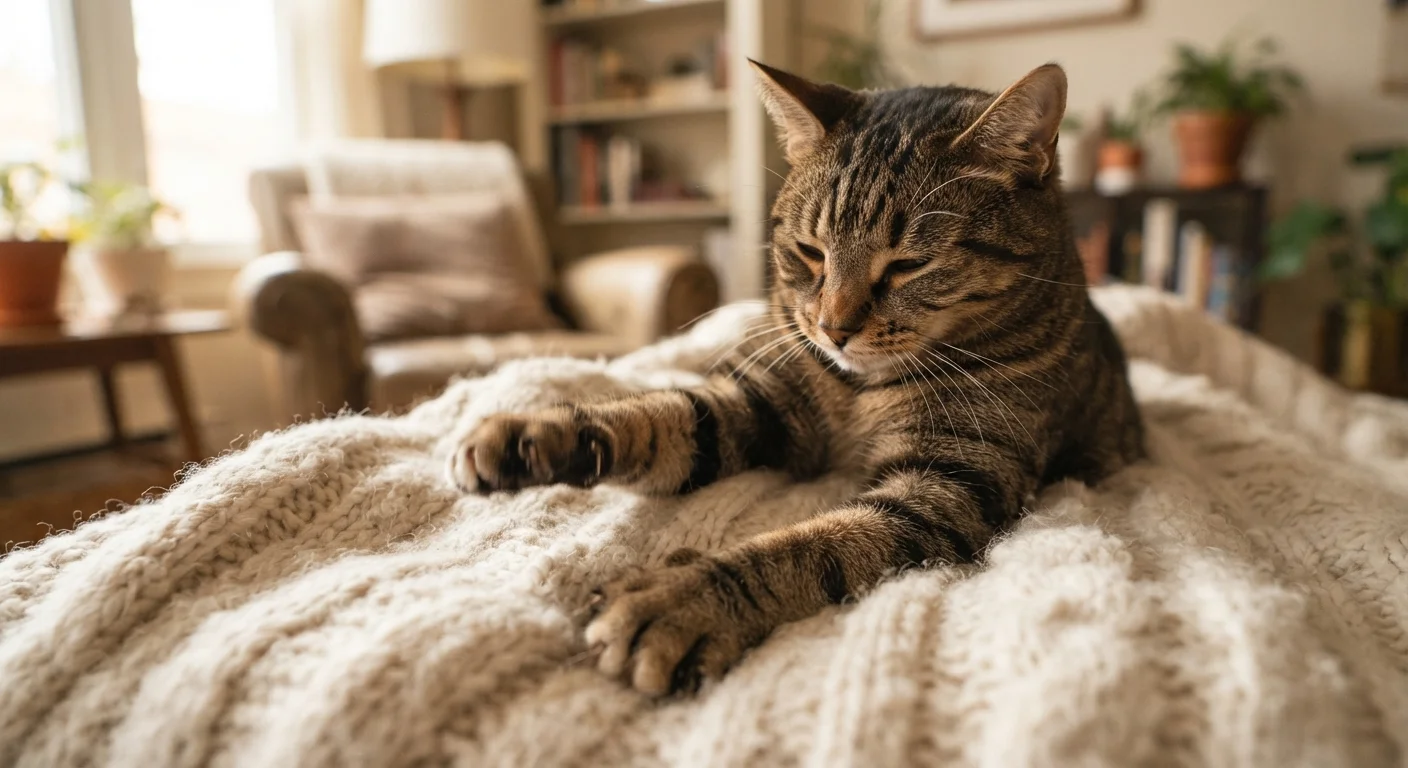
Where Kneading Begins: The Nursing Reflex
Kneading starts within hours of birth. Newborn kittens instinctively press their paws against their mother's mammary glands in an alternating rhythm to stimulate milk flow — a behavior sometimes called "milk treading." This motion is essential for survival in the first weeks of life, and it's paired with warmth, nourishment, and the scent of the mother.
The brain forms a powerful association between this action and feelings of safety. As kittens mature and no longer depend on nursing, the physical reflex often remains, now activated not by hunger but by emotional state. Many adult cats knead when they're relaxed, settling in for sleep, or seeking closeness with a trusted person — mirroring the conditions of early kittenhood.
This is why kneading is broadly understood by animal behaviorists as a retained neonatal behavior — one that carries emotional weight far beyond its original biological purpose. To understand more behavioral signals your cat uses, see our practical guide to reading pet body language.
Make Kneading Comfortable for Both of You
If your cat's kneading is painful due to sharp claws, place a thick blanket on your lap before your cat settles in. This allows your cat to express the behavior naturally without discomfort. Avoid punishing or physically stopping kneading — it can erode the trust the behavior itself signals.
What Kneading Signals About Your Cat's Emotional State
When an adult cat kneads, it's communicating something meaningful about how it feels in that moment. The most common emotional drivers include:
- Contentment and relaxation: Cats frequently knead just before settling into sleep, signaling a deep sense of calm.
- Affection toward a trusted person: Kneading on a human's lap is a notable sign of bonding. Your cat is associating you with the same security it once felt with its mother.
- Nesting instinct: Particularly in female cats, kneading can precede sleep as a way of "preparing" a soft surface — an echo of wild ancestors creating a resting spot.
- Stress self-soothing: In some cases, cats knead as a coping mechanism during mild anxiety, similar to how humans might fidget or rock.
Kneading is rarely an isolated signal. Pairing it with purring, slow blinking, or a relaxed body posture typically confirms contentment. Our article on what a cat's tail position signals offers additional context for reading these combined cues.
“Many behaviors we see in adult cats are essentially neonatal behaviors that have been redirected toward the human caregiver — the owner becomes a substitute attachment figure, and the cat responds with the same instinctual repertoire it used with its mother.”
— John Bradshaw, Anthrozoologist and author of 'Cat Sense', University of Bristol
The Scent-Marking Dimension
There's a territorial layer to kneading that's easy to overlook. Cats have scent glands located in the soft pads of their paws. When a cat kneads a surface — whether a blanket, a couch cushion, or a person's leg — it deposits a subtle chemical signature unique to that individual cat.
This scent marking isn't aggressive. It functions more like a quiet claim of familiarity: "this space is safe, and it belongs to me." In multi-cat households, you may notice cats kneading preferred resting spots more frequently, reinforcing their personal scent in shared territory.
Kneading Is Not Exclusive to Domestic Cats
Wild felids including cheetahs, pumas, and several small wild cat species have been observed kneading in captivity and in the wild. This suggests the behavior has ancient evolutionary roots rather than being a byproduct of domestication alone. It underscores how deeply embedded kneading is in feline neurobiology.
This combination of emotional expression and scent communication makes kneading a richer behavior than it first appears — one that touches on feline social structure, security, and identity simultaneously.
When Kneading Warrants a Closer Look
For the overwhelming majority of cats, kneading is a normal, healthy behavior requiring no intervention. However, a few patterns are worth noting:
- Sudden increase in frequency: A cat that begins kneading compulsively or for unusually long periods may be experiencing heightened stress or anxiety.
- Kneading accompanied by discomfort signs: If your cat kneads while also vocalizing, losing appetite, or showing changes in movement, a veterinary evaluation is appropriate.
- Kneading hard surfaces obsessively: This can occasionally be associated with compulsive behavior disorders in cats, which a veterinarian or veterinary behaviorist can assess.
Sharp claws during kneading are a common practical concern for owners. Regular nail trimming — covered in our home grooming guide for cats and other pets — can make the behavior more comfortable for both of you without discouraging it entirely.
This article is for general informational purposes only. For concerns about your cat's health or behavior, consult a licensed veterinarian or certified veterinary behaviorist.
Frequently Asked Questions
Cats typically knead surfaces or individuals they associate with safety and comfort. When a cat kneads you, it's a strong behavioral signal of trust and affection — your cat perceives you as a secure, nurturing presence similar to its mother.
Early weaning is one factor that may contribute to more persistent kneading in adult cats, but it isn't the sole cause. Many cats weaned at appropriate ages continue to knead throughout their lives. The behavior is deeply instinctive and common across all domestic cats.
Kneading is a natural, harmless behavior that generally doesn't need to be discouraged. If sharp claws are a concern, keeping your cat's nails trimmed can help. Redirect to a blanket or designated soft surface if needed.
Kneading is usually a comfort behavior, not a pain indicator. However, if your cat suddenly kneads excessively, seems restless, or pairs kneading with vocalizing or changes in appetite, it's worth consulting a veterinarian to rule out underlying issues.
Purring and kneading frequently occur together because both behaviors are associated with states of relaxation and contentment. The combination often replicates the full sensory experience of nursing, which was the original context for both.
Most domestic cats knead, but frequency and intensity vary significantly by individual. Some cats knead daily with great enthusiasm; others rarely do it at all. Neither extreme is abnormal.
The content on this site is for informational purposes only and is not a substitute for professional advice. Always consult a qualified professional for guidance specific to your situation.