

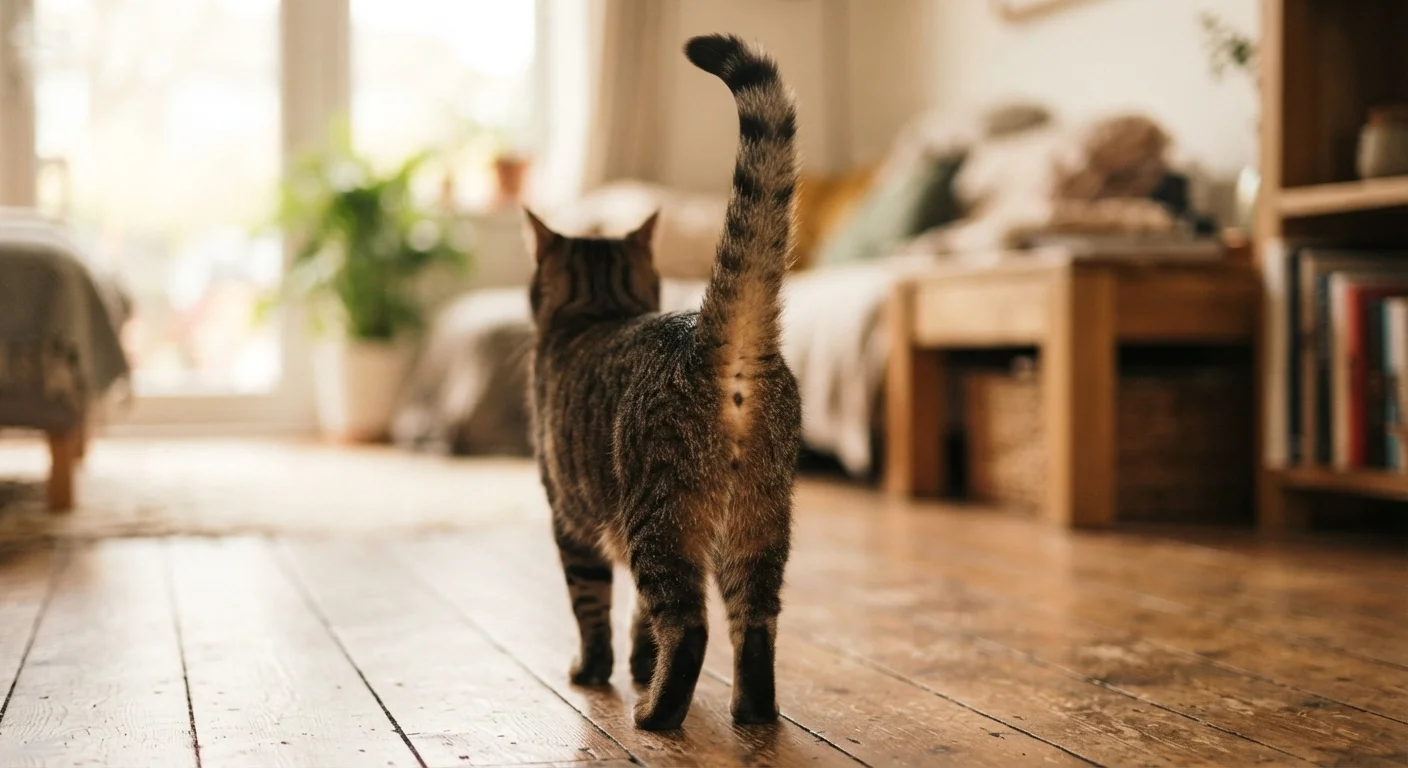
Why the Tail Is a Cat's Most Expressive Tool
Cats communicate through a layered system of postures, vocalizations, and movements — and the tail is one of the most dynamic channels in that system. Unlike dogs, whose tails swing broadly and often ambiguously, cats use precise tail positions to signal emotional states ranging from deep contentment to outright aggression. Reading these signals accurately helps owners respond appropriately and strengthen the human-cat bond over time.
Tail communication doesn't operate in isolation. Context always matters: what the rest of the body is doing, who else is in the room, and whether the environment is familiar all shape what a given tail position means. For a broader framework on interpreting feline and canine signals together, see our practical field guide to pet body language.
| Primary function of tail signaling | Emotional and social communication |
| High vertical tail meaning | Confidence, contentment, friendly greeting |
| Puffed tail trigger | Fear or aggression (involuntary piloerection) |
| Tail lashing (fast) meaning | Irritation or warning — back off |
| Tail wrapped around owner | Affiliation and social bonding |
| Low or tucked tail meaning | Fear, submission, or anxiety |
Common Tail Positions and What They Signal
The following positions represent the most frequently observed tail postures, each with a distinct communicative meaning.
Tail Held High (Vertical)
A tail pointed straight up — often with a slight curve at the tip — is one of the clearest signs of a confident, content cat. Cats typically approach familiar humans or friendly animals this way. It functions as a social greeting and an indicator of positive intent.
Tail Curved at the Tip (Question Mark Shape)
A high tail that hooks at the end like a question mark signals a cat that is friendly and open to interaction, but also slightly curious or playful. This is an invitation to engage — gently and on the cat's terms.
Tail Low or Tucked
A tail carried low, close to the body, or tucked between the hind legs indicates anxiety, submission, or fear. A cat in this posture may be feeling threatened or overwhelmed. Repeated displays of low-tail posture in everyday situations can suggest chronic stress and may warrant a conversation with a veterinarian.
Tail Puffed Up (Piloerection)
When the tail inflates to two or three times its normal size, the cat is experiencing a strong fear or aggressive response — often both simultaneously. This piloerection (hair standing on end) is involuntary and designed to make the cat appear larger. Giving the cat space and removing any perceived threat is the appropriate response.
Tail Lashing or Thrashing
Slow, deliberate swishing from side to side signals agitation or intense focus — for example, during predatory stalking. Fast, whipping movements indicate escalating irritation. Unlike a dog's enthusiastic tail wag, a rapidly lashing cat tail is a clear warning to back off. This is often misread by children and new cat owners.
Tail Wrapped Around Another Cat or Person
Draping the tail over or around another individual is a feline gesture of affiliation and social bonding. It is the tail equivalent of a friendly arm around the shoulder. Cats that do this frequently with their owners demonstrate a high degree of comfort and attachment. This behavior connects to other affiliative behaviors explored in our article on why cats knead.
Piloerection
The involuntary bristling of fur caused by the contraction of small muscles attached to hair follicles. In cats, it occurs during intense fear or aggression and makes the tail — and sometimes the back — appear significantly larger.
Affiliative behavior
Social behaviors that promote bonding and positive relationships between individuals. In cats, these include tail-wrapping, slow blinking, and mutual grooming.
Predatory stalking posture
A focused, low-body position cats adopt when tracking prey or a toy. The tail may swish slowly during this state as concentration increases.
Social greeting
A behavior used to acknowledge and positively initiate contact with a known individual. In cats, the high-held vertical tail is a classic social greeting directed at humans and familiar cats.
When Tail Signals Point to Something More Serious
Tail behavior can occasionally reflect physical discomfort rather than pure emotion. A cat that holds its tail rigidly to one side, guards it from touch, or has suddenly changed its tail posture habits may be experiencing pain or injury. Tail injuries — including nerve damage from trauma — are more common than many owners realize and can affect mobility and sensation.
Because cats instinctively mask discomfort, behavioral changes are often the earliest detectable sign. Our companion article on signs a pet may be in pain outlines what to watch for beyond the obvious. If a cat's tail posture changes suddenly and persistently without an obvious trigger, a veterinary evaluation is always the right step.
Understanding what your cat is communicating moment to moment — through its tail and the rest of its body — is a skill that deepens with observation. For a broader look at the signals other pets use daily, the animal communication field guide provides a useful cross-species reference.
Context Always Modifies Meaning
No tail position carries meaning in isolation. A high tail in a relaxed home environment signals confidence; the same posture during a tense standoff with another cat may be part of an assertive or threatening display. Always read the tail alongside facial expression, ear position, and overall body posture. Our pet body language field guide covers how these signals combine.
The content on this site is for informational purposes only and is not a substitute for professional advice. Always consult a qualified professional for guidance specific to your situation.