

What Debt-to-Income Ratio Actually Measures
Your debt-to-income ratio (DTI) is a straightforward calculation: the percentage of your gross monthly income that goes toward paying recurring debts. Lenders use it to gauge how much financial room you have left after meeting existing obligations.
The formula is simple:
DTI = (Total Monthly Debt Payments ÷ Gross Monthly Income) × 100
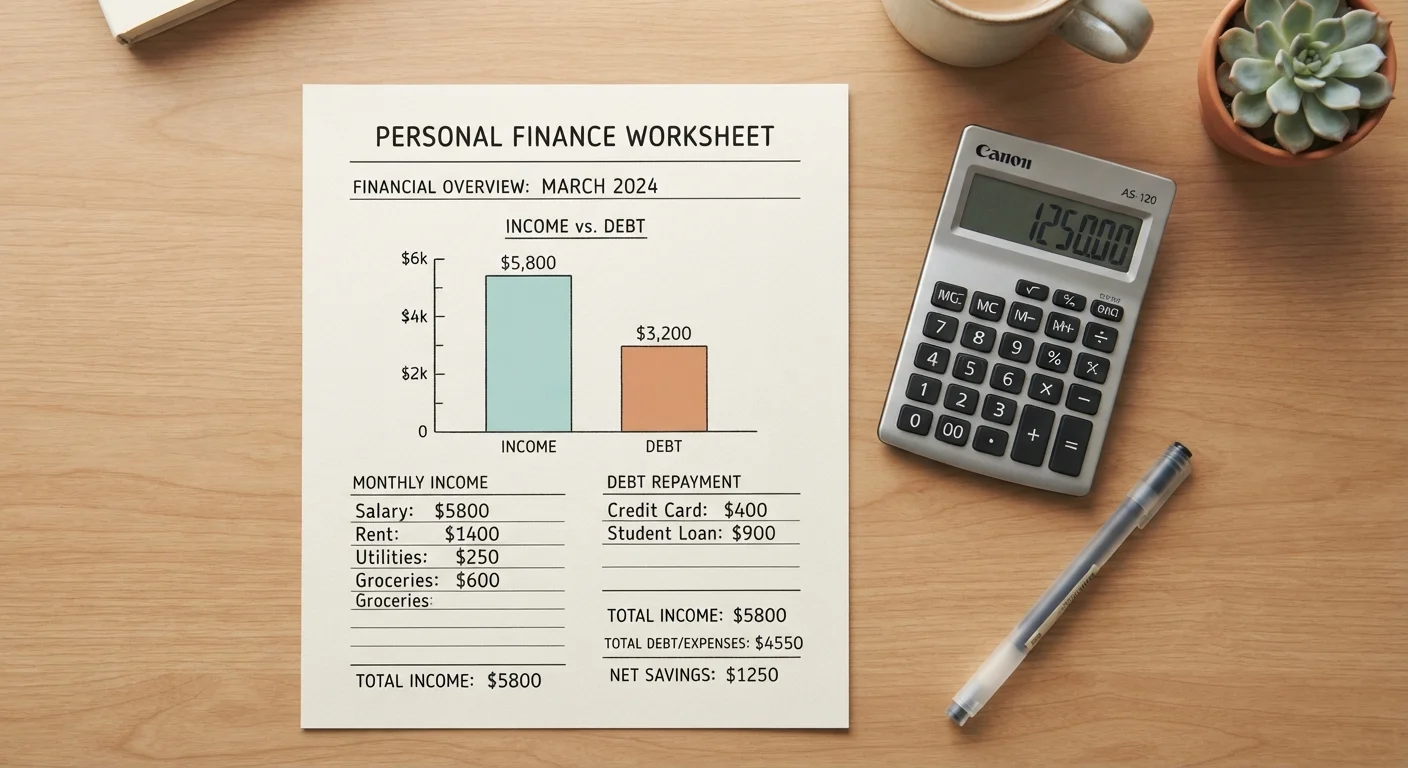
For example, if your gross monthly income is $5,000 and your total recurring debt payments are $1,500, your DTI is 30%.
What counts as a debt payment? Lenders typically include: mortgage or rent, car loans, student loans, minimum credit card payments, personal loans, and child support or alimony obligations. They use gross income — what you earn before taxes — not your take-home pay.
| DTI Formula | Monthly debt payments ÷ Gross monthly income × 100 |
| Typical front-end guideline | Below 28% of gross income for housing costs (Common conventional lending standard) |
| Typical back-end guideline | Below 36%–43% for all debt combined (Varies by loan type and lender) |
| Does DTI affect your credit score? | No — DTI is not part of credit scoring models |
| Income used in calculation | Gross (pre-tax) monthly income |
Why Lenders Pay Close Attention to It
DTI is one of the most reliable signals a lender has about whether a borrower can handle a new payment. A strong credit score tells a lender you've paid on time historically. DTI tells them whether you have the cash flow to continue doing so.
Most lenders work with two benchmarks:
- Front-end DTI: Housing costs only (mortgage principal, interest, taxes, and insurance) as a share of gross income. A common guideline is staying below 28%.
- Back-end DTI: All recurring debts combined. For conventional mortgages, many lenders prefer this figure below 36%, though some loan programs allow up to 43% or slightly higher with strong compensating factors.
A lower DTI signals more financial flexibility, which makes a lender more confident you can absorb unexpected expenses without missing payments. Understanding this context pairs well with a broader view of how borrowing decisions work — see our guide on good debt vs. bad debt for the full picture.
DTI Is Separate From Your Credit Score
Many borrowers assume DTI and credit score measure the same thing — they don't. Your credit score reflects payment history, credit utilization, and account age. DTI reflects cash flow and capacity. Lenders typically look at both metrics together when evaluating an application. A strong credit score won't fully offset a high DTI, and vice versa.
How to Interpret Your Own Number
DTI benchmarks generally fall into four zones, though lenders may apply their own thresholds:
Debt-to-Income Ratio (DTI)
The percentage of your gross monthly income consumed by recurring debt payments. It is calculated by dividing total monthly debt obligations by gross monthly income and multiplying by 100.
Gross Monthly Income
Your total earnings before taxes, deductions, or withholdings are removed. Lenders use this figure — not take-home pay — when calculating DTI.
Front-End DTI
A narrower version of DTI that includes only housing-related costs (mortgage principal, interest, property taxes, and insurance) as a share of gross income.
Back-End DTI
The full DTI calculation that includes all recurring monthly debt obligations — housing plus car loans, student loans, credit card minimums, and other installment debts.
Compensating Factors
Positive financial characteristics — such as significant savings, a large down payment, or a long employment history — that may allow a lender to approve a borrower with a higher-than-ideal DTI.
DTI does not appear on your credit report, and it isn't part of your credit score — it's calculated fresh each time you apply for credit using the information you provide. That means improving your DTI is something you can work on actively before you apply.
Two levers move your DTI in the right direction: paying down existing debt (reducing the numerator) or increasing your income (raising the denominator). Even small, consistent reductions to monthly obligations can shift your ratio meaningfully over time. If high balances are the core challenge, the patterns explored in why people stay in debt may be worth reviewing alongside your numbers.
It's also worth knowing that paying off an account doesn't always affect every financial metric the same way — what happens to your credit score when you pay off debt explains how those dynamics differ.
If you're weighing whether to put extra money toward debt or savings, DTI is a useful input — but it's one factor among several. Our article on saving and debt repayment at the same time walks through that trade-off without a one-size-fits-all prescription.
This article is for general informational purposes only and does not constitute personalized financial or lending advice. Consult a licensed financial professional for guidance specific to your situation.
The content on this site is for informational purposes only and is not a substitute for professional advice. Always consult a qualified professional for guidance specific to your situation.