

The Safety Foundation: Power Off, Verified Off
Before any outlet work begins, the single most critical rule is deceptively simple: cut power at the breaker and confirm it is dead. Tripping a breaker is not enough on its own — labels are frequently wrong, and some circuits are wired in ways that leave unexpected voltage present even after you flip the switch you intended.
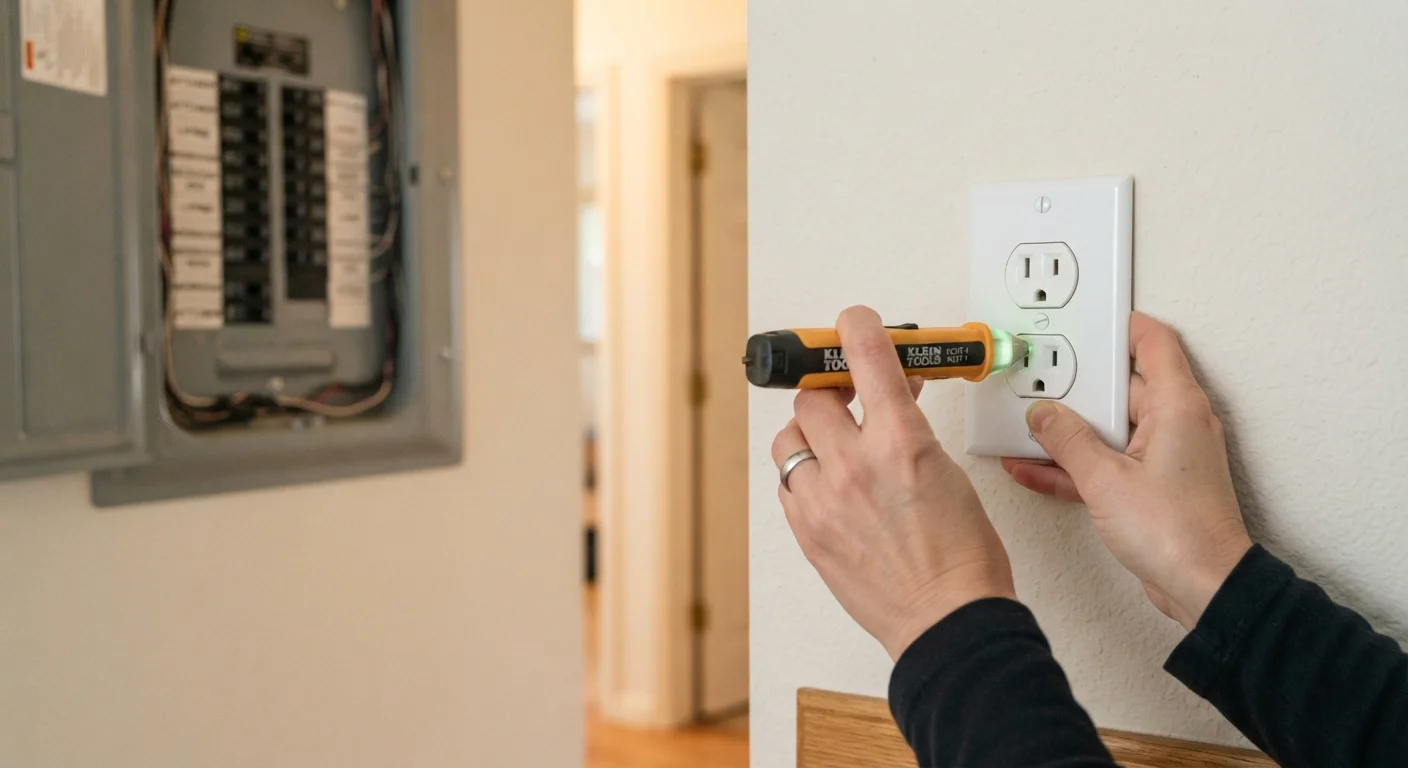
Always use a non-contact voltage tester (sometimes called a tick tracer) to probe the outlet slots before touching anything. These tools cost very little and can be found at any hardware store. Hold the tip near each slot and the ground hole. If the tester signals voltage — stop. Find the correct breaker, trip it, and test again before proceeding.
Verify Power Is Off — Every Time
Never skip the voltage tester step, even if you're certain you flipped the right breaker. Breaker labels in older homes are frequently inaccurate, and some outlets share circuits in non-obvious ways. A non-contact voltage tester is inexpensive, requires no electrical knowledge to use, and is the single most important tool for safe outlet work.
It's also worth letting a family member know you're working on a circuit, or placing a strip of tape over the breaker, so nobody inadvertently restores power while your hands are in the box.
What Homeowners Can Reasonably Handle
Once power is reliably off, a small category of outlet tasks sits within reach of a careful, patient homeowner:
- Replacing a damaged outlet cover plate — no wiring involved, no special knowledge required.
- Swapping a faulty standard duplex outlet with an identical replacement — same amperage (typically 15A or 20A), same wiring configuration, same grounded circuit. Photograph the existing wiring connections before disconnecting anything, and reconnect wire-for-wire.
- Resetting a tripped GFCI outlet — the TEST and RESET buttons on GFCI outlets are designed for homeowner use. If it won't reset, the underlying fault needs professional diagnosis.
Even within these tasks, pay attention to what you find inside the box. See our complete DIY home repair guide for more on reading a repair job before committing to it.
~51,000
Home electrical fires reported annually in the U.S.
According to the U.S. Fire Administration, electrical fires are among the leading causes of residential fires, often traced to wiring faults and overloaded circuits.
400+
Electrocution deaths per year in the U.S.
The Electrical Safety Foundation International (ESFI) reports that hundreds of Americans die from electrocution annually, with home wiring and appliances among the leading causes.
Where the Line Is: Work That Requires a Licensed Electrician
Several situations move firmly out of DIY territory, regardless of a homeowner's comfort level:
- Burned, discolored, or melted wiring. Char marks signal arcing or overloading — a fire hazard that the outlet swap itself won't fix.
- Adding a new outlet or extending a circuit. Running new cable through walls and connecting to a breaker panel requires permits in virtually all U.S. jurisdictions and must be inspected.
- Upgrading to a higher amperage circuit (e.g., adding a 20A dedicated circuit for an appliance). This always involves the panel.
- Older or non-standard wiring systems. Homes built before the mid-1970s may have aluminum branch-circuit wiring, and pre-1950 homes may have knob-and-tube systems. Both require specialized handling — standard outlet replacement techniques do not apply safely.
- Any work inside the breaker panel itself. Panels carry lethal voltage on the main lugs even when the main breaker is off. This is not a DIY space.
Just as knowing when not to attempt a repair yourself applies to vehicles, it's equally true at home. Our related article on DIY vs. mechanic decisions illustrates why drawing that line protects both safety and your wallet. Similarly, our piece on common DIY home repair myths explores how skipping a professional can cost more in the long run.
Permits Protect You, Not Just the Code
It can be tempting to skip a permit for what feels like a minor electrical job, but permitted work is inspected — which means a licensed inspector confirms the work is safe before it's concealed inside walls. Unpermitted electrical work can also complicate home sales and may affect insurance claims if a wiring-related incident occurs.
GFCI and AFCI Outlets: Upgrade With Care
Upgrading to GFCI (ground fault circuit interrupter) or AFCI (arc fault circuit interrupter) outlets is often required when renovating kitchens, bathrooms, bedrooms, or other spaces under current NEC standards. Both types involve more complex wiring than a standard outlet replacement:
- GFCI outlets have LINE and LOAD terminals. Wiring them incorrectly means the protection won't function — or downstream outlets on the same circuit won't be protected as intended.
- AFCI protection is increasingly required in living spaces and bedrooms; it is most commonly implemented at the breaker, not the outlet. An AFCI breaker installation always involves the panel and should be left to a licensed electrician.
If you have pets at home, note that unprotected or damaged outlets are also a household hazard for animals. Our guide on creating a safe home environment for pets covers this and other hidden risks worth addressing.
This article is for general informational and educational purposes only. Electrical work can present serious hazards including shock and fire. Always verify local permit and code requirements with your municipality, and consult a licensed electrician for any work beyond simple device replacement.
Frequently Asked Questions
Replacing a standard outlet with an identical replacement on a properly de-energized circuit is one of the more manageable DIY electrical tasks. The key requirements are confirming power is off with a non-contact voltage tester, matching the outlet's amperage and wiring type exactly, and restoring power only after the device is fully reassembled. When in doubt, hire a licensed electrician.
Call a licensed electrician if you find burned wires, smell something like melted plastic, notice the outlet is hot to the touch, or if you need to add a new circuit. Aluminum wiring, knob-and-tube systems, or any work inside the breaker panel also require a professional. These situations carry real fire and shock hazards.
Permit requirements vary by municipality. Simple like-for-like outlet replacements are often exempt, but upgrading outlet types, adding new outlets, or running new wiring almost always requires a permit and inspection. Contact your local building department before starting to confirm what applies to your project.
Use a non-contact voltage tester — an inexpensive tool widely available at hardware stores — held near the outlet slots after switching off the relevant breaker. The tester beeps or lights up if voltage is still present. Never rely on the breaker label alone; labels are sometimes incorrect.
A ground fault circuit interrupter (GFCI) outlet detects tiny imbalances in current flow and shuts off power within milliseconds to prevent shock. The NEC requires GFCI protection in kitchens, bathrooms, garages, basements, and outdoor areas. If your home lacks GFCI outlets in these locations, upgrading is strongly recommended for safety.
The content on this site is for informational purposes only and is not a substitute for professional advice. Always consult a qualified professional for guidance specific to your situation.