

Screws: The Everyday Workhorse
Screws are threaded fasteners designed to be driven into a material — typically wood, drywall, or metal — using a screwdriver or drill. Their helical threads grip the surrounding material, creating a pull-down force that holds two surfaces together without a nut.
| Most common household screw size | #8 x 1-5/8" coarse thread |
| Standard drywall thickness (US) | ½ inch (most interior walls) |
| Lag bolt typical diameter range | ¼" to ¾" |
| Toggle bolt load capacity (general range) | Up to 100+ lbs. depending on size and wall (Verify with product specifications) |
| Fastener finish for outdoor use | Stainless steel or hot-dip galvanized |
Common Screw Types
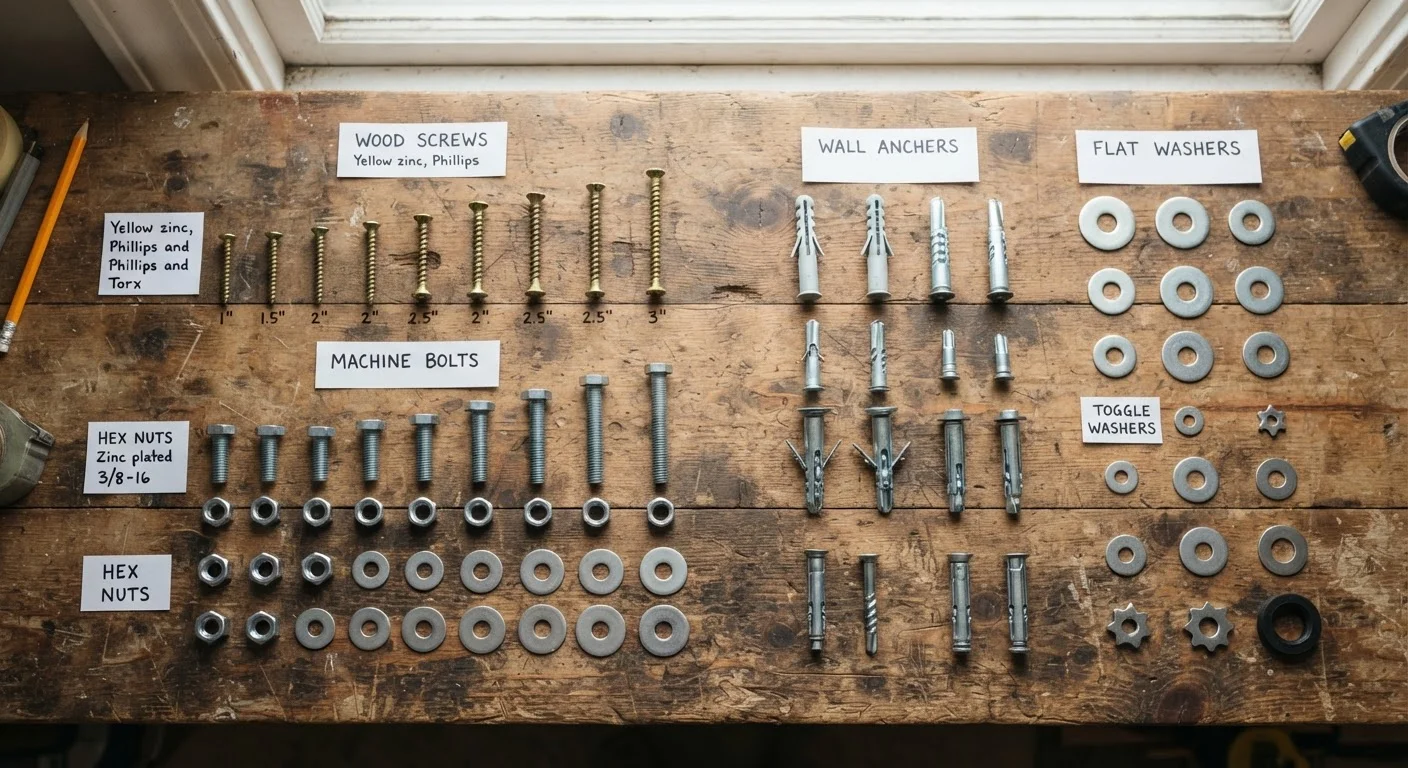
- Wood screws: Coarse threads with a tapered shank. Best for joining solid wood or plywood. The partially unthreaded shank lets the top board pull flush against the bottom piece.
- Drywall screws: Fine or coarse threads with a bugle head that countersinks cleanly. Designed specifically for attaching drywall to wood or metal studs — not ideal as a general-purpose fastener.
- Sheet metal screws: Fully threaded from tip to head. Cuts its own thread as it drives into thin metal, making it useful for HVAC ducts and metal brackets.
- Deck screws: Coated for outdoor moisture resistance, with serrated threads that resist the wood's natural expansion and contraction.
Drive type matters too. Phillips, square (Robertson), and Torx heads each have tradeoffs in cam-out resistance and tool availability. Always match your bit to the head recess to avoid stripping.
Bolts, Nuts, and Washers: When You Need Real Holding Power
Unlike screws, bolts pass entirely through a material and are secured on the far side with a nut. This through-connection distributes load more evenly and is the right choice when a joint will face significant shear or tension forces — think deck ledger boards, structural brackets, or heavy machinery mounts.
Shear force
A force that acts parallel to the fastener's length, trying to slide one surface past another. Bolts with washers handle shear better than screws alone.
Tensile strength
The maximum load a fastener can bear when pulled along its axis before it fails. Bolt grade markings indicate tensile strength rating.
Pilot hole
A small guide hole drilled before driving a screw or anchor. Prevents wood splitting and allows more controlled fastener placement.
Countersink
A tapered recess cut or drilled so a screw head sits flush with or below the material surface, rather than protruding.
Grade (bolt grade)
A standardized rating — marked by lines or numbers on the bolt head — that indicates its tensile strength and material quality. Higher grades handle greater loads.
Galvanized
A zinc coating applied to steel fasteners to resist corrosion. Hot-dip galvanized offers thicker, more durable protection than electroplated zinc coatings.
Common Bolt Types
- Hex bolts: The standard six-sided head bolt used in framing, machinery, and metal fabrication. Available in a wide range of diameters (typically ¼" to 1") and grades.
- Carriage bolts: A domed, smooth head with a square shoulder beneath it. The square locks into wood as the nut tightens, preventing spinning — ideal for wood-to-wood structural connections.
- Lag bolts (lag screws): Heavy-duty fasteners with a hex head and coarse wood-screw threads. Driven directly into wood without a nut, they're used for structural connections such as attaching a ledger board to a house rim joist.
Washers Matter
Flat washers spread the clamping load over a larger surface area, protecting softer materials from the head or nut digging in. Lock washers and nylon-insert locknuts resist loosening under vibration. Never skip washers on structural or load-bearing connections.
For detailed context on tackling structural connections and other first repairs, see our complete DIY home repair guide.
Wall Anchors: Fastening Into Hollow or Weak Surfaces
When there's no stud, joist, or solid backing to drive into, a wall anchor transfers the load to a wider area of the wall surface itself. Choosing the wrong anchor — or skipping one entirely — is a leading cause of mounted shelves, mirrors, and fixtures failing unexpectedly.
#1
Cause of mounted fixture failure in drywall
Using an undersized or incorrect wall anchor is widely cited by home improvement professionals as the leading reason shelves and fixtures pull away from walls.
16"
Standard stud spacing in US wood-frame construction
Most US homes are built with wall studs spaced 16 inches on center, though 24-inch spacing is also used — always verify with a stud finder before fastening heavy items.
50 lbs.
Typical rated load for a threaded drywall anchor
Ratings vary by anchor size and drywall thickness; always confirm the manufacturer's published load rating for your specific anchor before use.
Anchor Types by Surface
- Plastic expansion anchors: The small ribbed plugs included with many hardware kits. Suitable only for light loads (picture hooks, small shelves) in drywall or masonry. They expand as the screw is driven in.
- Threaded drywall anchors (E-Z Anchors): Self-drilling anchors with coarse outer threads that bite into drywall without a pilot hole. Rated for moderate loads — typically up to 50 lbs. in ½" drywall, though always verify the manufacturer's rating.
- Toggle bolts (butterfly toggles): A bolt with spring-loaded wings that open behind the wall. These provide strong holding power in hollow walls — often 100 lbs. or more for heavy items like TV mounts. Requires a larger pilot hole.
- Snap toggles (strap toggles): A reusable channel-and-bolt system. The plastic strap keeps the toggle in place even if you remove the bolt, making them useful for items you need to take on and off.
- Masonry anchors (wedge anchors, sleeve anchors): For concrete or brick walls. Require a hammer drill and masonry bit. Used for mounting heavy shelving, water heaters, or structural brackets in basements and garages.
Always check the anchor's rated load against what you plan to hang — and when in doubt, find the stud.
Matching Fastener to Task: A Quick Decision Guide
Choosing correctly comes down to three questions: What material am I fastening into? How much load will this joint carry? Will it be exposed to moisture or movement?
| Situation | Recommended Fastener |
|---|---|
| Hanging a lightweight picture on drywall, no stud | Plastic expansion anchor + wood screw |
| Mounting a heavy mirror or shelf on hollow drywall | Toggle bolt or snap toggle |
| Joining two boards face-to-face (wood framing) | Structural wood screw or carriage bolt + nut |
| Attaching deck ledger to house | Lag bolts into rim joist (code-specified pattern) |
| Fastening hardware to concrete basement wall | Sleeve or wedge anchor with masonry bit |
| Installing outdoor hardware subject to moisture | Stainless steel or hot-dip galvanized fasteners |
When a project involves structural connections, electrical boxes, or load-bearing elements, verifying local building code requirements and consulting a licensed contractor is always the prudent step. Understanding fastener vocabulary also helps when reading design plans — if you want to brush up on broader home terminology, our home décor glossary is a useful companion reference.
Safety Note for Structural and Permitted Work
Structural connections — including deck ledger attachments, load-bearing wall modifications, and masonry anchoring for heavy equipment — may require a building permit and inspection in many US jurisdictions. Work involving gas lines, electrical panels, or load-bearing elements should always be handled by a licensed contractor. Check your local building department's requirements before beginning any structural fastening project.
The content on this site is for informational purposes only and is not a substitute for professional advice. Always consult a qualified professional for guidance specific to your situation.