

Our Verdict
Fitness trackers offer genuine value for building awareness of daily movement patterns and staying motivated over time. However, their metrics carry meaningful margins of error — particularly for calorie estimates and sleep staging — and should never substitute for clinical assessment. Used as a directional guide rather than a precise instrument, wearable data can be a helpful component of a sustainable health routine.
Adults looking to build consistent daily movement habits who want supportive data feedback, and who understand that the numbers are trend indicators rather than medical-grade measurements.
What Fitness Trackers Actually Measure
Modern fitness wearables and smartphone apps collect several categories of data. Understanding what sits behind each metric helps you interpret it honestly.
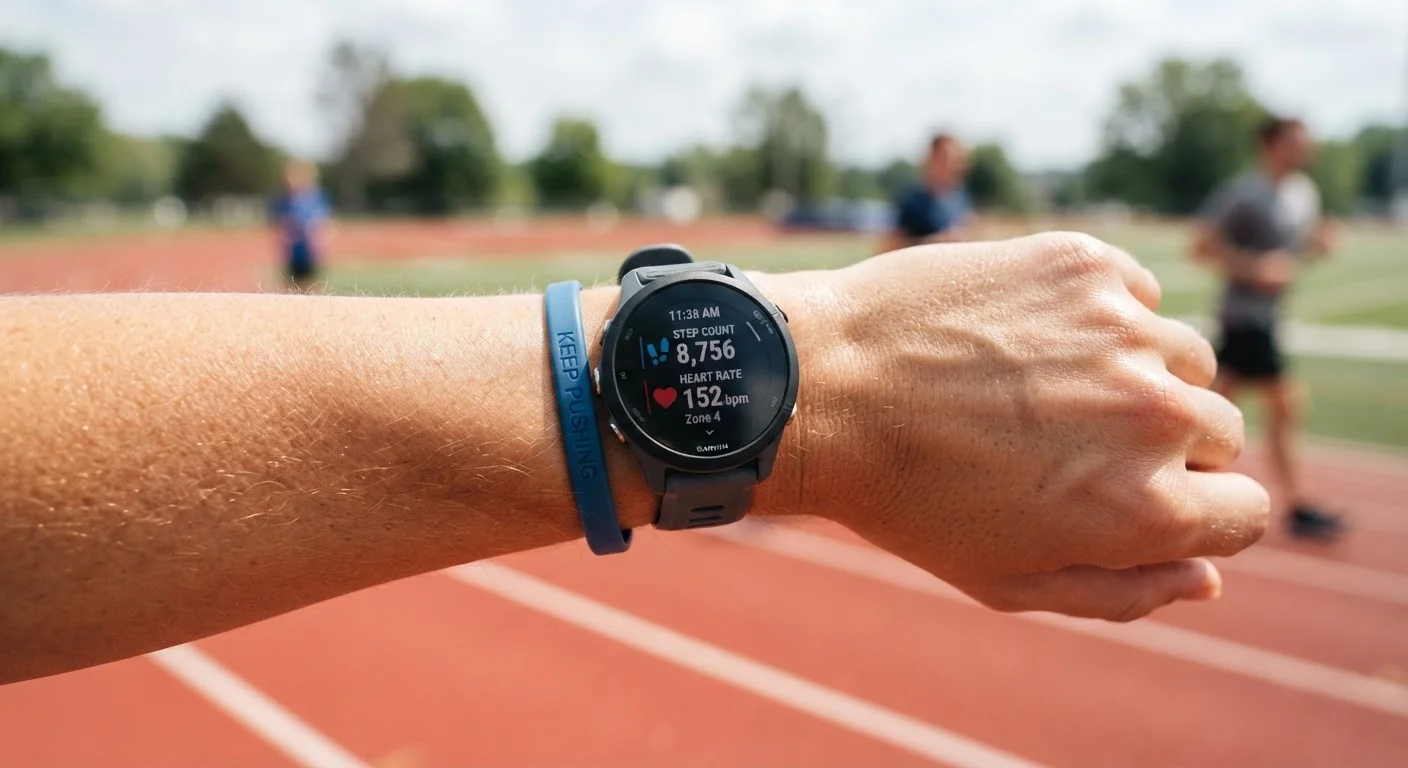
Steps: Most devices use an accelerometer — a motion sensor — to count movement patterns consistent with walking or running. This is generally the most reliable consumer metric, though it can miscount during activities like cycling or weightlifting.
Heart rate: Optical sensors on the wrist measure blood flow through the skin using light pulses (a method called photoplethysmography). Resting heart rate readings are reasonably consistent, but real-time exercise heart rate — particularly during high-intensity intervals — can lag or drift. For a deeper look at how self-monitored readings compare to clinical ones, see our guide to self-checks versus clinical readings.
Calorie burn: Trackers estimate energy expenditure using a formula that combines movement data, heart rate, and personal inputs like age, weight, and height. These estimates carry the widest margin of error of any common metric — independent studies have found deviations of 20–90% compared to laboratory measurements, depending on the device and activity type.
Sleep: Devices infer sleep stages from movement and heart rate patterns, not from brain activity. This produces broad approximations rather than clinically validated sleep architecture data.
Accuracy Varies by Metric — and by Device
Not all fitness metrics are equally reliable, and accuracy differences between devices can be significant. Step counting tends to be the most consistent metric across wearables, while calorie burn and sleep staging show the widest variability. Before placing significant weight on any metric, it helps to understand the measurement method underlying it. Independent academic reviews of wearable accuracy are published periodically and offer a more detailed picture than manufacturer claims.
The Real Advantages of Tracking
Despite their limitations, fitness trackers offer tangible benefits when used with appropriate expectations.
Builds awareness of daily movement levels
Seeing objective data on activity patterns — even rough figures — helps many people recognize sedentary gaps in their day they hadn't noticed before.
Supports consistent habit formation
Self-monitoring is one of the most consistently supported behaviour-change strategies in health psychology, particularly for physical activity adherence in early habit stages.
Tracks resting heart rate trends over time
While individual readings vary, long-term resting heart rate trends visible in wearable dashboards can reflect meaningful changes in cardiovascular fitness.
Provides motivational feedback and accountability
Goal-progress notifications and weekly summaries give many users a structured sense of progress, which can be especially helpful when external motivation is low.
Encourages reflection on sleep and recovery
Even approximate sleep tracking can prompt users to notice patterns — such as consistently short sleep on workdays — that they might otherwise overlook.
One of the strongest documented effects is increased awareness. Seeing a step count that falls short of your usual pattern is a prompt — not a diagnosis — and that prompt often motivates people to move more throughout the day. Research consistently links self-monitoring with behaviour change, particularly in the early stages of forming new habits. For context on how much daily movement public health guidelines actually recommend, the physical activity guidelines explained is a useful starting point.
Tracking also supports pattern recognition over time. Resting heart rate trends, for instance, can reflect changes in cardiovascular fitness across weeks — even if any single reading is imperfect. Longitudinal trends are where wearable data is most credible.
20–90%
Calorie estimate error range in consumer wearables
Independent validation studies have found that consumer fitness trackers can deviate from laboratory-measured calorie expenditure by this range, depending on device and activity.
~80%
Adults who report increased activity after tracking
Research reviews on self-monitoring interventions consistently find that people who track physical activity tend to increase it compared to those who do not track.
The Limitations You Should Know
The disadvantages of fitness tracking aren't reasons to abandon it — they're reasons to keep it in perspective.
Calorie estimates carry substantial error margins
Studies comparing wearable calorie readings to laboratory measurements have found significant inaccuracies — large enough to undermine decisions about diet or exercise if taken at face value.
Sleep stage data is not clinically validated
Consumer wearables infer sleep stages from movement and heart rate proxies, not brain wave activity, producing approximations that differ meaningfully from polysomnography — the clinical standard.
Can create anxiety around imperfect numbers
Obsessing over daily scores or feeling distressed when metrics dip can erode wellbeing rather than support it, turning a helpful tool into a source of stress.
Real-time exercise heart rate readings can lag
Optical wrist-based sensors are generally less accurate during high-intensity or interval exercise, where heart rate changes rapidly and motion interferes with the sensor signal.
Fitness data is not a substitute for clinical assessment
A wearable device cannot diagnose conditions, and acting on its outputs without professional context — particularly for cardiac or sleep concerns — can lead to misinformed decisions.
Privacy risks from health data collection
Fitness apps frequently share user data with third parties; the sensitivity of health-related data makes reviewing app privacy terms and permissions particularly important.
One underappreciated issue is metric fixation: when the goal shifts from moving well to hitting a number, the number can work against you. Chasing a daily step target on a day when your body genuinely needs rest, or feeling anxious when a sleep score looks poor, are signs that data has started to drive behaviour in an unhelpful direction. Understanding why fitness habits break down can help you recognise these patterns early.
There are also data privacy considerations. Fitness apps collect sensitive health-related information, often storing and sharing it with third-party partners. Reviewing privacy settings and data-sharing permissions in any wearable app is worth doing periodically.
Using the Numbers Wisely
The most effective approach treats wearable data as feedback, not verdict. A few practical principles help maintain that balance.
- Prioritise trends over individual data points. A single day's calorie estimate is not meaningful; a month-long pattern in resting heart rate may be.
- Cross-reference with how you feel. Perceived exertion, energy levels, and sleep quality as you experience them are important signals that no device can fully capture.
- Use metrics to reinforce, not replace, habits. Tracking steps is useful; becoming unable to exercise without a tracker is a sign the tool has become a crutch.
- Know when to involve a professional. If your wearable flags an irregular heart rate pattern, consistently poor sleep, or any data point that concerns you, discuss it with a qualified healthcare provider rather than self-diagnosing.
Health numbers of all kinds — from fitness trackers to clinical panels — work best when you understand their scope and limits. For a broader view of key preventive health markers, understanding cholesterol, blood sugar, and blood pressure offers useful context.
This article is for general informational purposes only and does not constitute medical advice. Consult a qualified healthcare professional for guidance specific to your health situation.
The content on this site is for informational purposes only and is not a substitute for professional advice. Always consult a qualified professional for guidance specific to your situation.