

How Speed Limits Are Actually Determined
Most drivers assume speed limits are chosen for convenience — a round number that feels administratively tidy. In reality, traffic engineers use a structured methodology to arrive at posted figures.
The most widely referenced tool in the US is the 85th-percentile speed: the pace at or below which 85% of vehicles travel on a given road when flowing freely under good conditions. The reasoning is behavioral — if the vast majority of drivers naturally choose a speed, posting a limit near that figure reduces the gap between fast and slow vehicles, which itself is a crash risk factor.
Beyond that baseline, engineers layer in additional criteria:
- Road geometry — curve radius, grade, and lane width affect the speed at which a vehicle can be safely controlled.
- Sight distance — how far ahead a driver can see determines how much reaction time is available.
- Land use — residential neighborhoods, school zones, and commercial strips introduce unpredictable pedestrian and vehicle movements.
- Crash history — locations with recurring injury patterns often prompt limit reductions regardless of the 85th-percentile figure.
The result is a number that attempts to balance mobility with safety across the realistic range of drivers who will use that road.
85th
Percentile speed used as a key engineering baseline
The 85th-percentile speed — where 85% of free-flowing traffic travels at or below — is a standard reference point in US traffic engineering studies.
4×
Stopping distance increase from 30 mph to 60 mph
Because kinetic energy scales with the square of speed, doubling your speed roughly quadruples the distance needed to stop under similar conditions.
~90%
Pedestrian fatality risk at 40 mph vs. 20 mph
Research cited by NHTSA indicates that pedestrian fatality risk rises sharply as vehicle speed increases, with significantly higher mortality rates above 40 mph compared to 20 mph impacts.
What the Number Does — and Doesn't — Tell You
A posted limit is a maximum under normal conditions, not a target speed or a guarantee of safety. This distinction matters enormously in practice.
Speed's relationship to stopping distance is not linear — it's exponential. A vehicle traveling at 60 mph doesn't simply stop twice as far as one traveling at 30 mph; it stops roughly four times as far, because kinetic energy increases with the square of velocity. Rain, worn tyres, or an inattentive moment at 60 mph compounds that distance further. For a detailed breakdown of the physics involved, see the science behind stopping distances.
Speed limits also carry legal nuance. Most US states operate under an absolute limit framework — exceeding the posted number is unlawful, period. A few states use prima facie limits, where a driver can argue that conditions made a higher speed reasonable. Either way, driving at the posted number in fog, ice, or heavy rain may still expose a driver to a reckless driving charge if conditions clearly warranted caution.
Conditions Trump the Posted Number
When roads are wet, icy, or visibility is poor, the safe speed is almost always lower than the posted limit. Adjust your speed to match stopping distance to what you can actually see ahead — not to what the sign says is legal. A driver traveling at the limit in unsafe conditions can still be found negligent if a crash occurs.
Urban, Rural, and Highway Limits Compared
Different road classifications carry distinct speed-setting philosophies because the environments — and their risks — differ fundamentally.
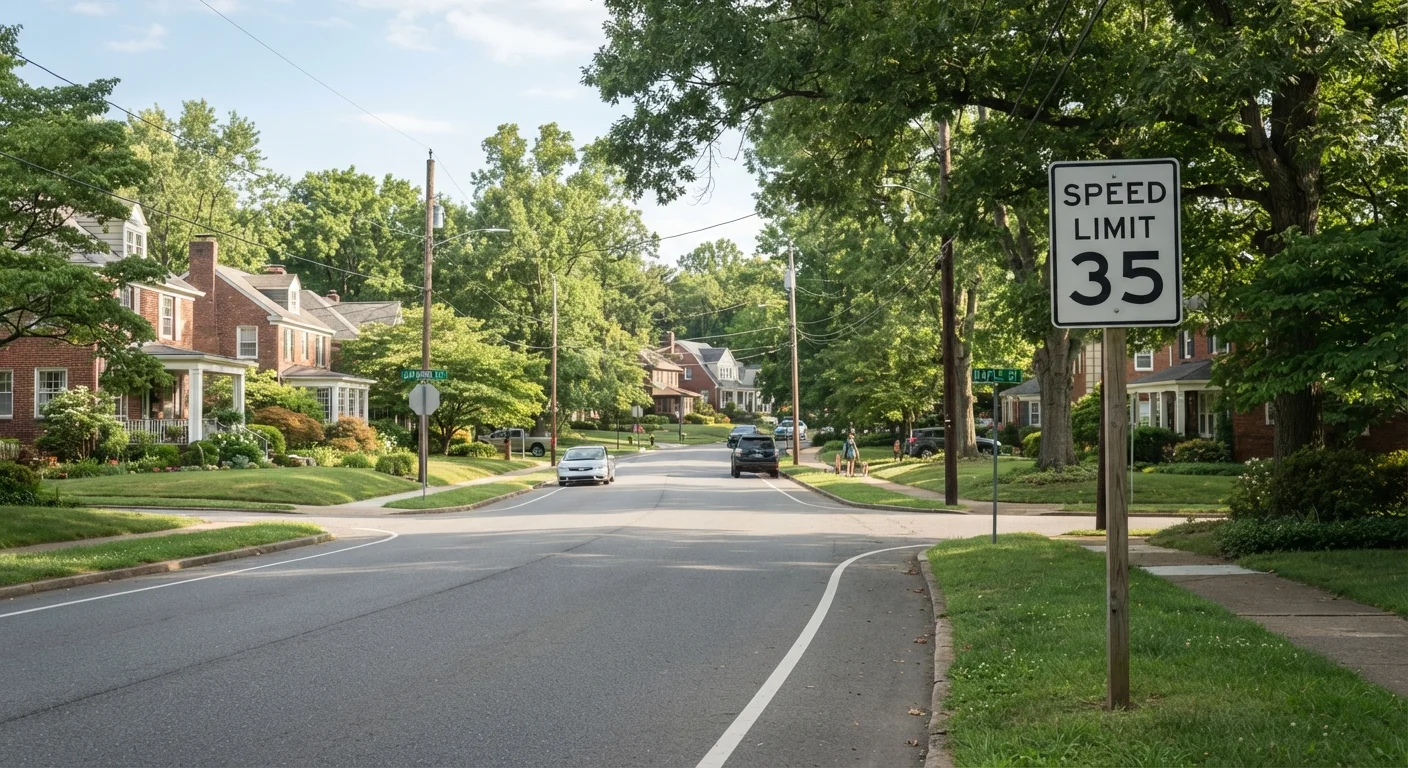
Urban and residential roads (typically 25–35 mph) are set low because pedestrians, cyclists, driveways, and parked cars create a dense field of potential conflicts. Research consistently links vehicle speed to injury severity in pedestrian crashes; at 40 mph, the risk of a fatal outcome for a struck pedestrian is dramatically higher than at 20 mph.
Arterial and collector roads (35–55 mph) serve through-traffic but still intersect frequently with cross streets and turning vehicles. Limits here balance throughput against intersection risk.
Interstates and freeways (55–85 mph depending on state) are engineered specifically for higher speeds — access is controlled, conflicts with pedestrians are eliminated, and geometry is designed for sustained velocity. Even so, higher speeds mean less time to react to lane changes, debris, or sudden slowdowns. New drivers especially benefit from building confidence gradually on these roads; motorway driving for new licence holders covers lane discipline and merging in detail.
Applying This Knowledge on the Road
Understanding the engineering behind limits reframes how you should read posted signs. The number represents a studied judgment about normal conditions — your job as a driver is to assess whether current conditions match that baseline.
Conditions that routinely require speeds well below the limit include wet or icy surfaces, reduced visibility from fog or glare, road construction zones, heavy traffic with compressed following distances, and unfamiliar road geometry. None of these factors change the posted number, but all of them change the speed at which you can actually stop safely.
Your vehicle's capabilities also matter. Tyre speed ratings, tread depth, and brake condition all influence real-world stopping performance. If you're curious about how tyre specifications translate to safety margins, tyre markings demystified explains what those sidewall codes mean in practice.
The takeaway for confident, responsible driving: treat the posted limit as a ceiling informed by engineering, then apply your own judgment to determine the appropriate speed for the conditions in front of you. The numbers exist to guide you — not to replace your assessment of the road.
“Speed limits are not arbitrary numbers plucked from thin air. They represent a studied compromise between the road's physical design, the behavior of the drivers who use it, and the consequences when something goes wrong.”
— Federal Highway Administration, US Department of Transportation agency responsible for highway safety and engineering standards
Frequently Asked Questions
Even roads that look alike can differ significantly in sight lines, intersection frequency, pedestrian crossings, and historical crash patterns. Engineers weigh all of these factors, which is why a straight suburban road and a visually similar rural highway can carry different limits.
It is a widely referenced guideline in traffic engineering, but states and municipalities are not required to follow it exclusively. Some jurisdictions also weight crash data, school zones, and land-use density more heavily, resulting in limits below the 85th-percentile speed.
Not necessarily. Posted limits assume normal, dry conditions with adequate visibility. Rain, ice, fog, heavy traffic, or road construction all demand lower speeds. The legal standard 'reasonable and prudent' applies even when you're at or under the limit.
Yes. Limits can be revised when traffic volumes change, after road redesigns, or following significant crash patterns. Authority typically rests with state transportation departments for highways and local governments for municipal roads, usually after engineering review.
A prima facie limit is a presumed-safe maximum that a driver can challenge in court by demonstrating conditions warranted a higher speed. It differs from an absolute limit, where exceeding the number is unlawful regardless of conditions. California uses prima facie limits on many roads.
The content on this site is for informational purposes only and is not a substitute for professional advice. Always consult a qualified professional for guidance specific to your situation.