

Why Subtle Habits Are the Harder Problem
When driver distraction comes up, phone use dominates the conversation. And rightly so — handheld phone use is among the most studied and legislated driver behaviours in the US. But focusing exclusively on phones lets a wide range of quieter habits go unchallenged. These are the behaviours that feel ordinary, even justified, which is precisely what makes them persistently dangerous.
Distraction is typically divided into three types: visual (eyes off the road), manual (hands off the wheel), and cognitive (mind off the task of driving). The most hazardous habits combine two or three of these simultaneously. Eating, for example, is visual and manual. Replaying an argument in your head is cognitive. Adjusting navigation is all three at once.
Understanding which category a habit falls into helps you assess its real cost — not just its social acceptability. The mistakes outlined below cover the full spectrum, and most drivers will recognise at least a few as their own.
Distraction Lingers Longer Than You Think
Research from the AAA Foundation for Traffic Safety found that cognitive distraction can persist for up to 27 seconds after a driver stops a distracting task. At 25 mph, that's the length of nearly three football fields driven in a mentally impaired state. Completing a voice-text or adjusting settings at a red light does not mean you're fully focused when the light turns green.
Common Habits That Quietly Drain Your Focus
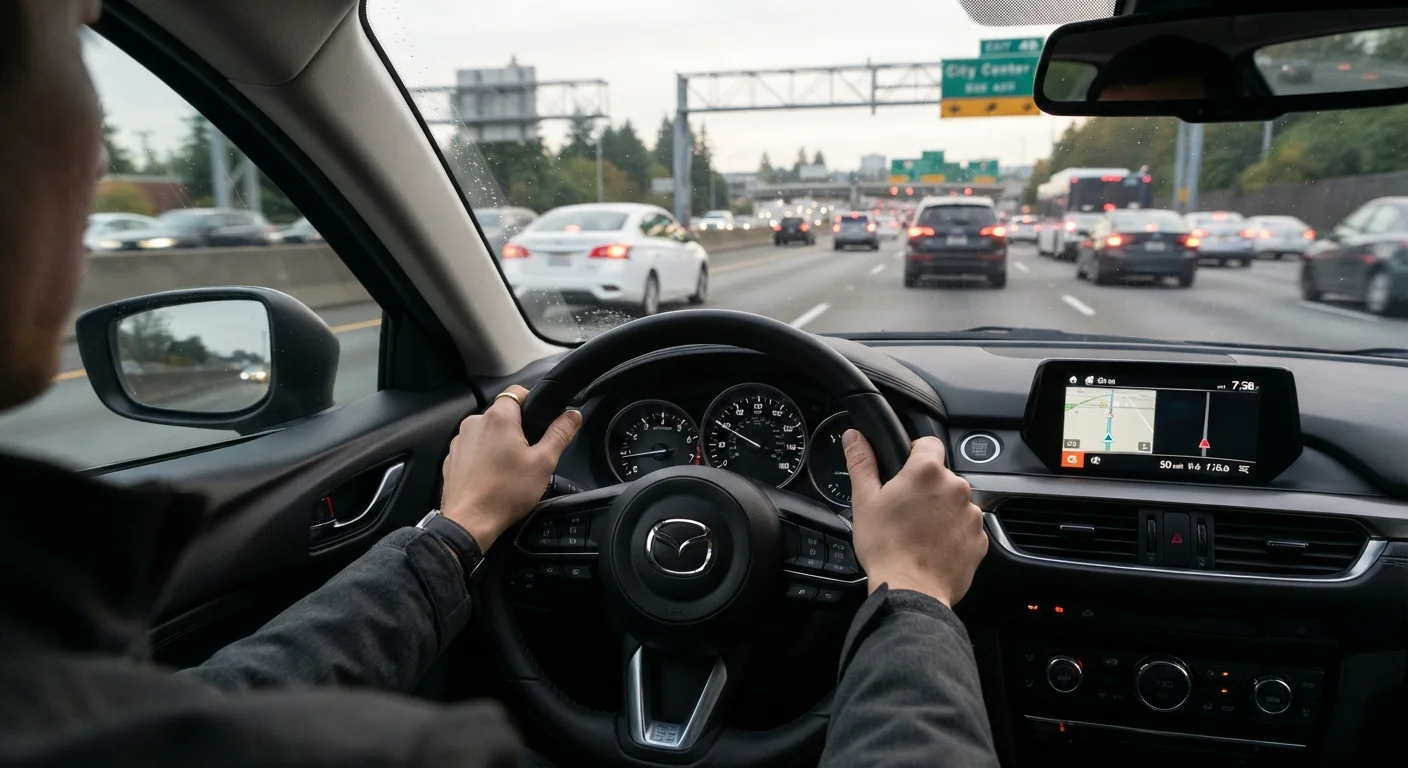
Adjusting the navigation system while the vehicle is moving.
Why it happens: Drivers often remember a route change or missed turn only after they're already in motion, creating an urgency to fix the map immediately.
Eating or drinking behind the wheel, even at slow speeds.
Why it happens: Busy schedules push meals into commute time, and eating while driving feels mundane compared to phone use, so it rarely registers as dangerous.
Allowing passenger conversations to become cognitively absorbing arguments or emotional discussions.
Why it happens: Unlike phone calls, in-person passengers can read road conditions and naturally moderate their demands — but heated or complex topics override this instinct.
Frequently glancing at a dashboard-mounted phone for notifications.
Why it happens: Drivers assume a phone in a cradle is 'safe,' but visual attention is repeatedly pulled from the road every time a notification lights the screen.
Driving while emotionally activated — angry, anxious, or deeply preoccupied.
Why it happens: There's social pressure to push through and get somewhere on time, and emotional states are invisible to others, so drivers rarely feel accountable for them.
Turning to look at something outside the vehicle — a crash, unusual building, or roadside activity.
Why it happens: The brain is wired to orient toward novel stimuli. A striking scene triggers an almost reflexive head turn before conscious thought can intervene.
These habits tend to feel isolated, but they compound. A driver who eats during a commute, checks navigation twice, and is ruminating over a stressful morning has stacked multiple attention deficits before encountering a single road hazard. For insight into how even familiar routes can reduce vigilance, see our piece on why driving conditions demand more than most realise.
Building a Cleaner Pre-Drive Routine
Most of these habits are most effectively interrupted before you start moving. A two-minute pre-drive routine — navigation set, phone silenced, music or podcast selected, mirrors adjusted, emotional state checked — eliminates the in-motion decisions that fragment attention. It also removes the feeling of urgency that prompts adjustments while driving.
Autopilot on Familiar Routes Is a Real Risk
Driving a route you know well can put your brain into a low-engagement mode — sometimes called 'highway hypnosis' — where you navigate correctly but retain almost no conscious memory of the drive. This state reduces your ability to respond to sudden, unexpected hazards. If you notice you've arrived somewhere with no clear memory of the journey, treat it as a warning sign that your attention strategy needs adjusting.
Urban environments add particular pressure to driver attention, because hazards arise with little warning. Pedestrians, cyclists, and tight gaps demand fast processing — exactly the capacity eroded by the habits above. Our guide to urban driving hazards that catch drivers off guard covers the specific demands of city driving. Equally, keeping your vehicle in good mechanical condition reduces in-cabin distractions caused by warning lights or unfamiliar sounds — tasks covered in the car maintenance section of this site.
27 sec
Cognitive distraction after completing a task
According to the AAA Foundation for Traffic Safety, mental impairment from distraction can persist for up to 27 seconds after the distracting activity ends.
~8%
Of crashes involve distraction as a factor
The NHTSA has consistently reported that distracted driving plays a role in a significant share of reported traffic crashes annually in the United States.
3x
Higher crash risk when eating while driving
NHTSA research has indicated that eating and drinking while driving can increase crash risk by roughly three times compared to undistracted driving.
Attention is a finite resource. The habits worth changing aren't the dramatic ones — you already know to avoid those. It's the mundane, repeated ones that matter most, because they're the ones you'll encounter on every single drive.
The content on this site is for informational purposes only and is not a substitute for professional advice. Always consult a qualified professional for guidance specific to your situation.