

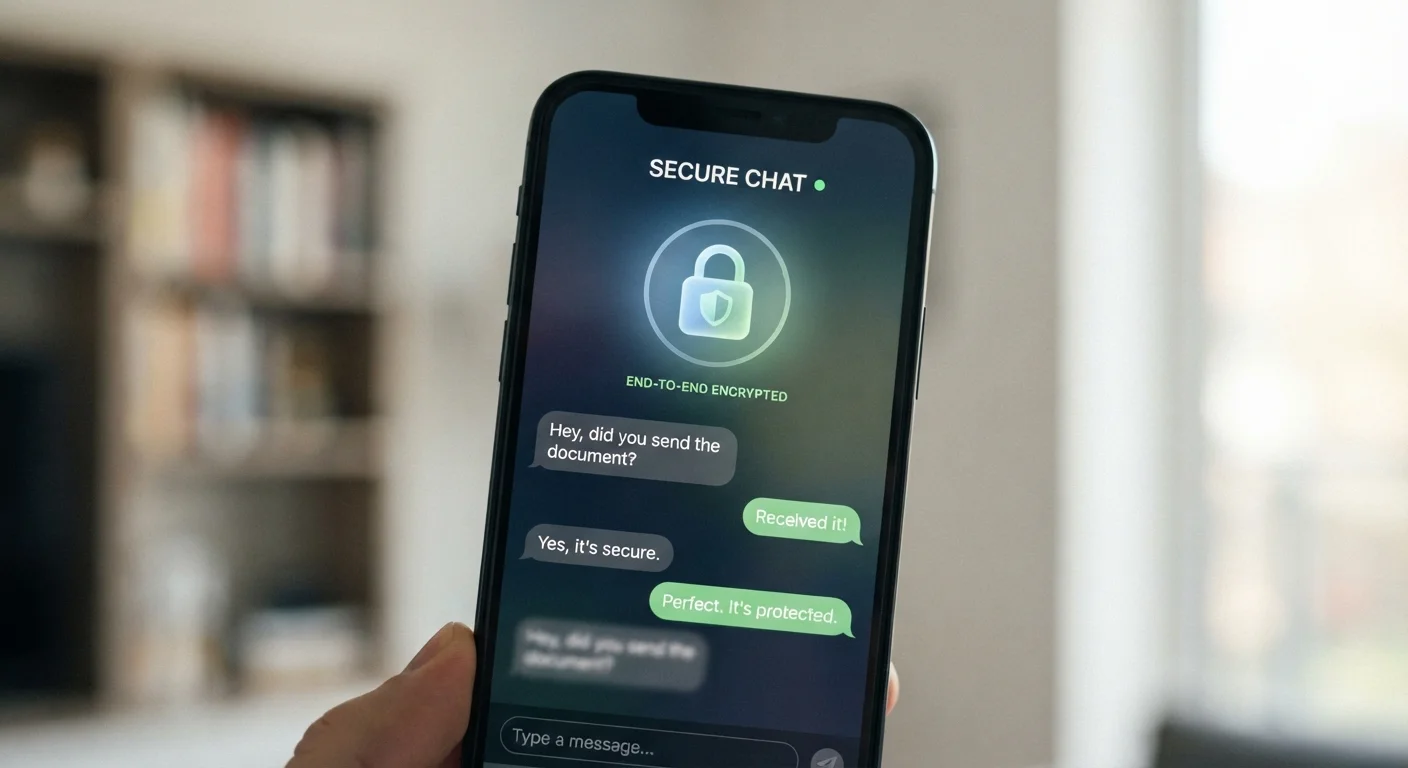
What Encryption Actually Does
When you send a message through an end-to-end encrypted app, the content is scrambled on your device before it ever leaves. It travels across the internet in an unreadable form and is only unscrambled when it arrives on your recipient's device. Think of it like sealing a letter inside a lock-box that only the recipient holds the key to — even the postal service can't peek inside.
This protection is meaningful and real. Anyone intercepting your internet traffic — whether on public Wi-Fi or at the network level — sees only encrypted noise. The messaging company's own servers act as a relay but cannot read what passes through them. For everyday users, this is a significant upgrade over unencrypted SMS messages, which travel in plain text across carrier networks.
To understand the terminology involved, our plain-English privacy glossary breaks down terms like encryption, metadata, and more without requiring a technical background.
~2 billion
Users of end-to-end encrypted messaging apps worldwide
WhatsApp alone reports over 2 billion monthly active users, making E2EE one of the most widely deployed encryption technologies in consumer software.
~45%
US adults who say they use encrypted messaging
Pew Research Center surveys on technology adoption have found substantial and growing awareness of encrypted messaging among American adults.
The Gaps Encryption Doesn't Cover
Encryption secures content in transit. It says nothing about what happens on either end of the conversation — and that's where most real-world privacy risks actually live.
Your Device and the Recipient's Device
Once a message is decrypted and displayed on a screen, it's as readable as any other text. If your phone is unlocked and unattended, or if the recipient's device is compromised by malware, screenshots can be taken, or messages forwarded without your knowledge. Encryption cannot protect against someone simply reading over your shoulder or accessing an unlocked phone.
Metadata
Encrypted apps typically still log metadata — records of who communicated with whom, and when. This information can reveal social networks, patterns of behavior, and relationships, even without a single word of content. Apps vary significantly in how much metadata they retain and for how long. This is one of several common privacy myths — many people assume encryption means total invisibility, which it doesn't.
Cloud Backups
Many people back up their phones automatically. If your encrypted messages are included in a standard cloud backup, they may be stored without encryption on the backup provider's servers. Some apps offer end-to-end encrypted backup options, but these are often not enabled by default. Always verify your backup settings explicitly.
Default Settings Aren't Always the Safest
Some apps offer optional encryption features — like encrypted backups or disappearing messages — that are not turned on by default. It's worth reviewing the privacy and security settings of any messaging app you rely on. Don't assume that using an encrypted app automatically means every setting is configured for maximum privacy.
Identity, Anonymity, and Account Data
Using an encrypted messaging app does not make you anonymous. Most apps require a phone number or email address to create an account. The provider knows your identity, your device information, and your account activity — even if they can't read your messages. If privacy from the service provider itself is a concern, understanding each app's data practices is essential.
Our guide on how messaging apps differ covers what sets popular options apart beyond their encryption claims — including data retention policies and registration requirements.
It's also worth remembering that account security remains a distinct layer. Even a perfectly encrypted message channel is undermined if someone gains access to your account through a weak password or a phishing attack. Our article on why strong passwords alone aren't enough explores the broader picture of account protection.
Check Your Backup Encryption Settings
If your encrypted messaging app offers an end-to-end encrypted backup option, consider enabling it. Standard cloud backups often store message data without the same protections as in-transit encryption. Look in the app's settings under 'Chats' or 'Privacy' for backup options. When in doubt, consult the app's official support documentation for guidance specific to your platform.
Putting It Into Perspective
End-to-end encryption is a genuinely valuable privacy tool — it's not marketing fluff. It meaningfully reduces the risk that your message content will be intercepted or read by third parties during transmission. For the vast majority of everyday communication, that's a substantial protection.
But it's one layer in a larger security picture, not a complete shield. Realistic privacy involves thinking about device security, common device security assumptions, backup settings, metadata exposure, and the trustworthiness of the people on the other end of your conversations.
Understanding what encryption actually covers — and what it doesn't — puts you in a far better position to make informed choices about how and where you communicate.
This article is for informational and educational purposes only. It does not constitute legal or professional security advice. For sensitive situations involving personal safety or legal matters, consult a qualified professional.
Frequently Asked Questions
Not entirely. E2EE protects message content while it's in transit, meaning no one intercepting the connection can read it. However, metadata (like who you messaged and when), backups, and anything visible on either device are outside that protection.
With true end-to-end encryption, the company cannot read message content because the decryption key never reaches their servers. However, they may still access metadata and account information, depending on their privacy policy.
Not necessarily. When messages are backed up to a cloud service (like iCloud or Google Drive), they may be stored without end-to-end encryption unless you've explicitly enabled that feature. Always check the backup settings in your specific app.
Metadata is information about your communication — such as who you contacted, when, and how frequently — rather than the content itself. Even without reading your messages, metadata can reveal meaningful patterns about your relationships and behavior. See our <a href="/tech-gadgets/internet-privacy/your-personal-data-online-a-plain-english-glossary">plain-English glossary</a> for more on this term.
No. Most encrypted messaging apps require a phone number or account to register, so the provider knows your identity. Encryption protects message content, not your identity or account activity.
In most cases, an app with genuine E2EE cannot hand over message content to authorities because the company doesn't possess the decryption key. However, metadata, account information, and device-level data may be accessible through legal processes.
The content on this site is for informational purposes only and is not a substitute for professional advice. Always consult a qualified professional for guidance specific to your situation.