

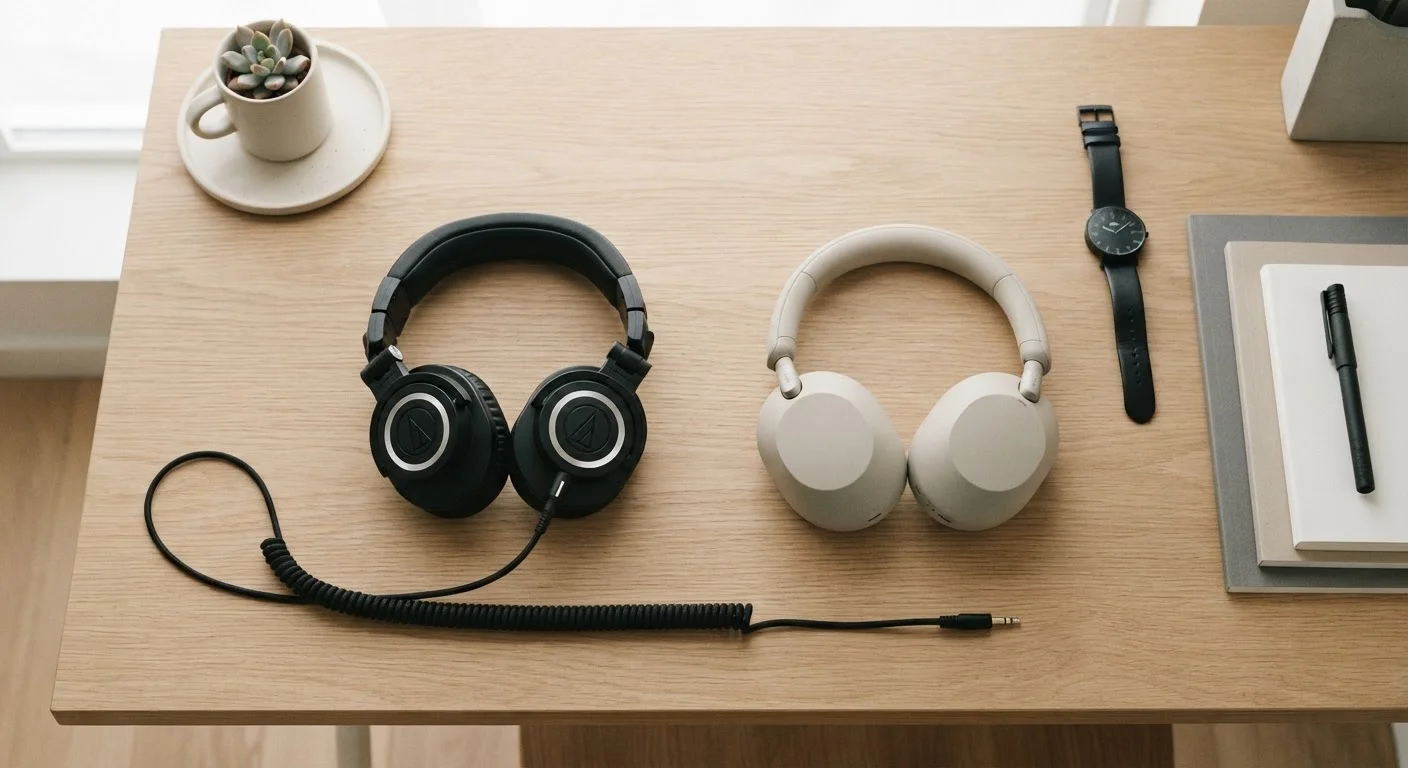
Option A
Wired Headphones
The reliable, no-compromise audio workhorse.
Best for: Listeners who prioritize consistent audio quality, zero latency, and never worrying about battery life.
Option B
Wireless Headphones
The flexible, cord-free everyday companion.
Best for: Commuters, gym-goers, and multitaskers who value freedom of movement over absolute audio purity.
The Core Trade-Off in Plain Terms
Wired headphones send audio as an electrical signal directly from your device through a cable. Wireless headphones receive a Bluetooth signal — a radio transmission that your device encodes, transmits, and your headphones decode before you hear anything. That extra step is where most of the meaningful differences originate.
Understanding how Bluetooth works compared to other wireless standards helps clarify why wireless audio involves inherent compromises. Bluetooth was designed for low power consumption and reasonable range — not primarily for audiophile-grade fidelity.
The result is a genuine trade-off, not a story where one technology has simply overtaken the other. Each makes real sacrifices to deliver its defining advantage.
| Criterion | Wired Headphones | Wireless Headphones |
|---|---|---|
| Audio signal | Uncompressed electrical signal | Bluetooth codec (compressed) |
| Latency | Effectively zero | 40–200ms+ depending on codec |
| Battery required | No — draws from device | Yes — requires regular charging |
| Freedom of movement | Limited by cable length | Full range within Bluetooth distance |
| Connection reliability | Consistent; no interference | Subject to radio interference |
| Port dependency | Requires 3.5mm jack or adapter | No port needed |
| Long-term durability | Fewer components to fail | Battery degrades over time |
Audio Quality and Latency: Where Wired Still Has an Edge
Wired connections carry an uncompressed or minimally processed signal. What leaves your device is essentially what reaches your ear. Wireless audio, by contrast, uses codecs — compression algorithms — to encode audio data for transmission. Common codecs like SBC, AAC, aptX, and LDAC vary significantly in how much they compress and how much quality they preserve.
For most casual listening — streaming playlists, podcasts, video calls — the difference is subtle enough that most people don't notice it. Where it becomes more apparent is in critical listening: high-resolution audio files, studio monitoring, or anything where a trained ear is comparing closely.
Latency — the delay between a sound being triggered and reaching your ears — is more consistently noticeable. Wired headphones have effectively zero perceptible delay. Bluetooth introduces latency that varies by codec and device, typically ranging from around 40 milliseconds to over 200 milliseconds in some implementations. For watching video on a well-optimized platform, modern devices compensate reasonably well. For gaming, live instrument monitoring, or real-time audio work, even small delays are disorienting.
~40ms
Minimum Bluetooth audio latency (aptX Low Latency codec)
Standard SBC Bluetooth can exceed 150–200ms; aptX Low Latency targets approximately 40ms, though real-world performance varies by device pair.
990kbps
Maximum bitrate of Sony LDAC codec
LDAC, developed by Sony and adopted into Android, supports up to 990kbps — significantly higher than SBC's typical 328kbps ceiling, narrowing the gap with wired fidelity.
20–40 hrs
Typical wireless headphone battery life per charge
Most over-ear wireless headphones fall in the 20–40 hour range; true wireless earbuds with charging cases can extend total available listening time further.
Battery Life and Convenience: The Wireless Reality Check
Battery dependence is the most underappreciated limitation of wireless headphones. A wired pair is ready whenever your device is. A wireless pair needs to be charged — and at the worst moments, it won't be. Most wireless headphones offer between 20 and 40 hours of playback per charge, with charging cases extending that further for true wireless earbuds. That's genuinely impressive engineering, but it introduces a new variable into your routine: remembering to charge them.
On the convenience side, wireless headphones remove real friction. There's no cable to untangle, no risk of yanking a laptop off a desk, no port conflicts when a device lacks a headphone jack. For users who move between rooms, exercise, or commute, that freedom translates to a noticeably better experience day to day.
It's also worth noting that wireless headphones carry more components — radios, batteries, charging circuits — which can affect long-term durability and repairability. Charging habits and battery care matter more with wireless headphones; repeatedly draining a battery to zero shortens its usable lifespan over time.
A Note on Bluetooth Codec Compatibility
The audio quality of a wireless headphone depends not just on which codecs it supports, but which codecs your source device supports. Both ends of the connection must support the same codec for it to be used — otherwise the connection defaults to the lowest common denominator, typically SBC. Checking codec compatibility between your device and headphones before deciding is worthwhile if audio quality is a priority for you.
Which Listening Context Actually Drives the Decision
The honest answer is that neither wired nor wireless headphones are universally superior — the right choice is almost entirely determined by where and how you listen most often.
Stationary listening at a desk, home studio, or dedicated audio setup strongly favors wired. You lose nothing meaningful by having a cable, and you gain reliability and fidelity. Active, mobile, or multi-device listening favors wireless, where the cable's limitations become genuine daily annoyances and Bluetooth's minor compromises fade into background noise.
Many people find they want both: a wired pair for focused or professional use, and wireless for everything else. That's not an unreasonable conclusion — it reflects the reality that each format genuinely excels in different circumstances rather than one having made the other obsolete.
The content on this site is for informational purposes only and is not a substitute for professional advice. Always consult a qualified professional for guidance specific to your situation.