

The Brain: SoC, CPU, and GPU
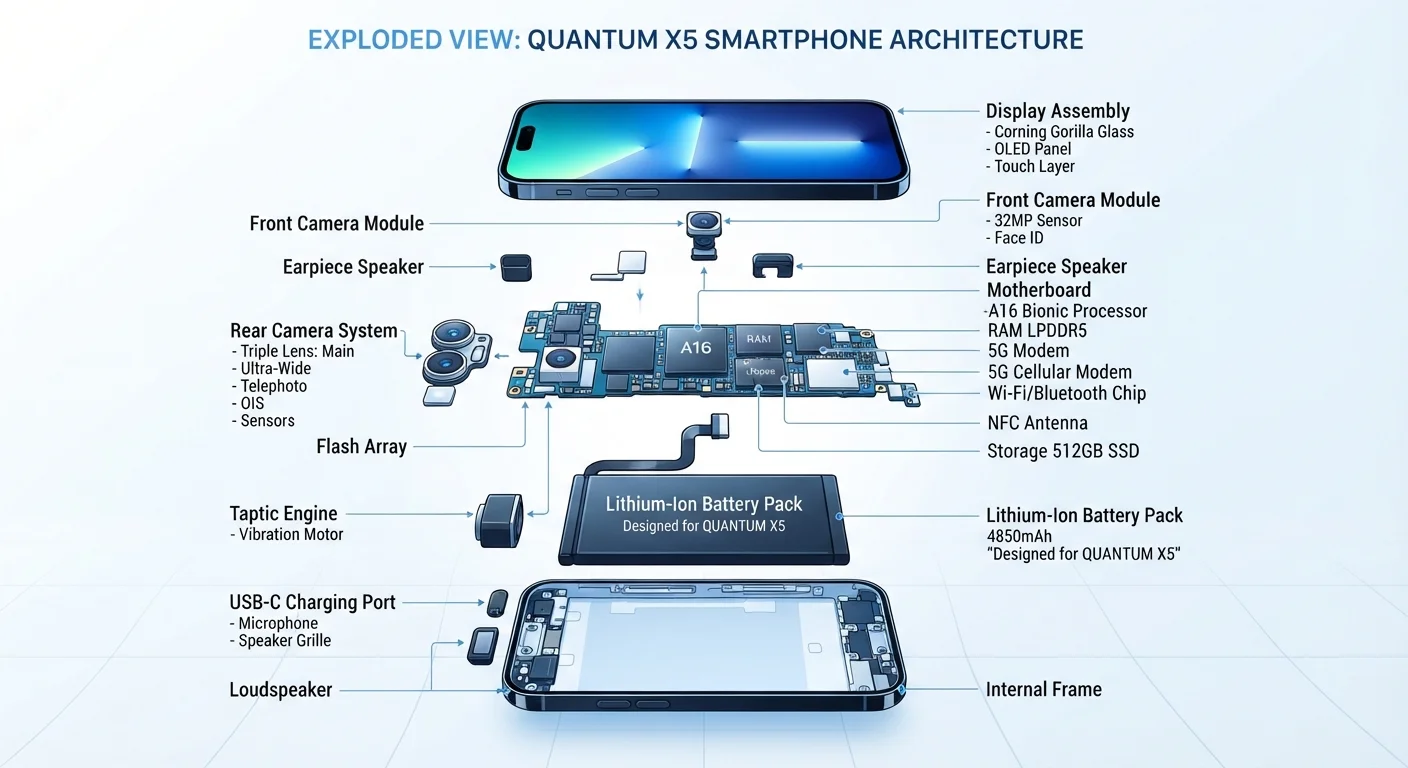
The System on a Chip (SoC) is where most of your phone's intelligence lives. It packages the CPU (Central Processing Unit), which executes the instructions behind every app and function, alongside a GPU (Graphics Processing Unit), which renders everything you see on screen — from scrolling text to 3D game environments.
Modern SoCs also include dedicated processors for specific workloads. A neural processing unit (NPU) handles AI-driven tasks like voice recognition, camera scene detection, and real-time translation without draining the battery the way a general-purpose CPU would. Think of the SoC as a specialized team rather than a single employee.
“The smartphone is perhaps the most complex consumer device ever mass-produced. What makes it remarkable is not any single component, but how dozens of specialized systems cooperate invisibly within the space of your hand.”
— A leading mobile hardware researcher, Semiconductor industry analyst and author on consumer electronics design
Memory and Storage: Two Very Different Things
RAM is your phone's short-term working memory. When you open an app, the phone loads it into RAM so it can run quickly. More RAM means more apps stay ready in the background without needing to reload. Internal storage, by contrast, is the long-term vault — where your photos, music, and installed apps actually live when not in use.
These two components are often confused because both are measured in gigabytes, but they serve completely different functions. A phone with 8 GB of RAM but only 64 GB of storage will multitask smoothly but fill up fast. Understanding what each spec actually limits can help you prioritize the right number for your habits.
Matching Specs to Your Actual Needs
If you primarily use your phone for browsing, calls, and social media, a mid-range SoC with 6 GB of RAM is typically more than sufficient. Reserve the higher-spec configurations for users who run demanding games, edit video on-device, or need extended multitasking. Buying more than you need rarely improves the daily experience noticeably.
Display, Battery, and Camera Hardware
The display is among the most complex components in a phone. It consists of a panel (OLED or LCD), a touch-sensing layer, and a digitizer that converts your finger's position into precise coordinates. How touch screens distinguish between display types explains the key differences between the technologies most phones use today.
The battery is measured in milliamp-hours (mAh) — a higher number generally means longer life, though an efficient SoC can outperform a larger battery paired with a power-hungry chip. Camera systems now include dedicated image signal processors (ISPs) — either built into the SoC or as separate chips — that process raw sensor data into the polished photos you see on screen. Optical image stabilization (OIS) uses tiny physical movements of the lens element to counteract hand shake.
~3,000
Typical smartphone battery capacity (mAh)
Entry-level phones often start around 3,000 mAh, while larger flagship devices commonly exceed 5,000 mAh, according to general industry specifications.
Billions
Transistors in a modern smartphone SoC
Leading chip manufacturers have publicly stated that their latest mobile processors contain over 10 billion transistors on a single chip.
10+
Distinct sensors in a flagship smartphone
Beyond the camera, modern flagship phones routinely include accelerometers, gyroscopes, barometers, proximity sensors, ambient light sensors, and more.
Sensors and Radios: The Invisible Infrastructure
Smartphones carry a suite of sensors most users never think about. The accelerometer detects linear movement and orientation (it's why your screen rotates). The gyroscope measures rotational speed precisely, enabling smooth AR experiences and gaming. A barometer measures atmospheric pressure for altitude estimates in navigation apps. A proximity sensor cuts the display when you raise the phone to your ear.
Wireless communication is handled by dedicated radio modules. Cellular modems — sometimes integrated into the SoC, sometimes a separate chip — manage 4G LTE and 5G connections. Wi-Fi, Bluetooth, and NFC each operate on different frequency bands and serve distinct purposes, from high-speed internet to contactless payments. Our guide on Wi-Fi, Bluetooth, and NFC signals in everyday life goes deeper into how these coexist without interfering with each other.
5G Modems Add Complexity
5G connectivity requires significantly more sophisticated radio hardware than 4G. Some manufacturers integrate the 5G modem directly into the SoC, while others use a separate modem chip. This architectural choice affects heat management, battery efficiency, and cost — which is partly why 5G phones initially carried a noticeable price premium over their 4G counterparts.
Frequently Asked Questions
The SoC (System on a Chip) is generally considered the most important component because it handles the phone's processing, graphics, and communications coordination. However, battery capacity and RAM also significantly affect everyday performance.
RAM (Random Access Memory) holds data for apps that are currently active, enabling smooth multitasking. Storage holds your photos, apps, and files permanently. See our <a href="/tech-gadgets/everyday-devices/storage-ram-and-processing-power-what-each-one-actually-limits">plain-language breakdown of RAM vs. storage</a> for a deeper explanation.
Different lenses serve different purposes — a wide-angle lens captures broad scenes, a telephoto lens zooms in optically, and an ultrawide lens fits more into the frame. Using multiple lenses gives photographers flexibility without needing to carry separate equipment.
A gyroscope measures rotational motion, helping the phone detect orientation changes precisely. It enables features like image stabilization, augmented reality apps, and immersive mobile gaming where tilting the device controls the action.
Most phones include a combined wireless radio chip that handles both Wi-Fi and Bluetooth simultaneously on separate frequency channels. NFC operates on a different, shorter-range frequency and is typically a separate module.
The content on this site is for informational purposes only and is not a substitute for professional advice. Always consult a qualified professional for guidance specific to your situation.