

How Compound Interest Actually Works
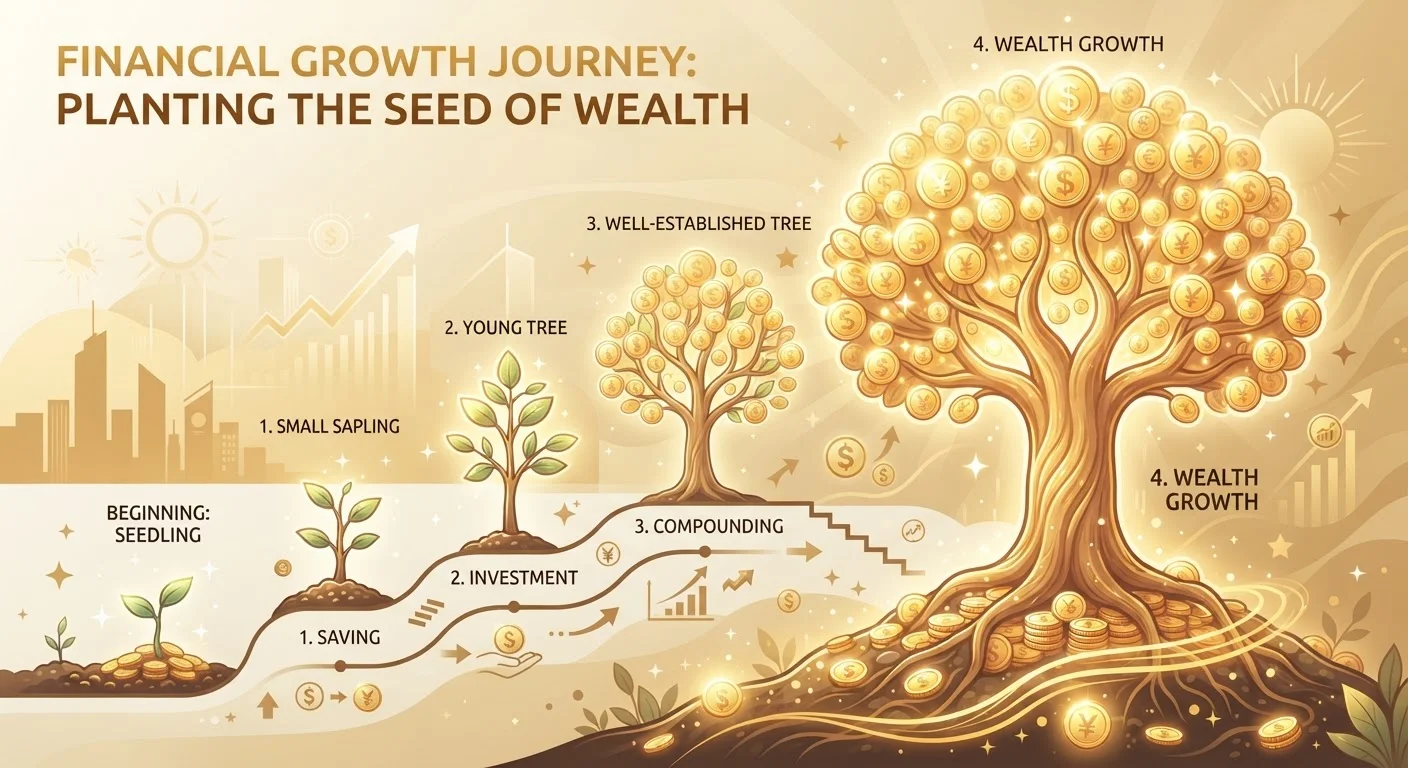
Think of compound interest as interest that feeds on itself. In year one, you earn interest on your starting balance. In year two, you earn interest on your starting balance plus the interest from year one. By year three, the base keeps growing — and so does each year's interest payment.
This is what sets compounding apart from simple interest, where the calculation always resets to the original amount. With compounding, your balance doesn't just grow — it accelerates.
Consider a straightforward illustration: $5,000 deposited at a 5% annual rate. With simple interest, you earn $250 every year — the same amount each time. With compound interest calculated annually, you earn $250 in year one, $262.50 in year two (because your balance is now $5,250), and so on. The difference looks small at first. Over 30 years, it becomes substantial.
Compounding Frequency Varies by Account
Not all accounts compound at the same frequency. Some compound daily, others monthly or annually. When comparing savings products, look at the Annual Percentage Yield (APY), not just the stated rate — APY already accounts for compounding frequency and allows for a fair comparison.
For a plain-language reference to other financial terms you'll encounter alongside compound interest, see our everyday personal finance glossary.
Why Time Is the Dominant Variable
Of all the factors in the compound interest formula — principal, rate, frequency, and time — time has the most outsized effect. This is because compounding is exponential, not linear. Each passing year builds on a larger base than the last.
72
Years to double money via Rule of 72
Divide 72 by your annual interest rate to estimate doubling time — at 6%, money doubles in approximately 12 years.
10x+
Potential growth of $5,000 over 40 years
At a hypothetical 6% annual compound rate, $5,000 grows to over $51,000 in 40 years with no additional contributions — illustrating the long-run power of compounding.
A common illustration used in financial education compares two hypothetical savers. The first saves consistently for 10 years starting early, then stops contributing entirely. The second waits and saves for 30 years starting later. Despite saving three times as long, the second person may end up with less — because the first person's money had more years to compound. The math depends on the specific rate and amounts, but the underlying principle is consistent: time amplifies everything.
The takeaway isn't that you need to be young to benefit — it's that starting sooner, at any age, gives compounding more runway. This connects directly to the value of automating savings contributions so that time keeps working even when you're not actively thinking about it.
Compounding on the Debt Side — the Risk You Should Know
Compound interest isn't only a tool for building wealth — it also works powerfully against you when you carry debt. Credit card balances are a common example. When a balance goes unpaid, interest is added to the total owed. The next billing cycle, interest is charged on that larger amount. Left unchecked, the balance can grow substantially even without new spending.
Pay More Than the Minimum on High-Interest Debt
Even modest extra payments reduce the principal faster, which directly shrinks the base on which interest compounds. On a 20% APR card, every extra dollar paid toward principal saves future interest charges — sometimes many times the value of that dollar over time.
This is why paying more than the minimum on high-interest debt matters so much. The trade-off between saving and debt repayment is a real tension many households face — and understanding how compounding operates on both sides of the ledger helps clarify those decisions.
As a general principle, the higher the interest rate on a debt, the more urgently compounding is working against you — and the more valuable it is to reduce that balance consistently.
Putting It Together: From Concept to Habit
Understanding compound interest intellectually is useful. Applying it consistently is where the real impact lies. Small, regular contributions to a savings vehicle give compounding more material to work with over time — and consistency tends to matter more than the size of any single deposit.
This is one reason personal finance guides often link compound interest to broader habits. The way you approach daily money habits — tracking spending, redirecting small surpluses, avoiding unnecessary high-interest debt — directly affects how much compounding can do for you over time.
If you're thinking about whether to save, invest, or both, consider reviewing the difference between saving and investing — because compound interest plays a role in both contexts, though the mechanisms and risk profiles differ significantly.
This article is for general informational and educational purposes only and does not constitute personalised financial, investment, or tax advice. Consult a qualified financial professional for guidance specific to your situation.
Frequently Asked Questions
Simple interest is calculated only on the original principal. Compound interest is calculated on the principal plus any accumulated interest. Over long periods, compound interest produces significantly larger balances than simple interest at the same rate.
The more frequently interest is compounded — daily, monthly, or quarterly versus annually — the faster your balance grows. Daily compounding produces slightly more than monthly, which produces more than annual, at the same stated interest rate.
Yes. Credit cards, personal loans, and other debt products often compound interest, meaning unpaid balances grow faster over time. Carrying a high-interest balance without paying it down regularly can cause debt to grow quickly.
The Rule of 72 is a mental shortcut: divide 72 by your annual interest rate to estimate how many years it takes to double your money. For example, at 6% annual return, your money would roughly double in 12 years (72 ÷ 6 = 12).
No. Interest rates on savings accounts can change over time, and no specific return is guaranteed. Compound interest describes how growth is calculated — not the rate itself, which varies by institution and market conditions.
The general principle in personal finance is: the earlier, the better. Even modest contributions made early have more time to compound than larger contributions made later. Starting later is still worthwhile — earlier is simply more advantageous mathematically.
The content on this site is for informational purposes only and is not a substitute for professional advice. Always consult a qualified professional for guidance specific to your situation.