

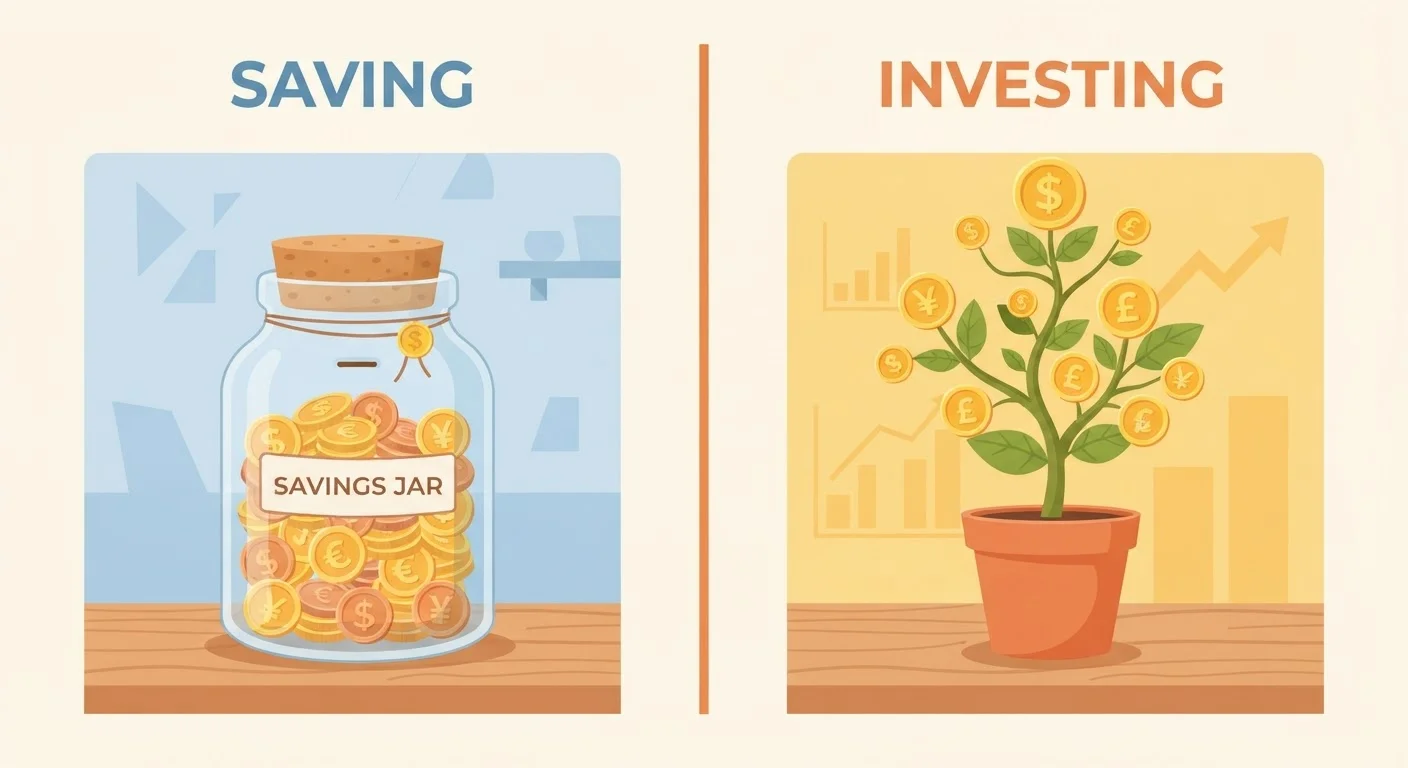
Two Tools, Two Very Different Jobs
People often use "saving" and "investing" interchangeably, but confusing them can lead to real financial missteps — holding too much cash when you should be growing it, or taking on too much risk when you need stability. Understanding the distinction is one of the most practical things you can do for your long-term financial health.
Saving is about preservation and access. When you put money into a checking or savings account, the goal is to keep it safe and available. You are not expecting dramatic growth; you are expecting the money to be there when you need it. Banks in the U.S. typically insure deposits through the FDIC, meaning your principal is protected up to applicable limits.
Investing is about growth over time. When you invest, you are purchasing an asset — shares in a company, a bond, a mutual fund — with the expectation that its value will increase. In exchange for that growth potential, you accept the possibility that the value could also decline. Investing is not gambling, but it does carry real risk, and that risk must be managed thoughtfully.
Risk Is Not the Same as Danger
In financial terms, "risk" means the possibility of a value fluctuating — not that an outcome is reckless or irresponsible. Investing in a diversified portfolio carries risk, but so does holding all your money in cash (the risk of inflation eroding value). Understanding both sides of risk helps you make more informed, balanced choices.
When to Save vs. When to Invest
The clearest decision-making tool here is time horizon — how long before you need the money.
- Short-term goals (under 3 years): Save. Whether you're building an emergency fund, saving for a vacation, or setting aside a house down payment, you cannot afford to have that money shrink in a market downturn. Keep it accessible and protected. For a practical starting point, see how to build a savings habit from zero.
- Long-term goals (5+ years): Invest. Retirement savings, building generational wealth, or funding a child's education in 15 years — these goals benefit from growth that saving alone rarely delivers. Time in the market allows you to ride out short-term volatility.
- Mid-range goals (3–5 years): Often a blended approach, leaning conservative. The right balance depends on your personal risk tolerance and the consequences of a shortfall.
For structuring these different timelines side by side, short-term vs. long-term savings goal planning walks through how to fund each without one crowding out the other.
Use Separate Accounts for Each Goal
Keeping your emergency fund, short-term savings, and long-term investment accounts physically separate makes it far easier to avoid accidentally spending money earmarked for a specific goal. Many banks allow you to open multiple savings accounts and label each one — a simple organizational step that reinforces financial discipline.
The Role of Inflation — and Why It Changes the Math
One reason the saving-versus-investing question matters so much is inflation. When the cost of goods and services rises year over year, cash sitting in a low-yield account quietly loses purchasing power. A dollar today will not buy the same amount of goods in 20 years if inflation continues at historical rates.
This does not mean you should avoid savings accounts — they are essential for short-term needs and emergency reserves. But it does mean that holding large amounts of cash for decades is not a neutral decision. Over long periods, the real value of uninvested savings tends to shrink.
Investing in diversified assets has historically offered returns that outpace inflation over long periods, though this is not guaranteed, and past performance does not predict future results. This is the core reason financial educators consistently encourage people to start investing early — the longer your timeline, the more potential there is for compounding to work in your favor.
3–6 months
Recommended emergency fund size
Financial educators widely cite 3 to 6 months of essential living expenses as the target for an emergency fund held in liquid savings.
$250,000
FDIC insurance limit per depositor
The Federal Deposit Insurance Corporation insures deposits up to $250,000 per depositor, per insured bank, protecting savings account balances from bank failure.
~3%
Average annual U.S. inflation rate (historical)
The U.S. long-run average inflation rate has hovered around 3%, illustrating why cash held for decades loses meaningful purchasing power without investment growth.
This article is for general informational and educational purposes only. It does not constitute personalized financial, investment, or tax advice. Consult a licensed financial adviser before making decisions about your own financial situation.
Building a Plan That Uses Both
For most people, the answer is not "save" or "invest" — it is a sequence and a balance. A practical starting framework looks like this:
- Build a small starter emergency fund (often cited as $500–$1,000) before doing anything else, so an unexpected expense does not derail your plan.
- Pay down high-interest debt aggressively, since carrying expensive debt often costs more than investing gains. Weighing saving against debt repayment involves trade-offs worth understanding carefully.
- Grow your emergency fund to 3–6 months of essential expenses, kept in a savings account — liquid and safe.
- Begin investing for long-term goals, starting with tax-advantaged accounts where available (such as a 401(k) or IRA), prioritizing any employer match first.
- Continue saving for near-term goals in parallel, keeping those funds separate from investment accounts.
Automating both saving and investing is one of the most effective ways to stay consistent. The "pay yourself first" approach — directing money to savings and investments before discretionary spending — removes the temptation to skip a contribution. How the pay yourself first principle works in practice offers practical guidance on setting this up.
If you want quick, actionable habits to complement these strategies, the Everyday Money Tips hub covers a range of day-to-day financial decisions worth exploring.
Frequently Asked Questions
No. A savings account is a saving tool — your principal is protected and the balance is accessible on demand. Investing involves purchasing assets whose value can fluctuate, meaning you can lose money. The key differences are risk and return potential.
A common guideline is to build a starter emergency fund of at least one month's expenses before investing, then grow that fund to 3–6 months while beginning to invest for long-term goals. This sequencing protects you from having to sell investments during a financial emergency. Consult a licensed financial adviser to tailor this to your situation.
In nominal terms, FDIC-insured accounts protect up to $250,000 per depositor, so you won't lose the dollars you deposit. However, if your savings account interest rate is lower than inflation, your money's purchasing power decreases over time — a form of real, if invisible, loss.
A savings goal has a defined, near-term timeline and can't afford loss — a car down payment in 12 months, for example. An investment goal is typically longer-term (retirement, a child's education) and can weather market fluctuations because there is time to recover.
It depends on the interest rate of the debt. High-interest debt (such as credit card balances) often makes mathematical sense to pay off before investing, since the debt's cost likely exceeds typical investment returns. Lower-interest debt may justify saving and investing alongside repayment. See <a href="/money-finance/saving-and-debt/saving-and-debt-repayment-at-the-same-time-how-to-weigh-the-trade-off">our guide on saving and debt at the same time</a> for a fuller discussion.
No. Many investment accounts can be opened with small initial amounts, and workplace retirement plans often allow contributions as low as 1% of a paycheck. Starting with small amounts invested consistently over time can produce meaningful results through compound growth, though outcomes are never guaranteed.
The content on this site is for informational purposes only and is not a substitute for professional advice. Always consult a qualified professional for guidance specific to your situation.