

How Minimum Payments Are Calculated
Credit card issuers use one of two common methods to set your minimum payment each month. The first is a straightforward flat percentage of your current balance — typically between 1% and 3%. The second is a floor-plus formula, where the issuer adds accrued interest and fees to a small percentage of the principal, often 1%, and requires at least a fixed floor (commonly $25 or $35). The higher of these two results becomes your minimum.
This structure has a predictable consequence: as your balance decreases, so does your minimum payment. That sounds helpful, but it also means your payoff progress slows over time. You end up paying less and less each month — not because the debt is nearly gone, but because the formula keeps shrinking alongside the balance.
Your card's terms and conditions will specify the exact calculation method. It is worth locating that detail, because it tells you how much flexibility you actually have in what you owe each month versus what you are simply required to pay.
Where Your Money Actually Goes
When you carry a balance on a card with a high annual percentage rate (APR) — many consumer cards sit between 20% and 30% — the vast majority of each minimum payment goes straight toward interest charges, not the principal balance. This is the core problem.
Here is a simplified illustration: suppose you have a $3,000 balance at a 22% APR and your minimum is set at 2% of the balance. Your first minimum payment would be roughly $60. Of that, approximately $55 covers interest alone, meaning only about $5 reduces your actual debt. The next month's minimum is calculated on a slightly lower balance — and the cycle repeats.
~15+ years
Time to repay $3,000 at 22% APR on minimums only
Based on a standard 2% minimum payment calculation with no new charges added to the balance.
20%–30%
Typical APR range on consumer credit cards
The Federal Reserve tracks average credit card interest rates, which have risen significantly in recent years.
~$5
Principal reduced on first minimum payment for $3,000 balance at 22% APR
Illustrative calculation: a $60 minimum payment minus roughly $55 in monthly interest leaves only about $5 applied to the actual debt.
This dynamic is sometimes called the minimum payment trap: the structure is designed to keep the account current, not to get you out of debt efficiently. It is not a flaw in your payment behavior — it is simply how the math works at high interest rates.
Staying stuck in debt even while making payments is a predictable outcome when minimums are the default strategy.
The Long-Term Cost in Real Terms
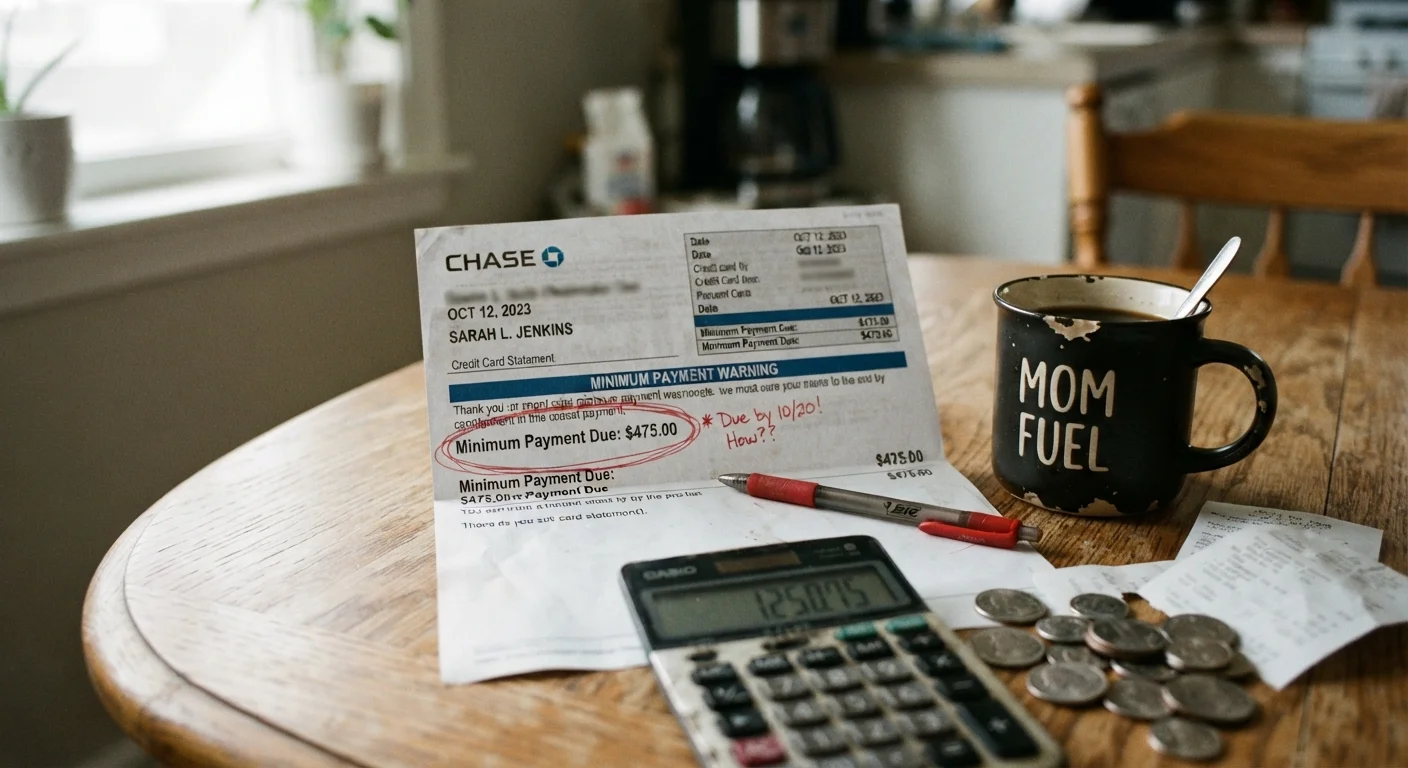
Federal regulations require card issuers to include a minimum payment warning on every statement. This box shows exactly how long it will take to pay off your current balance paying only the minimum, and the total interest you will pay. If you have not looked at this section of your statement closely, it is worth a careful read.
The figures are often striking. A $3,000 balance at 22% APR, paid at a 2% minimum with no new charges, can take over 15 years to retire and generate more than $3,500 in interest — meaning you pay more than double the original amount borrowed. The total cost depends on your specific APR, balance, and issuer's calculation method, so use your own statement's disclosure as the reference point.
Use Your Statement's Own Warning
Every credit card statement is required to show a minimum payment warning box that calculates exactly how long payoff will take — and the total interest cost — if you pay only the minimum. Use that number as your motivation benchmark rather than an abstract figure. Aim to pay at least double the stated minimum whenever your budget allows.
Common myths about debt — including the idea that making minimum payments is "handling" debt — can quietly extend how long you carry a balance.
How to Break Out of the Minimum Payment Cycle
The most direct lever you have is to consistently pay more than the minimum. Even a modest increase — say, an extra $30 or $50 per month — can meaningfully shorten your repayment timeline and reduce total interest paid. The key is consistency: adding extra payments when cash allows, rather than treating the minimum as a fixed target.
Two structured approaches can help if you carry balances across multiple cards. The debt avalanche directs extra payments toward the highest-APR balance first, minimizing total interest. The debt snowball targets the smallest balance first to build momentum. Both are more effective than paying minimums across the board. See how the snowball and avalanche methods compare to find an approach that fits your situation.
If you are weighing whether to put extra cash toward debt or savings simultaneously, that trade-off is worth thinking through carefully. Balancing savings and debt repayment outlines the key considerations.
Paying down balances can also affect your credit profile. What happens to your credit score when you pay off debt explains what typically shifts — and why results vary. For a broader foundation, explore the Saving & Debt hub.
This article is for general informational and educational purposes only and does not constitute personalized financial advice. Consult a qualified financial professional for guidance specific to your situation.
Frequently Asked Questions
At high APRs, most of each minimum payment covers monthly interest charges rather than the principal balance. Only the small remainder reduces what you actually owe, which is why the balance can seem to barely move. Increasing your payment above the minimum directs more money toward the principal.
Most issuers use either a flat percentage of your balance (commonly 1–3%) or a formula that adds accrued interest and fees to a small percentage of the principal, subject to a fixed dollar floor. The specific method is disclosed in your card's terms and conditions.
Paying the minimum on time keeps your account current and avoids late-payment marks on your credit report. However, a persistently high balance relative to your credit limit — your credit utilization ratio — can weigh on your credit score over time. Reducing your balance helps on both fronts.
Any consistent amount above the minimum helps, but a practical starting point is to pay at least twice the stated minimum when possible. Your card statement's minimum payment warning box shows the concrete impact of different payment levels, which can help you set a realistic target.
Yes, in terms of total interest paid over time. Every dollar above the minimum that reduces your principal also reduces the balance on which future interest is calculated. Over months or years, this compounding effect can result in meaningful savings — though exact amounts depend on your APR and balance.
The content on this site is for informational purposes only and is not a substitute for professional advice. Always consult a qualified professional for guidance specific to your situation.