

What Most People Get Wrong About Budgets
Ask most people what a budget is, and you'll hear some version of the same answer: a list of things you can't buy. That's the most common and most costly misunderstanding in personal finance.
A budget is not a punishment. It is not a sign that you're struggling. It is not a rigid rulebook that strips the joy from your paycheck. A budget is simply a plan — one that describes, on paper or on a screen, how you intend to use the money you earn before you actually spend it.
The confusion stems partly from how budgets are talked about. Phrases like "staying within budget" or "blowing the budget" frame it as a ceiling, a constraint. But the more accurate frame is that a budget is a mirror: it shows you the financial reality of your life so you can shape it deliberately.
Budgeting Is Not Only for People in Debt
A widespread assumption is that budgets are crisis tools — something you turn to when things go wrong. In practice, a budget is just as valuable for someone building wealth as for someone paying down debt. It's a planning instrument, not a distress signal. High earners and financially comfortable households use budgets to direct money toward goals, not just to avoid shortfalls.
If you're curious about other widespread misconceptions that may be holding you back, see our guide to common budgeting myths.
The Core Structure of a Personal Budget
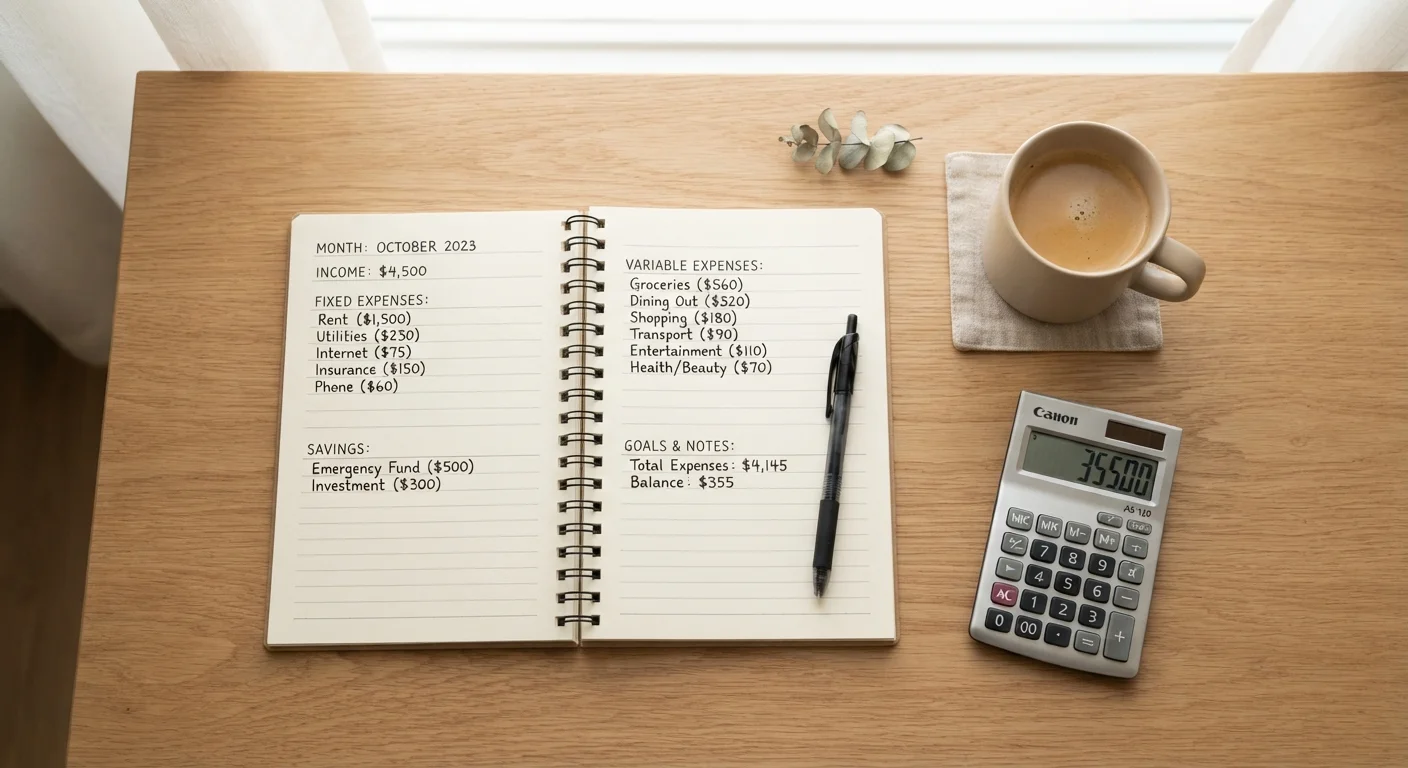
Every personal budget, regardless of how simple or detailed, rests on the same foundation: income minus expenses equals your net position for the period.
Income is money coming in — your take-home pay after taxes, any side income, or other regular inflows. Budgets work with net income (what actually lands in your account), not gross salary figures.
Expenses fall into two main buckets:
- Fixed expenses — costs that stay roughly the same each month, like rent, a car payment, or a subscription fee.
- Variable expenses — costs that fluctuate, like groceries, gas, dining out, or entertainment.
The third element some budgets include is savings and debt repayment, treated as non-negotiable line items rather than whatever is left over. Popular frameworks like the 50/30/20 rule — which divides after-tax income into 50% needs, 30% wants, and 20% savings and debt — formalize this structure into actionable categories.
32%
Americans who follow a formal written budget
According to Gallup polling, roughly one in three American adults maintains a detailed household budget, suggesting most people manage money without a formal plan.
50/30/20
Popular rule for dividing after-tax income
The 50/30/20 framework, widely cited in personal finance education, allocates 50% to needs, 30% to wants, and 20% to savings and debt repayment.
For a plain-language breakdown of budgeting vocabulary, our budgeting terms reference guide covers everything from net income to sinking funds.
Why a Budget Has to Reflect Real Life
One reason budgets fail is that they're built for an imaginary, optimized version of a person's life rather than the actual one. A budget that allocates $150 a month to groceries when you realistically spend $350 isn't a budget — it's a wish list.
An honest budget captures your real fixed costs, gives realistic room for variable spending categories, and sets savings targets you can actually meet. It may not look impressive on paper, but it will work in practice.
Build Your Budget Around Reality, Not Ideals
When setting spending categories, review your last two to three months of actual bank and card statements before assigning any numbers. Real spending patterns are a far more reliable starting point than estimates. A budget grounded in your actual habits is one you can genuinely follow — and adjust from a position of honesty rather than aspiration.
That's also why budgets should be revisited regularly. Life changes — income fluctuates, expenses shift, goals evolve. A budget built six months ago may no longer reflect the life you're living today. Think of it as a living document, not a one-time project.
Ready to put this into practice? Our guide for complete beginners walks through the steps from scratch, and our end-to-end budgeting guide covers the full picture from income calculation to long-term maintenance.
This article is for general informational and educational purposes only and does not constitute personalized financial advice. Please consult a qualified financial professional for guidance tailored to your specific situation.
Frequently Asked Questions
No — a budget simply means you plan for fun spending rather than leaving it to chance. Many budgeting frameworks, like the 50/30/20 rule, explicitly include a category for wants and discretionary spending. The goal is awareness, not deprivation.
A budget is useful at any income level. In fact, lower incomes often benefit most, because there is less margin for unplanned spending. A budget helps you stretch every dollar deliberately regardless of how many dollars you have.
A budget is a forward-looking plan — you decide in advance how much to allocate to each category. A spending tracker records what you've already spent. Both are useful, and many people use them together: the budget sets the target, the tracker measures whether you hit it.
Most people revisit their budget monthly, since expenses often vary from month to month. Beyond that, any significant life change — a new job, a move, a new household member — is a good trigger to rebuild it from scratch.
Not exactly. A budget is one tool within a broader financial plan. A financial plan may also include savings goals, investment strategy, insurance coverage, and debt payoff timelines. The budget manages day-to-day cash flow; the financial plan addresses the bigger picture.
The content on this site is for informational purposes only and is not a substitute for professional advice. Always consult a qualified professional for guidance specific to your situation.