

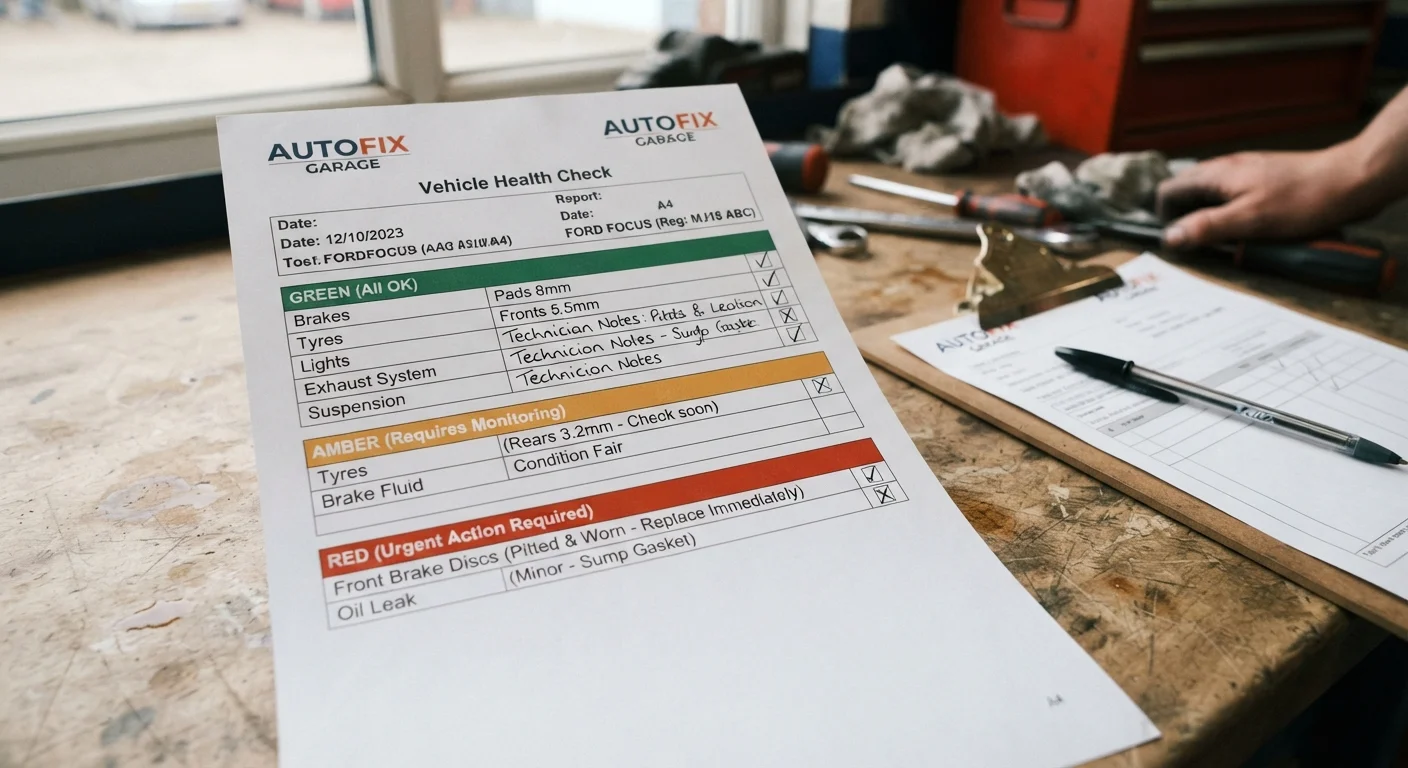
What a Vehicle Health Check Report Actually Is
A vehicle health check — sometimes called a courtesy check or multi-point inspection — is a systematic visual and physical assessment carried out by a technician, typically during a service or tyre appointment. The report documents the condition of key components across braking, steering, suspension, tyres, lights, and fluid levels, and assigns each item a colour rating.
It is important to understand what the report is not: it is not an MOT test, not a roadworthiness certificate, and not a guaranteed diagnosis of every fault on the vehicle. It reflects what a technician observed during a time-limited inspection. Some faults — particularly intermittent electrical issues — may not be visible at the time of the check.
That said, a well-completed health check report is one of the most useful documents a car owner can receive. It translates a technician's professional observations into a format you can act on, provided you know how to read it.
What you will need
Before working through the steps below, gather your report and your vehicle's service logbook if you have one. See our car maintenance hub for related guidance on keeping your vehicle road-ready.
Understanding the Colour System and Common Items
The red-amber-green (RAG) system is modelled on traffic light logic and is used consistently across most UK garages, though the precise wording around each colour can vary slightly between providers.
- Red — Immediate attention required. The component is worn, damaged, or operating outside safe limits.
- Amber — Advisory. The component is deteriorating or approaching a limit, but is not yet at the point of failure.
- Green — Satisfactory. The component met the technician's inspection criteria at the time of assessment.
Common items you will see in each category include tyres (tread depth and condition), brake pad and disc thickness, shock absorbers, wheel bearing play, battery condition, and fluid levels. Fluid-related advisories are among the most straightforward to address yourself — our plain-English guide to fluid levels under the bonnet explains each reservoir and what low readings signal.
Group Amber Items to Save Money
If two amber items involve components in the same area of the car — for example, both front shock absorbers — ask your mechanic whether addressing them together reduces total labour time. Bundling work in the same area often costs less than two separate visits.
For broader peace of mind before any longer journey, a pre-trip check of the items most commonly flagged on health reports is a sensible habit. Our pre-journey vehicle check guide walks through the essentials.
Red Items Are Not Optional
A red-rated item on a health check report signals a safety-critical fault — not a suggestion. Driving with a red-flagged component such as severely worn brake pads or a steering defect puts you and other road users at genuine risk. Do not defer these repairs without first consulting your mechanic about whether the vehicle is safe to drive at all.
The content on this site is for informational purposes only and is not a substitute for professional advice. Always consult a qualified professional for guidance specific to your situation.