

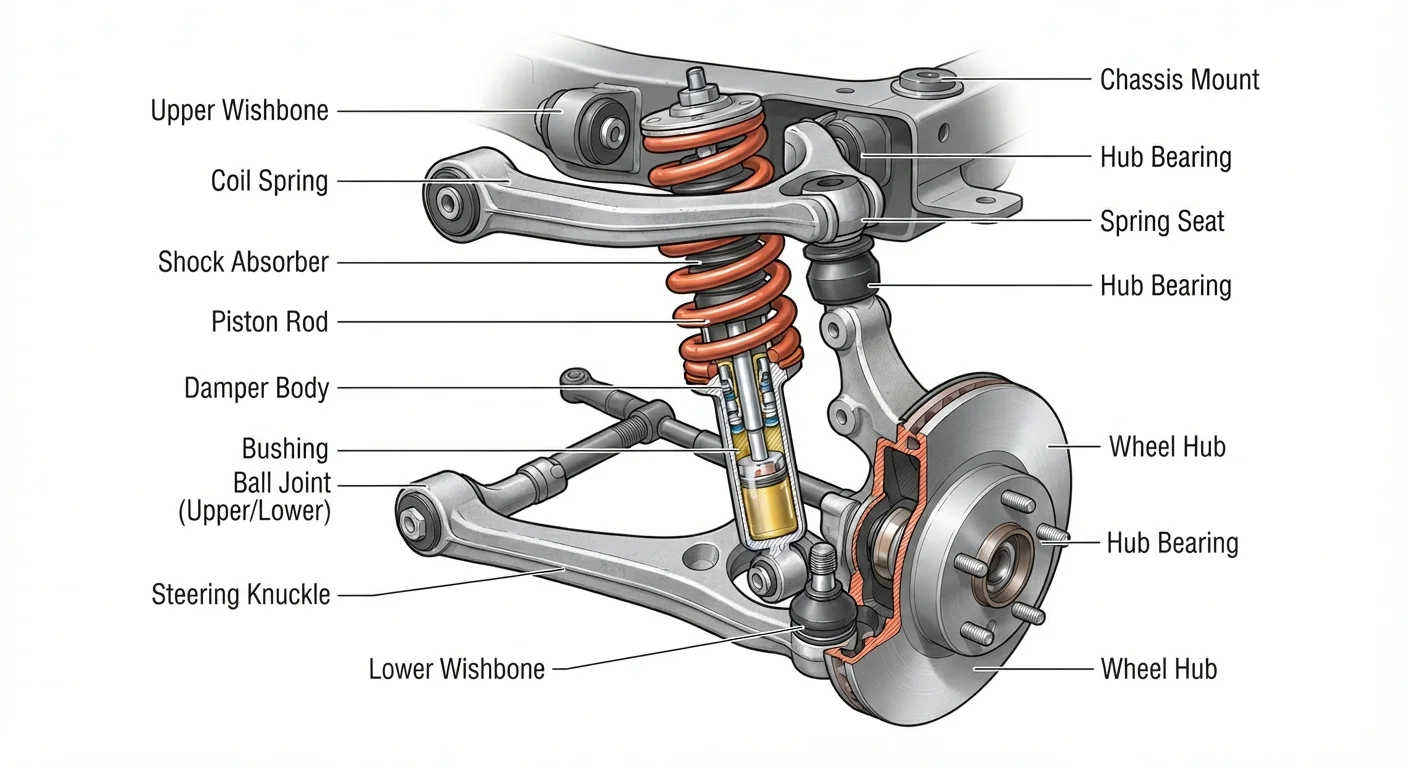
The Four Jobs Every Suspension System Must Do
Suspension has to accomplish four things at once: support the vehicle's weight, absorb road impacts before they reach the cabin, maintain steering geometry so the car tracks predictably, and keep the tires pressed against the road surface. That last point is critical — a tire that briefly loses road contact provides no braking, steering, or acceleration force at all.
These goals sometimes pull in opposite directions. A very stiff suspension transmits road feedback faithfully to the driver but punishes passengers over rough surfaces. A very soft setup is comfortable but allows too much body movement during cornering and braking. Every suspension design is an engineered compromise calibrated for the vehicle's intended purpose.
Springs, Dampers, and Why You Need Both
The spring — most commonly a coil spring or a leaf spring on trucks — is what actually absorbs an impact. When a wheel hits a pothole, the spring compresses to swallow the energy. The problem is that an undampened spring keeps bouncing: compress it once and it oscillates for several cycles before settling.
That's where the shock absorber (more accurately called a damper) comes in. A damper is a hydraulic cylinder that converts the spring's kinetic energy into heat as fluid is forced through small valves. The result is a single controlled compression and extension rather than repeated bouncing. Springs and dampers must be matched — a worn damper paired with a good spring still produces poor ride and handling because the spring oscillations go unchecked.
50,000–100,000 mi
Typical shock absorber service life range
General industry guidance suggests dampers begin to degrade noticeably in this mileage range, though road conditions and load significantly affect wear rate.
~20%
Potential increase in braking distance with worn dampers
Research cited by automotive safety organizations has found that severely worn shock absorbers can extend stopping distances meaningfully compared to serviceable units.
4
Key suspension jobs performed simultaneously
Every suspension system must balance weight support, impact absorption, steering geometry, and tire-to-road contact at all times.
On many modern vehicles, both components are packaged together as a MacPherson strut, a compact assembly where the damper body also acts as a structural pivot for the wheel. This is common on front axles due to its space efficiency.
Control Arms, Ball Joints, and Wishbones
Springs and dampers control vertical movement, but the wheel also needs to be held in the correct lateral and longitudinal position. Control arms (also called wishbones when A-shaped) are rigid links connecting the wheel hub to the vehicle's subframe. They allow the wheel to move up and down freely while resisting sideways movement.
At the outer end of the control arm is a ball joint — a spherical pivot that allows the wheel to steer left and right while still transmitting suspension loads. Ball joints wear over time, and a failed ball joint can allow the wheel to detach entirely, which is why they are inspected during routine safety checks. The rubber bushings at the inner pivot points also degrade with age, and worn bushings produce the clunking or vague steering feel many drivers associate with a high-mileage car.
Listen for Clunks Over Speed Bumps
A clunking or knocking sound when passing over a speed bump or dip is one of the most reliable early indicators of worn ball joints, control arm bushings, or anti-roll bar links. Have any persistent clunk investigated by a mechanic before it progresses — worn joints can fail suddenly and without further warning.
Anti-Roll Bars and Body Control
An anti-roll bar (also called a sway bar or stabilizer bar) is a torsional spring that links the left and right suspension on the same axle. When the vehicle corners, the body wants to lean outward. The anti-roll bar resists this by transferring load from the less-compressed side to the more-compressed side, keeping the car flatter through bends.
Critically, anti-roll bars only act when the two wheels are moving in opposite directions — during cornering. On a straight, bumpy road where both wheels rise and fall together, the bar has no effect on ride quality. This makes them an elegant tool: improved handling without sacrificing straight-line comfort. The bar connects to the control arms via small links and rubber bushings, both of which are wear items.
Independent vs. Solid Axle Suspension
In a solid axle setup (still common on heavy-duty trucks and some SUV rear axles), both wheels on an axle are rigidly connected. If one wheel hits a bump, the opposite wheel is affected. This is robust and simple, but limits ride refinement.
Independent suspension allows each wheel to move vertically without influencing its partner. This means better road-holding on uneven surfaces and generally a more refined ride. Most modern passenger cars use independent suspension at all four corners. The trade-off is more complexity and more components that can wear — which is why understanding which suspension parts wear on a predictable schedule helps owners plan ahead rather than react to failures.
“The suspension system is the interface between the road and everything else on the car. Get it wrong, and neither the engine, the brakes, nor the tires can do their jobs properly.”
— Carroll Smith, Motorsport engineer and author of 'Engineer to Win'
When Suspension Problems Become Safety Issues
Suspension wear is gradual enough that drivers often adapt to declining performance without noticing. Uneven tire wear — cupping, scalloping, or wear concentrated on one edge — is frequently the first measurable sign that geometry is off or a damper has lost effectiveness. A professional alignment check will reveal whether the issue is adjustment-related or indicates worn hardware.
Beyond comfort, degraded suspension directly affects active safety. Worn dampers reduce tire contact during emergency braking and reduce steering precision during avoidance maneuvers. For this reason, suspension inspection is a standard part of most state vehicle safety inspections and should not be deferred when symptoms appear.
Suspension Work and Your Safety Inspection
In many US states, worn ball joints, severely degraded dampers, or broken springs are grounds for failing a mandatory vehicle safety inspection. If your vehicle fails on suspension-related grounds, the components must be repaired before the vehicle can legally be operated on public roads. Check your state's DMV or transportation authority for the specific inspection standards in your area.
Frequently Asked Questions
Common signs include excessive bouncing after hitting a bump, the car pulling to one side, uneven tire wear, a nose-dive when braking, or clunking sounds over rough roads. A mechanic can inspect the components directly — visual checks and bounce tests are standard diagnostic steps.
Yes. Worn shock absorbers reduce tire-to-road contact during braking, which can meaningfully increase stopping distances. Industry testing has shown that severely degraded dampers can extend braking distances at highway speeds by several meters — enough to matter in an emergency.
A shock absorber is a damping unit that works alongside a separate spring. A strut (MacPherson strut) combines the damper and spring into a single structural assembly that also serves as part of the steering pivot. Both control ride motion, but struts are load-bearing in a way a standalone damper is not.
Shock absorbers and struts commonly begin to degrade noticeably between 50,000 and 100,000 miles, though driving conditions — potholes, unpaved roads, heavy loads — accelerate wear. Bushings and ball joints may wear sooner depending on use. Regular inspections are more reliable than mileage alone.
A broken or severely worn suspension component is a safety hazard and the vehicle should not be driven until it is inspected and repaired by a qualified mechanic. Loss of control, tire failure, or further structural damage are realistic risks.
The content on this site is for informational purposes only and is not a substitute for professional advice. Always consult a qualified professional for guidance specific to your situation.