

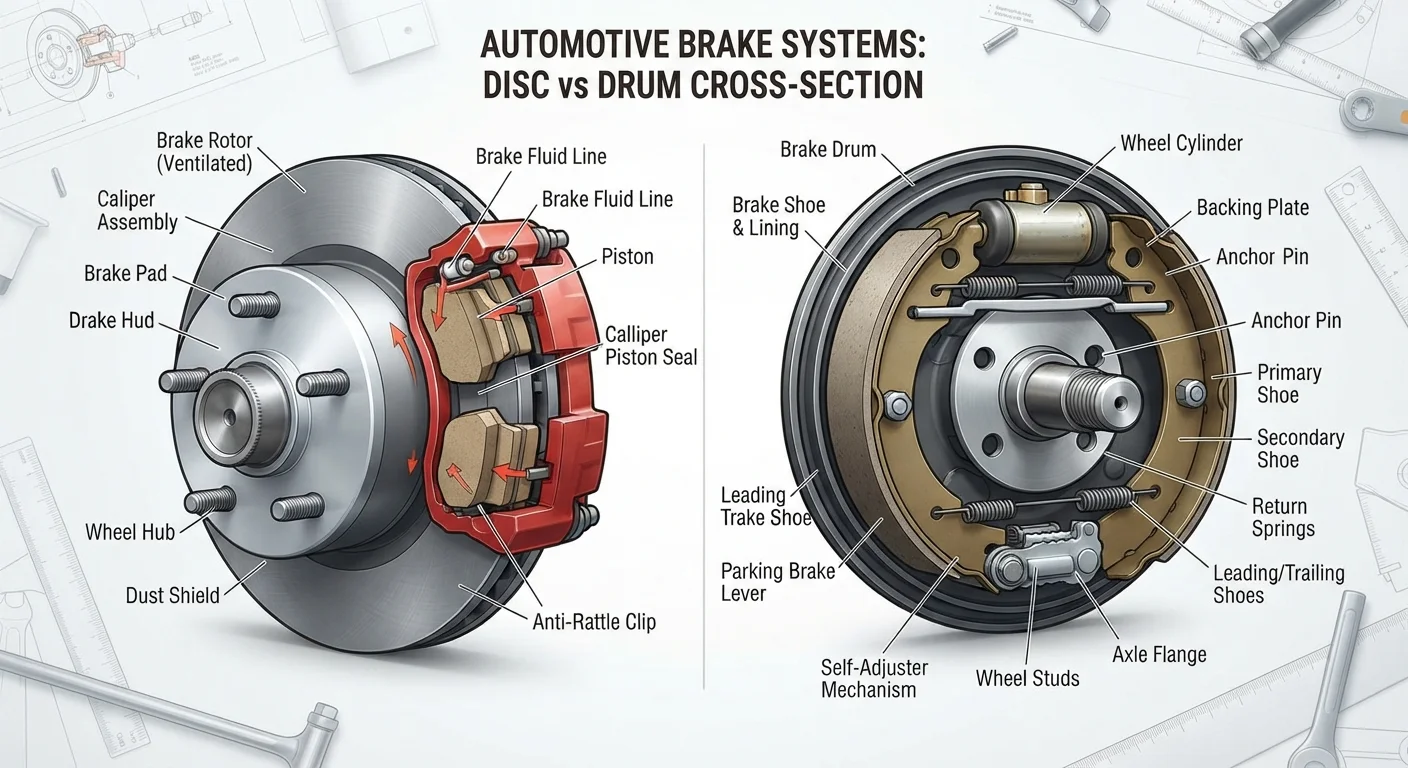
Option A
Disc Brakes
The high-performance, heat-shedding standard for modern vehicles.
Best for: Front axles and performance applications where heat dissipation, consistent stopping power, and wet-weather reliability are priorities.
Option B
Drum Brakes
The durable, cost-effective workhorse still common on rear axles.
Best for: Rear axles on everyday passenger vehicles and light trucks where integrated parking brake function and lower manufacturing cost are advantages.
How Each System Actually Works
Both disc and drum brakes convert kinetic energy into heat through friction — but they do it in very different ways.
A disc brake uses a flat, circular rotor (the disc) mounted to the wheel hub. When you press the brake pedal, hydraulic pressure squeezes a caliper, which clamps brake pads against both sides of the spinning rotor. The friction slows the rotor — and therefore the wheel. Because the rotor is exposed to open air, heat escapes quickly.
A drum brake works by expanding curved brake shoes outward against the inner surface of a metal drum that rotates with the wheel. Hydraulic pressure pushes the shoes outward into contact with the drum. The enclosed design traps heat more readily, which is the central limitation of drum brakes under sustained heavy use.
Understanding these mechanisms helps explain every performance and cost difference between the two systems. For a broader look at what happens when braking forces are applied in real driving situations, see our guide to stopping distances.
| Criterion | Disc Brakes | Drum Brakes |
|---|---|---|
| Heat dissipation | Excellent — open rotor radiates heat | Limited — enclosed drum traps heat |
| Resistance to brake fade | High | Lower under sustained heavy use |
| Wet-weather recovery | Fast | Slightly slower |
| Manufacturing cost | Higher | Lower |
| Parking brake integration | Requires additional mechanism | Built-in via shoe lock |
| Visual inspection ease | Easy — pads visible through wheel | Drum removal required |
| Typical fitment position | Front axle (and all four on many cars) | Rear axle on many passenger cars |
Why Modern Cars Typically Use Both
The front axle of a vehicle handles the majority of braking force — physics dictates that weight shifts forward under deceleration, loading the front wheels. For this reason, virtually all modern passenger vehicles use disc brakes at the front, where consistent, fade-resistant performance is non-negotiable.
The rear axle carries a lighter braking load, and this is where cost and design practicality come into play. Many mainstream cars and light trucks retain drum brakes at the rear because:
- They are cheaper to manufacture and source as original equipment.
- The drum housing doubles effectively as a parking brake mechanism without needing a separate system.
- Rear braking demands are lower, so the heat-management disadvantage of drums rarely becomes a real-world problem.
Higher-specification models, performance vehicles, and many electric vehicles use four-wheel disc brakes. Electric vehicles in particular often pair disc brakes with regenerative braking systems that recover energy during deceleration, further reducing wear on the friction brakes themselves.
~70%
Share of braking force handled by front axle
Weight transfer under deceleration means the front wheels do the majority of the stopping work, which is why front disc brakes are universal on modern vehicles.
4-wheel disc
Brake configuration on most new EVs
Electric vehicles commonly use four-wheel disc brakes paired with regenerative braking systems to reduce heat-friction brake wear and recover energy during deceleration.
Fade, Wet Weather, and Maintenance Differences
Brake fade occurs when braking surfaces overheat and lose friction efficiency. Disc brakes are significantly more resistant to fade because the open rotor radiates heat between applications. Drum brakes, with their enclosed geometry, accumulate heat — a relevant concern on long descents or in repeated emergency stops.
In wet conditions, disc rotors shed water almost immediately as the pads contact their surface. Drum brakes take slightly longer to restore full effectiveness because water can sit inside the drum housing before being expelled.
On maintenance: disc brake pads are generally straightforward to inspect visually and replace. Drum brake shoes require the drum to be removed for inspection, and the self-adjusting mechanisms inside the drum can seize if neglected. However, drum brake shoes often last longer than disc pads in normal driving because the rear axle carries less braking load. The predictable wear schedule of brake components is worth understanding so neither system is neglected past its service interval.
When to Consult a Qualified Mechanic
Brake system inspection and replacement should be performed by a qualified mechanic if you are not experienced with automotive brake work. Incorrectly installed brake components can create serious safety hazards. If you notice a spongy pedal, grinding noises, pulling to one side under braking, or longer-than-usual stopping distances, have the system inspected promptly. Do not defer brake maintenance.
The content on this site is for informational purposes only and is not a substitute for professional advice. Always consult a qualified professional for guidance specific to your situation.