

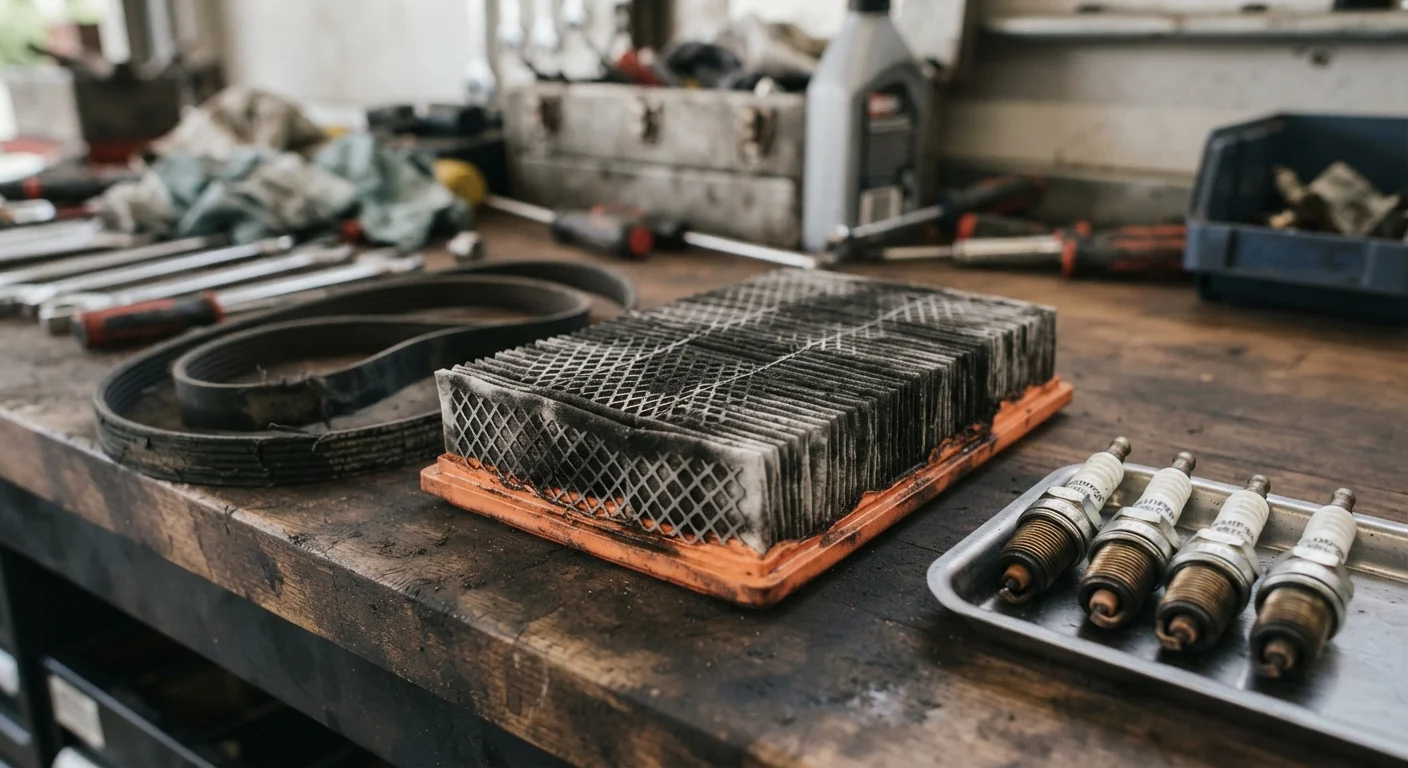
Small Parts, Large Consequences
Oil changes and tire rotations dominate most drivers' mental maintenance checklists — and for good reason. But three components sit quietly in the background, wearing down on a predictable schedule, rarely making noise until the damage is already done: the engine air filter, spark plugs, and drive belts.
None of them are expensive to replace on schedule. All of them become expensive when ignored. Understanding what each one does, how to spot wear, and when to act is exactly the kind of knowledge that separates reactive drivers from informed ones. Skipping scheduled servicing carries real costs that compound over time — and this trio is a prime example.
Bundle These Checks Into One Service Visit
Air filters, spark plugs, and belts are all accessible during a standard service appointment. Asking your mechanic to inspect all three at the same visit saves labor time and gives you a complete picture of each component's condition. Pairing these checks with your regular oil change interval is one of the easiest habits to build.
The Three Components Worth Your Attention
Engine Air Filter: The Lung Your Engine Can't Live Without
The engine air filter keeps dirt, dust, and debris out of the combustion chamber. Every combustion cycle pulls in outside air, and without a functioning filter, abrasive particles accelerate wear on cylinder walls, pistons, and rings — damage that accumulates invisibly over time.
A clogged filter restricts airflow, forcing the engine to work harder. You may notice sluggish acceleration, a drop in fuel economy, or a rough idle. In severe cases, a choked filter can disrupt the mass airflow sensor and trigger the check engine light.
Typical replacement interval: 15,000–30,000 miles, though driving in dusty or unpaved conditions shortens this significantly. Many filters are accessible without tools — a quick pull of the airbox lid reveals whether the filter looks gray and compressed or still light and open. If it's visibly dark and packed with debris, it's due for replacement regardless of mileage.
The part itself is inexpensive. What costs drivers money is going too long without replacement, then absorbing the fuel economy penalty mile after mile — or, worse, internal engine wear that compounds quietly before becoming a much larger repair bill.
A clogged air filter forces your engine to work harder, dragging down fuel economy mile after mile.
Spark Plugs: The Ignition Chain Reaction Starts Here
Spark plugs fire the air-fuel mixture in each cylinder — thousands of times per minute. A worn or fouled plug produces a weak or inconsistent spark, leading to misfires. Misfires waste fuel, increase emissions, and send unburned fuel into the exhaust system, where it can damage the catalytic converter — a repair that commonly runs several hundred dollars or more.
Signs of spark plug wear include rough idling, hesitation during acceleration, difficulty starting in cold weather, and reduced fuel efficiency. These symptoms rarely appear dramatically; they creep in gradually, which is exactly why spark plugs are so often overlooked until a secondary problem surfaces.
Typical replacement interval: Conventional copper plugs may need replacement every 30,000–50,000 miles. Iridium or platinum plugs, common in modern vehicles, are rated for 60,000–100,000 miles or more — but that doesn't mean they should be ignored. Always consult your owner's manual, since some engines are more sensitive to plug condition than others.
For high-mileage vehicles especially, staying current on spark plugs pays real dividends. Our guide to keeping a high-mileage car running well covers how plug maintenance fits into the broader picture of extended vehicle life.
Misfires from worn spark plugs can silently damage a catalytic converter — a repair far costlier than a routine plug change.
Drive Belts: The Quiet Component That Controls Everything
Most modern vehicles use a single serpentine belt to drive the alternator, power steering pump, air conditioning compressor, and water pump simultaneously. When this belt fails, it doesn't give you much warning — and the consequences are immediate. A snapped serpentine belt can disable charging, cooling, and steering assist in one stroke, leaving you stranded.
Separately, many interference engines — where the valves and pistons share the same space — use a timing belt rather than a timing chain. If this belt breaks, the engine can suffer catastrophic internal damage in milliseconds: bent valves, damaged pistons, destroyed cylinder head. Timing belt replacement is among the most consequential maintenance intervals on any vehicle equipped with one.
Typical replacement intervals: Serpentine belts generally last 60,000–100,000 miles but should be inspected for cracking, fraying, or glazing at each oil change. Timing belts are typically replaced between 60,000–105,000 miles depending on the manufacturer — check your owner's manual, as this interval is non-negotiable on interference engines.
Inspect belt surfaces for cracks along the ribs, shiny glazed edges, or visible fraying. A squealing noise from the engine bay, especially on startup or when running the AC, often points to a slipping or worn belt. Understanding which parts wear on a predictable schedule helps build a proactive maintenance mindset before failures occur.
A snapped serpentine belt can disable your alternator, cooling system, and steering assist simultaneously — with almost no warning.
Always Verify Intervals in Your Owner's Manual
Replacement intervals cited here reflect general industry guidance. Your vehicle's manufacturer may specify tighter or looser intervals based on engine design, drive cycle, and operating conditions. The owner's manual is the authoritative source for your specific vehicle. When in doubt, a qualified mechanic can assess component condition directly during a routine inspection.
Build These Into Your Maintenance Routine
The most practical approach to this trio is straightforward: don't wait for symptoms. Each component has a service window you can plan around. Integrate air filter and spark plug checks into your seasonal maintenance calendar so they don't fall through the cracks between oil changes. For belt inspection, make it a standing request at every service visit — a mechanic can assess condition in seconds.
If your vehicle is newer, don't assume extended service intervals mean you're off the hook for visual checks. Dust, heat, and hard driving all accelerate wear beyond what mileage alone predicts. And if you've recently acquired a used vehicle, verifying the service history on all three is a priority — particularly the timing belt, where an unknown history carries genuine engine risk.
Staying ahead of these three components protects fuel economy, reduces emissions, and preserves downstream engine components that cost far more to repair. That's maintenance working exactly as it should.
The content on this site is for informational purposes only and is not a substitute for professional advice. Always consult a qualified professional for guidance specific to your situation.