

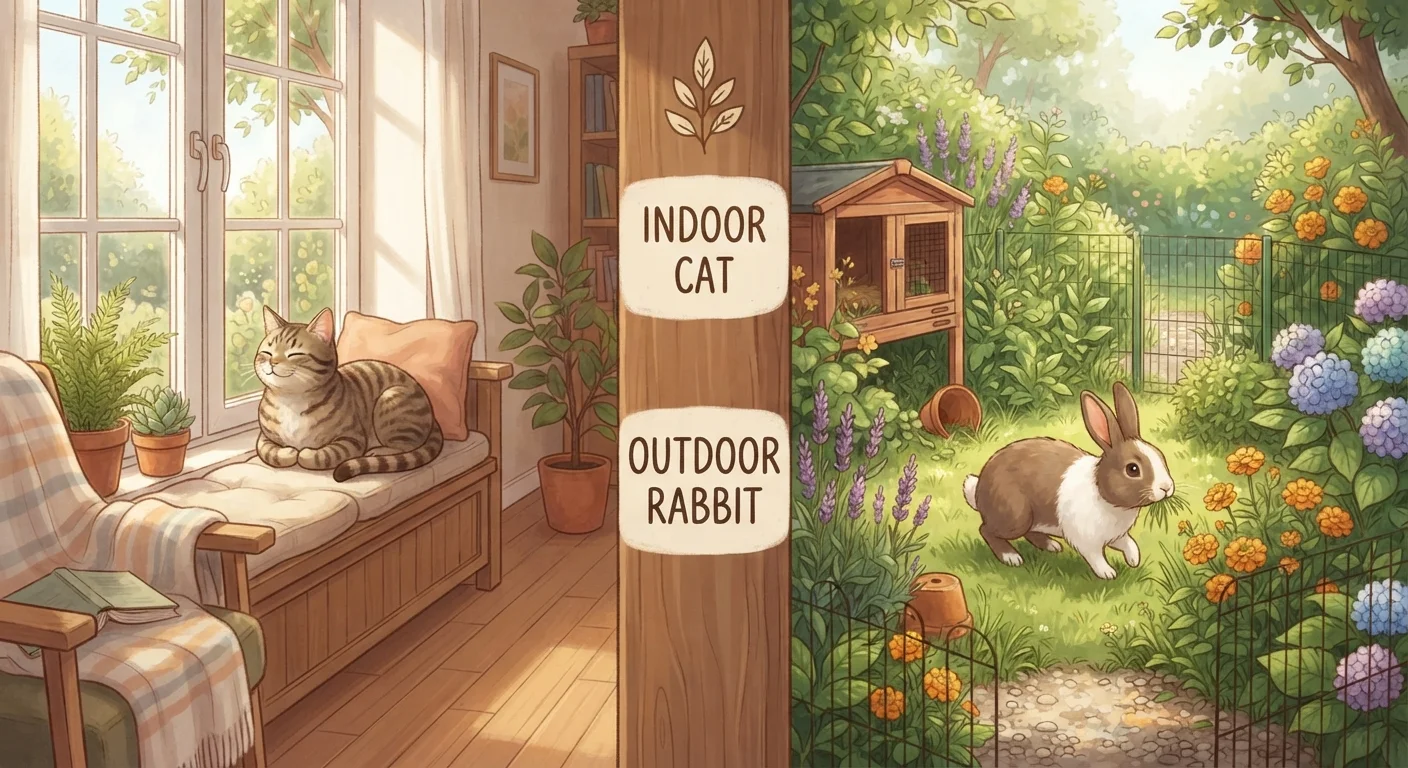
Option A
Indoor Pets
The controlled, lower-risk environment choice.
Best for: Owners in urban areas, those with predator-heavy neighborhoods, or pets with health vulnerabilities who benefit from a stable, sheltered setting.
Option B
Outdoor Pets
The enrichment-rich, more naturalistic alternative.
Best for: Owners with secure, spacious outdoor spaces and species suited to environmental stimulation, exercise, and natural behavior expression.
Why the Indoor vs. Outdoor Question Isn't One-Size-Fits-All
The decision to keep a pet primarily indoors or grant them outdoor access is one of the most consequential choices a pet owner can make — yet it's frequently oversimplified. Popular assumptions, like the idea that cats naturally belong outside or that rabbits are backyard animals, often run counter to veterinary guidance and animal welfare research.
The right answer depends on the species in question, the individual animal's temperament and health status, and the specific risks present in your local environment. Understanding your pet's social and behavioral needs is an important first step before making housing decisions. What keeps one animal thriving may place another at serious risk.
Rather than prescribing a universal answer, this guide examines the genuine trade-offs — grounded in animal science and veterinary consensus — so you can make an informed decision tailored to your pet and your circumstances.
The Case for Indoor Living: Safety and Health Control
For many common companion animals, an indoor environment eliminates or dramatically reduces several of the most significant threats to lifespan and wellbeing. These include vehicle collisions, predator attacks, exposure to pesticides and toxic plants, and contact with unvaccinated or sick animals.
| Criterion | Indoor Living | Outdoor Access |
|---|---|---|
| Predator & traffic risk | Negligible | Moderate to high |
| Infectious disease exposure | Low (controlled contacts) | Higher (wild and stray animals) |
| Environmental enrichment | Requires active effort | Naturally abundant |
| Temperature regulation | Fully controlled | Owner-dependent; variable risk |
| Exercise opportunities | Limited without enrichment | Greater for active species |
| Parasite exposure | Low | Higher (fleas, ticks, worms) |
| Mental stimulation | Requires deliberate setup | Provided by environment |
| Owner monitoring ease | High | Lower when unsupervised |
Cats are the clearest example. Veterinary organizations broadly agree that indoor-only cats live significantly longer on average than those with outdoor access — with some estimates suggesting outdoor cats live a fraction of the lifespan of their indoor counterparts. Free-roaming cats also face risks from territorial disputes, parasites, and exposure to diseases such as feline leukemia virus (FeLV) and feline immunodeficiency virus (FIV).
Rabbits present another instructive case. Many owners assume rabbits belong outdoors, yet they are highly susceptible to temperature extremes, fly strike (a potentially fatal parasitic condition), and predator stress — even when physically protected by a hutch. Creating a safe indoor space for a rabbit is often more practical and protective than an outdoor setup.
For pets managing chronic conditions or entering their senior years, the controlled environment of indoor living offers meaningful advantages. The health needs of aging pets often make outdoor hazards particularly consequential.
2–5 years
Estimated average lifespan of outdoor-only cats
Veterinary and animal welfare sources frequently cite this range compared to 12–18 years for indoor-only cats, though individual variation exists.
~50%
Of US cats kept exclusively indoors
According to the American Veterinary Medical Association's periodic pet ownership surveys, roughly half of owned cats in the US are kept indoors only.
Top 3
Cause of rabbit death: predator stress
Even without physical contact, the presence of predators near an outdoor hutch can cause fatal cardiac stress in rabbits, according to rabbit welfare organizations.
The Case for Outdoor Access: Enrichment and Natural Behavior
Outdoor environments offer stimulation that indoor spaces can struggle to replicate — varied terrain, natural scents, temperature fluctuation, and opportunities for exercise aligned with a species' evolved behaviors. For some animals, these benefits are genuinely significant.
Dogs, particularly high-energy working or sporting breeds, benefit substantially from outdoor exercise that goes beyond a daily walk. Access to a securely fenced yard can support physical conditioning and reduce stress-related behavioral problems. Consistent daily routines combining indoor rest with outdoor activity often represent the strongest approach for dogs.
Even for cats, the desire to roam and hunt is deeply ingrained. Rather than unmanaged outdoor access, many veterinarians and animal behaviorists recommend intermediate solutions — enclosed catios, leash training, or cat-proof garden enclosures — that provide environmental enrichment without the hazards of free-roaming.
Weight management is another consideration. Pets with access to outdoor exercise tend to have more opportunities for sustained physical activity, which is one factor in maintaining a healthy body condition. Managing a pet's weight requires attention to both diet and activity regardless of where they live.
This article provides general educational information about pet care and is not a substitute for advice from a qualified veterinarian familiar with your individual animal's needs.
The content on this site is for informational purposes only and is not a substitute for professional advice. Always consult a qualified professional for guidance specific to your situation.