

Our Verdict
Round-up saving is a genuinely useful entry point into saving, particularly for people who struggle to set aside money manually. It removes friction and builds a saving reflex without requiring willpower. However, the amounts it generates are too modest to fund meaningful financial goals on their own, and it should not substitute for structured saving strategies like automating a fixed percentage of income.
Ideal for someone just beginning to build a savings habit or anyone who wants a low-effort supplement to an existing savings plan — not a replacement for it.
How Round-Up Saving Actually Works
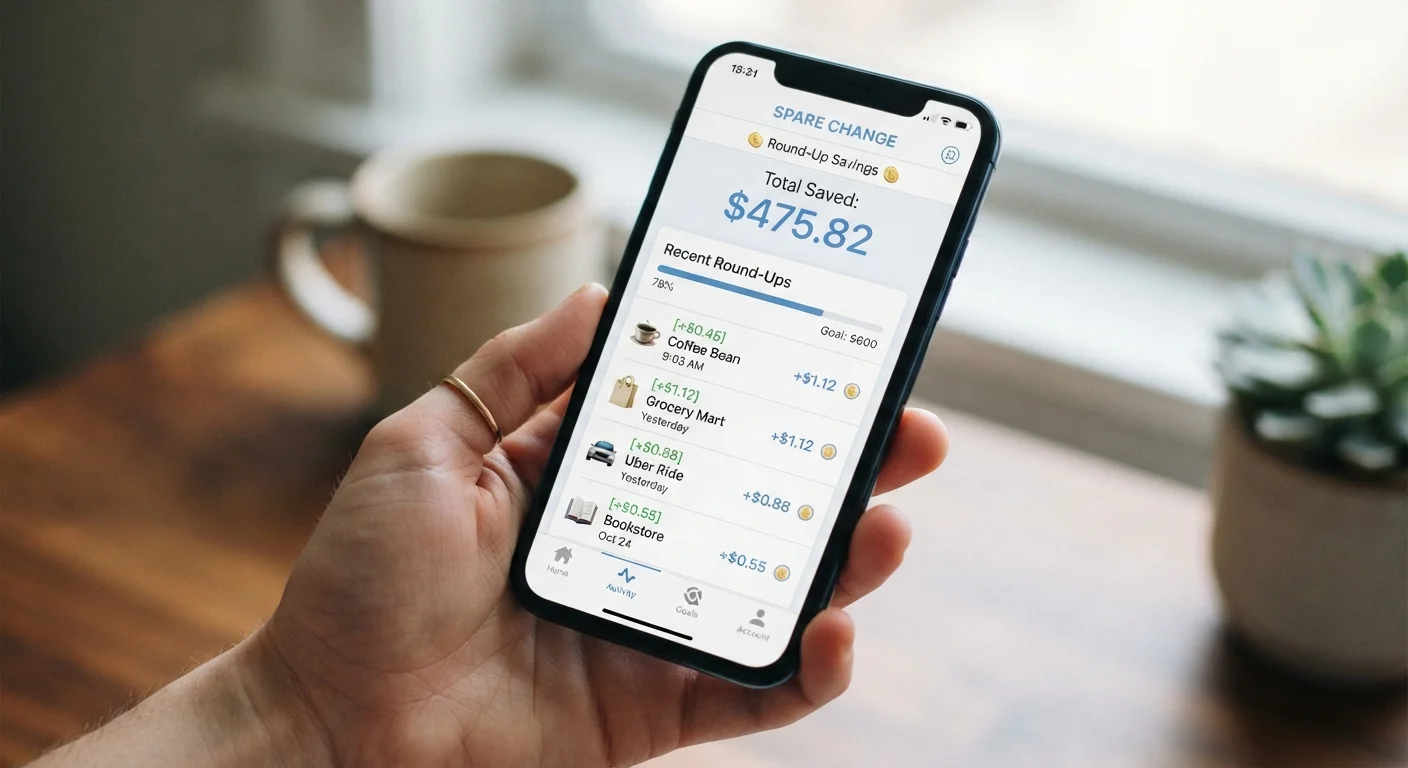
Round-up saving is straightforward in concept: when you spend $3.60 on a coffee, a round-up tool automatically transfers $0.40 — the gap to the next whole dollar — into a designated savings account or investment pocket. The transaction feels invisible because it happens in the background, triggered by your existing spending behavior.
Many banks and fintech apps offer this feature natively, and some allow you to multiply the round-up (for example, rounding up to the nearest $2 or $5 instead of $1). The accumulated spare change is typically held in a linked savings or cash account, and in some app-based platforms, it may be swept into a portfolio of index funds or exchange-traded funds. The exact mechanics, fees, and account type vary by provider — always read the terms before enrolling.
This approach sits within the broader category of micro-saving and habit-based finance, which prioritizes consistency over amount. The idea is that saving something — no matter how small — is better than saving nothing.
The Genuine Benefits of This Approach
Round-up saving has earned its popularity for several legitimate reasons, particularly among people who are building a savings habit from scratch.
Completely automatic — requires no willpower
Once enabled, round-ups happen without any conscious decision. This removes the friction that causes many people to delay or abandon manual saving.
Builds a saving identity through repetition
Seeing regular, small transfers accumulate helps reinforce the self-concept of being a saver, which behavioral research suggests makes larger saving behaviors more likely over time.
Low barrier to entry for new savers
You do not need a large income or budget surplus to participate. Anyone with a debit or credit card linked to a supported account can start immediately.
Painless because amounts feel negligible
A $0.30 or $0.70 transfer per transaction is unlikely to cause financial stress, making it one of the easiest savings behaviors to sustain consistently.
Can supplement, not replace, structured saving
When paired with a fixed automated transfer, round-ups add an incremental layer of savings without requiring budget restructuring.
$30–$50
Typical monthly round-up savings for average spenders
Financial planning educators generally estimate that moderate card users save between $30 and $50 per month through round-up tools, depending on transaction volume and multiplier settings.
57%
US adults without a $1,000 emergency fund
Bankrate's annual emergency savings survey has consistently found that a majority of US adults cannot cover a $1,000 unexpected expense from savings, highlighting how far micro-saving alone falls short.
The psychological lift is real: seeing a balance grow — even slowly — can reinforce the identity of someone who saves. That identity shift is often what makes more deliberate saving habits stick over time.
The Limits You Should Understand
Honest financial guidance requires naming what round-up saving cannot do, not just what it can.
Accumulation is very slow for most users
A typical spender may save only $15–$50 per month through round-ups alone, making it inadequate for funding meaningful financial goals within any reasonable timeframe.
Does not address structural budget problems
If income and expenses are already imbalanced, round-ups add a negligible buffer without fixing the underlying shortfall. A spending plan is needed first.
Earns less than high-interest debt costs
If you carry credit card debt at a high annual percentage rate, the interest charges almost certainly outpace any return generated by a small round-up balance.
App fees can erode or eliminate gains
Some round-up platforms charge monthly subscription fees that may equal or exceed the amounts saved, particularly for lower-frequency spenders. Always verify the fee structure.
May create false confidence about saving adequacy
Users who see a growing round-up balance might overestimate their overall savings progress, potentially delaying more impactful financial actions.
The core limitation is scale. Even a disciplined spender making 30 transactions per month might average $0.50 per round-up — producing roughly $15 to $18 in savings. That is meaningful as a habit signal, but it will not build an emergency fund, pay down a credit card, or fund a retirement account at any useful pace.
Round-ups also have no impact on the structural side of your budget. If spending is outpacing income, rounding up the difference does not resolve the underlying gap. For that, you need a spending plan — something covered in our budgeting basics hub.
If you carry high-interest debt, the interest charges likely exceed whatever the round-up account earns. The trade-off between saving and debt repayment deserves careful thought before treating round-ups as your primary financial move.
Round-Ups in Investment Accounts: An Added Layer of Risk
Some apps route round-up amounts into investment portfolios rather than FDIC-insured savings accounts. While this may offer higher long-term growth potential, it also introduces market risk — your balance can decrease in value. This is not inherently problematic, but it is meaningfully different from a traditional savings account. Understand exactly where your round-up funds are held before enrolling. Past investment performance does not guarantee future results.
Making Round-Ups Work Alongside a Bigger Strategy
Round-up saving is most effective when it plays a supporting role rather than a starring one. Consider it a behavioral on-ramp — a way to normalize the act of saving while you build more intentional systems alongside it.
The pay yourself first principle — automatically directing a fixed amount to savings before discretionary spending — is structurally stronger. A round-up tool can complement this without replacing it.
You might also think about how micro-savings fit into your short- and long-term savings goals. Round-ups work well as a fund for smaller, near-term goals — a small emergency buffer, a seasonal expense, or a targeted purchase — rather than retirement or a home down payment.
Finally, watch for habits that quietly dilute your savings progress. Our guide on habits that undermine long-term savings identifies patterns worth examining alongside any micro-saving tool you adopt.
This article is for general informational and educational purposes only and does not constitute personalized financial advice. Please consult a qualified financial professional regarding your individual circumstances.
The content on this site is for informational purposes only and is not a substitute for professional advice. Always consult a qualified professional for guidance specific to your situation.