

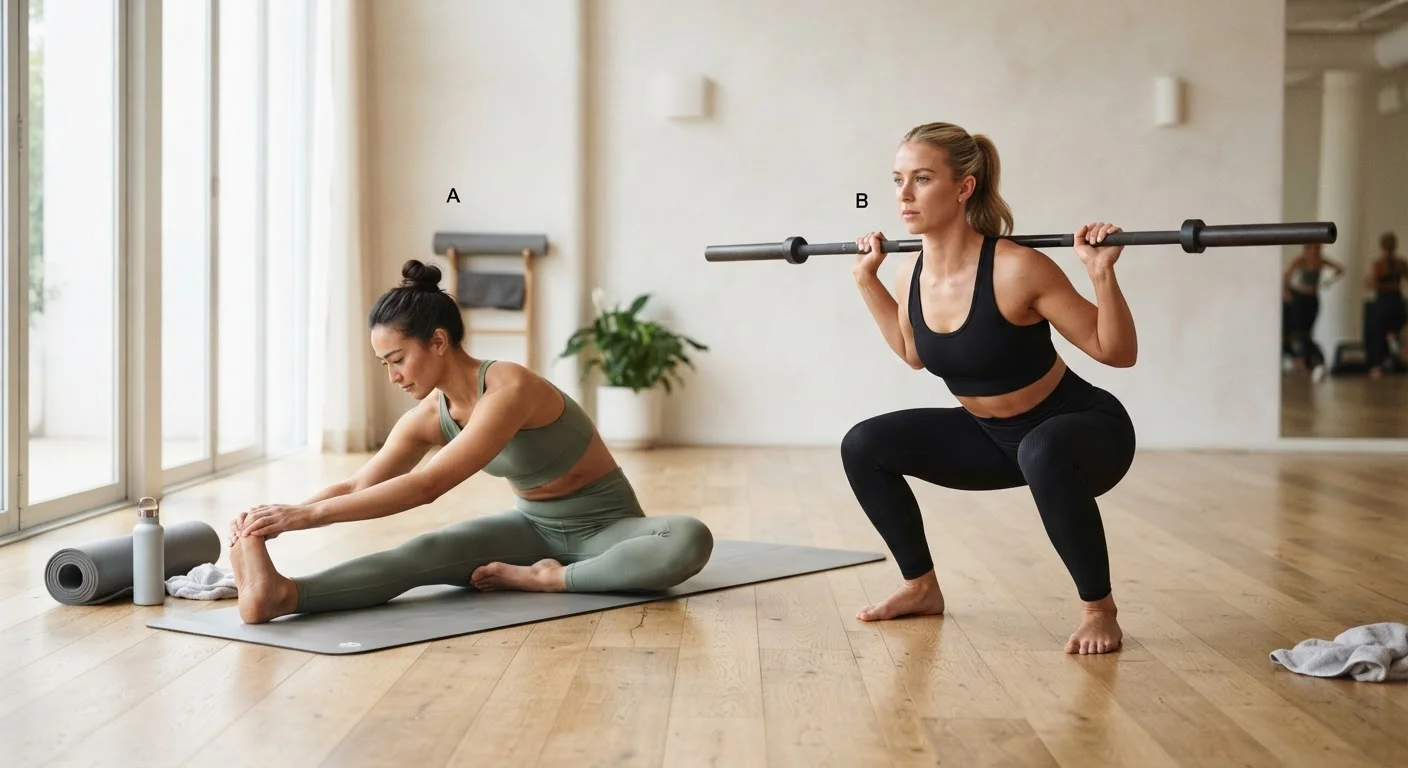
Option A
Flexibility
The passive range your muscles can reach.
Best for: Individuals looking to lengthen tight muscles, reduce tension, and improve posture through sustained stretching.
Option B
Mobility
The active control you have through a range of motion.
Best for: Adults aiming to move more freely in daily life, prevent injury, and maintain functional independence as they age.
What Each Term Actually Means
The words flexibility and mobility are used interchangeably in gyms, wellness apps, and everyday conversation — but they describe meaningfully different physical qualities. Getting clear on the distinction helps you train smarter and understand what your body actually needs.
Flexibility is a property of muscle tissue. It describes the ability of a muscle (or group of muscles) to passively lengthen — essentially, how far it can be stretched when an external force is applied, such as gravity, a prop, or a partner. A seated forward fold that relies on body weight to deepen the stretch is a classic flexibility exercise. The muscle is being lengthened, but you're not necessarily generating force through that range.
Mobility, by contrast, is a joint-level quality. It describes how much usable range of motion a joint has — range you can actively control with muscular strength. A deep squat you perform under your own power, maintaining balance and alignment throughout, is a mobility exercise. You're not just passively reaching a position; you're actively owning it.
The practical implication: a person can be quite flexible (high passive range) yet still lack mobility (limited active control). A gymnast may fold easily at the waist in a stretch but struggle to maintain an upright torso in a loaded squat — flexibility without the strength to use it.
A Common Misconception Worth Clarifying
Many people assume that being flexible automatically makes them mobile — or that stretching is the solution to all movement limitations. In reality, mobility requires not just range, but strength and neuromuscular control through that range. Stretching alone won't build the active stability a joint needs to move safely under load. Both types of training serve important, distinct roles.
How They Compare: A Side-by-Side Look
Understanding the distinction becomes clearer when you look at specific attributes side by side. Both qualities matter for physical health, but they respond to different types of training and serve different functions in daily life.
| Criterion | Flexibility | Mobility |
|---|---|---|
| Definition | Passive muscle lengthening capacity | Active joint range under muscular control |
| Primary focus | Muscle tissue | Joints and surrounding structures |
| Training method | Static stretching, yoga, foam rolling | Dynamic movement, loaded range-of-motion work |
| Effort type | Passive or assisted | Active, strength-dependent |
| Daily life carryover | Reduces tension and stiffness | Improves functional movement patterns |
| Measurable by | Reach distance, degree of stretch | Quality and control of movement through range |
| Declines with | Inactivity, aging, dehydration | Sedentary habits, joint stiffness, weakness |
As the comparison shows, flexibility training — think static stretching held for 30–60 seconds — is straightforward and accessible. Mobility training tends to be more dynamic: controlled articular rotations, deep bodyweight movements, and exercises that load the joint through its range. Both approaches are complementary; one doesn't replace the other.
This connects to a broader theme explored in how physical health needs shift across adulthood — as we age, maintaining joint mobility becomes increasingly tied to functional independence, while flexibility work supports recovery and tension management at every life stage.
Why Both Matter for Everyday Adults
For most adults, the practical goal isn't athletic performance — it's moving through daily life without pain, limitation, or injury. Both flexibility and mobility contribute to this, but in different ways.
Poor flexibility often shows up as muscular tightness: pulling sensations in the hamstrings when bending over, chest tightness from hours at a desk, or restricted shoulder reach. Consistent stretching addresses these symptoms and can improve posture over time.
Poor mobility, meanwhile, tends to surface as movement problems: an inability to squat down to pick something up from the floor without losing balance, difficulty turning the head fully while driving, or hip stiffness that shortens stride length when walking. These limitations are often more disruptive to quality of life than simple muscle tightness — and they're less effectively solved by stretching alone.
~30%
Decline in joint flexibility by age 70
Research published in exercise physiology literature suggests adults may lose roughly 30% of their flexibility between ages 30 and 70, underscoring the value of consistent stretching across adulthood.
2–3x
Increased fall risk with poor hip mobility
Studies in geriatric health have found that restricted hip and ankle mobility is associated with substantially higher fall risk in older adults, making mobility training a key preventive strategy.
The good news is that both qualities respond to consistent training. A modest investment of time — even 10 to 15 minutes of intentional movement daily — can produce measurable improvements. Common entry points include yoga, tai chi, and dynamic warm-up routines, all of which blend elements of both flexibility and mobility work. If you're new to structured movement or managing a health condition, consulting a physical therapist or qualified fitness professional before beginning a new routine is advisable.
This article is for informational purposes only and does not constitute medical advice. Always consult a qualified healthcare professional before starting a new exercise program, particularly if you have an existing health condition or injury.
The content on this site is for informational purposes only and is not a substitute for professional advice. Always consult a qualified professional for guidance specific to your situation.